




Eastbound trans-Pacific ocean container spot rates plunged again this week as container ship capacity on the trade lane recovers and volumes reset at a lower level than they were pre-Lunar New Year.
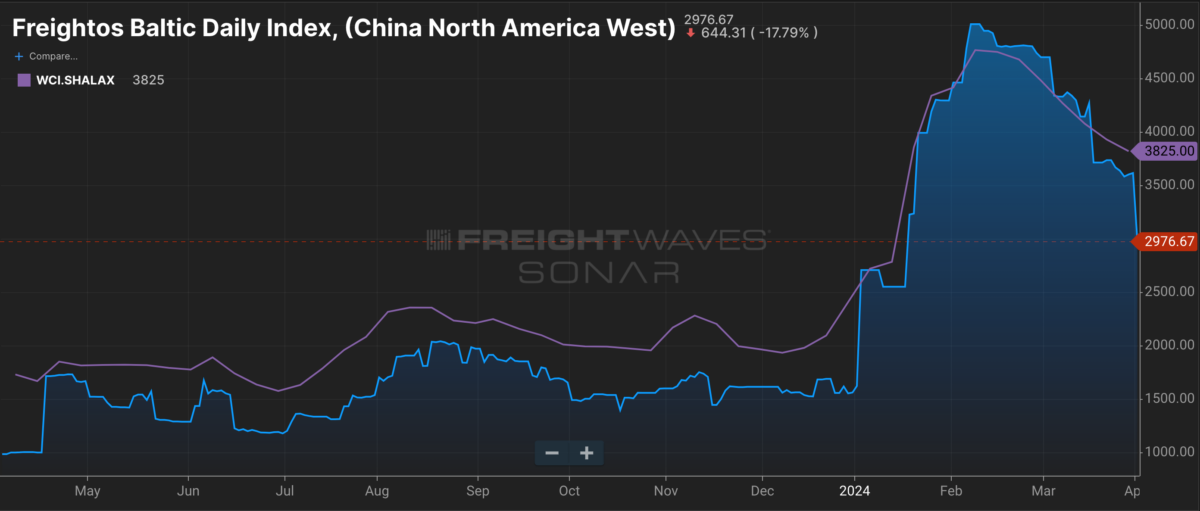
The Freightos Baltic Daily Index spot rate for China to the West Coast of North America fell from $3,620 per forty-foot equivalent unit to $2,976 per FEU this week, a drop of 17.8%. The rate has come down more than 36% since March 1 as steamship line networks have adjusted and capacity has loosened during the Red Sea crisis.
A similar benchmark, the Drewry’s World Container Index, Shanghai to Los Angeles, stands at $3,825 per FEU after declining from its high of $4,771 on Feb. 8.
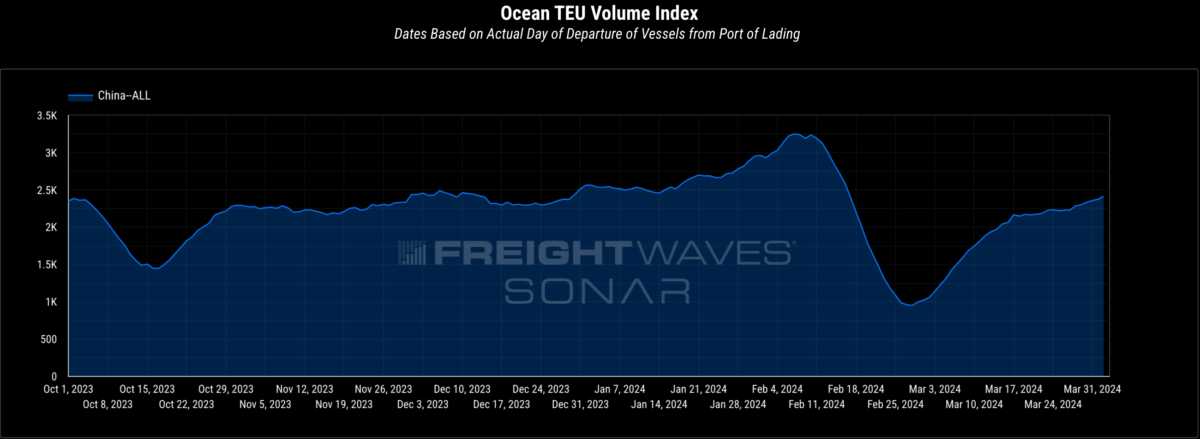
According to the Caixin manufacturing purchasing managers’ index, China’s industrial activity is growing again: The diffusion index hit 51.1 on Monday, above 50, the level indicating expansion, for the fifth month in a row. But that growth — or to be precise, optimism regarding growth — hasn’t yet shown up in China-U.S. trade. According to SONAR’s Container Atlas, ocean container bookings outbound from China to all ports globally have recovered nicely, reaching the equivalent of pre-Lunar New Year levels with a notable acceleration in bookings in the past week.
But it appears that exports to the United States — or directly to the United States — are accounting for a smaller share of that outbound container flow.
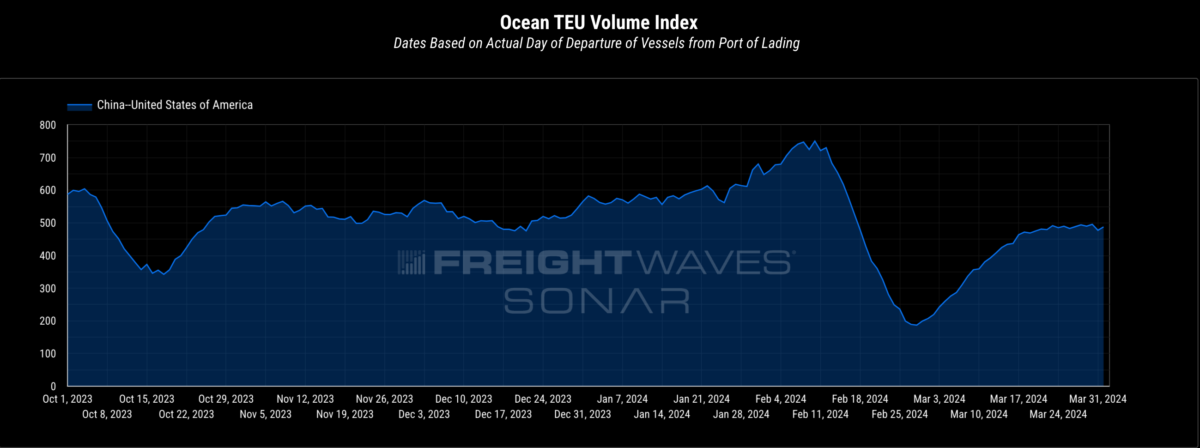
Last week, FreightWaves reported on Maersk’s open admission and indeed advertisement of its services helping importers avoid tariffs by moving goods through Mexican ports and then into the U.S. Gradually shifting container flows that take advantage of those services and improving Mexican logistics infrastructure may be responsible for lagging volumes from China to the U.S.
Steamship lines may be taking steps to put a floor under eastbound trans-Pacific rates, although these measures haven’t been felt much, according to other SONAR Container Atlas data points. In the past few weeks, total twenty-foot equivalent unit capacity on China to U.S. routes has peaked and started coming down, from 572,000 TEUs of capacity departing the week of March 22 to just 427,000 TEUs of capacity departing Chinese ports during the week of April 1. Meanwhile, rejection rates bounced upward from 11.9% to 14.2% over approximately the same time period, while lead times have continued to normalize following the Lunar New Year, contracting from a peak of more than 17 days on Feb. 22 to eight days on Tuesday. Less capacity and higher rejections indicate a slight tightening in the market. Shorter lead times can be caused by rebookings after rejections and a greater sense of urgency on the part of shippers to find capacity, although a lead time of eight days is still on the shorter end of the ‘normal’ lead time range.
The backhaul or westbound lane on the trans-Pacific is also very low; at $200 per FEU, according to the Freightos Baltic Daily Index, shippers moving goods from the West Coast back to China are enjoying the lowest rates they’ve seen in years. Drewry’s World Container Index, meanwhile, shows a rate of $691 per FEU from Los Angeles to Shanghai, which has been cut in half since the summer of 2022 but remains above pre-pandemic levels.
Brokerage Compliance Symposium
The day before F3. Every compliance issue you face - fraud exposure, carrier liability, FMCSA rules, cargo theft, insurance gaps - navigated by attorneys and operators defining best practices in a changing industry.
F3 Awards Dinner
The night before F3. FreightTech100 companies honored. FreightTech 25 and Shipper of Choice winners revealed live. Cocktail reception into dinner and live music - 300 industry leaders in one purpose-built room.
F3: Future of Freight Festival
Industry-defining keynotes, rapid-fire technology demos, and industry leaders networking in experiences across Chattanooga - plus the inaugural F3 Awards Dinner featuring the FreightTech and Shipper of Choice reveals.
The day before F3. Every compliance issue you face - fraud exposure, carrier liability, FMCSA rules, cargo theft, insurance gaps - navigated by attorneys and operators defining best practices in a changing industry.
The Signal at Chattanooga Choo Choo • Chattanooga, TN Register NowThe night before F3. FreightTech100 companies honored. FreightTech 25 and Shipper of Choice winners revealed live. Cocktail reception into dinner and live music - 300 industry leaders in one purpose-built room.
The Signal at Chattanooga Choo Choo • Chattanooga, TN Register NowIndustry-defining keynotes, rapid-fire technology demos, and industry leaders networking in experiences across Chattanooga - plus the inaugural F3 Awards Dinner featuring the FreightTech and Shipper of Choice reveals.
The Signal at Chattanooga Choo Choo • Chattanooga, TN Register Now