









In Maersk’s press release last week about a new warehousing facility in Tijuana, Mexico, one line stood out. It was sandwiched between a list of value-added services offered and a paragraph about the facility’s sustainable energy practices and certifications.
“Alternatively, it could operate [fulfillment or e-fulfillment] operations into the United States, leveraging the Section 321 Shipment Type** for e-commerce shipments.”
Under U.S. Customs and Border Protection rules, a Section 321 shipment is an import to the United States that, because it’s valued at less than $800, is exempt from tariffs. This rule has gained attention as a strategy to sidestep the extra costs of moving goods into the U.S. So Maersk’s inclusion of it in the release is no afterthought.
The provision is widely used to support cost-effective cross-border movement of goods. The new facility is designed to capitalize on exactly that, across more than 320,000 square feet of space.
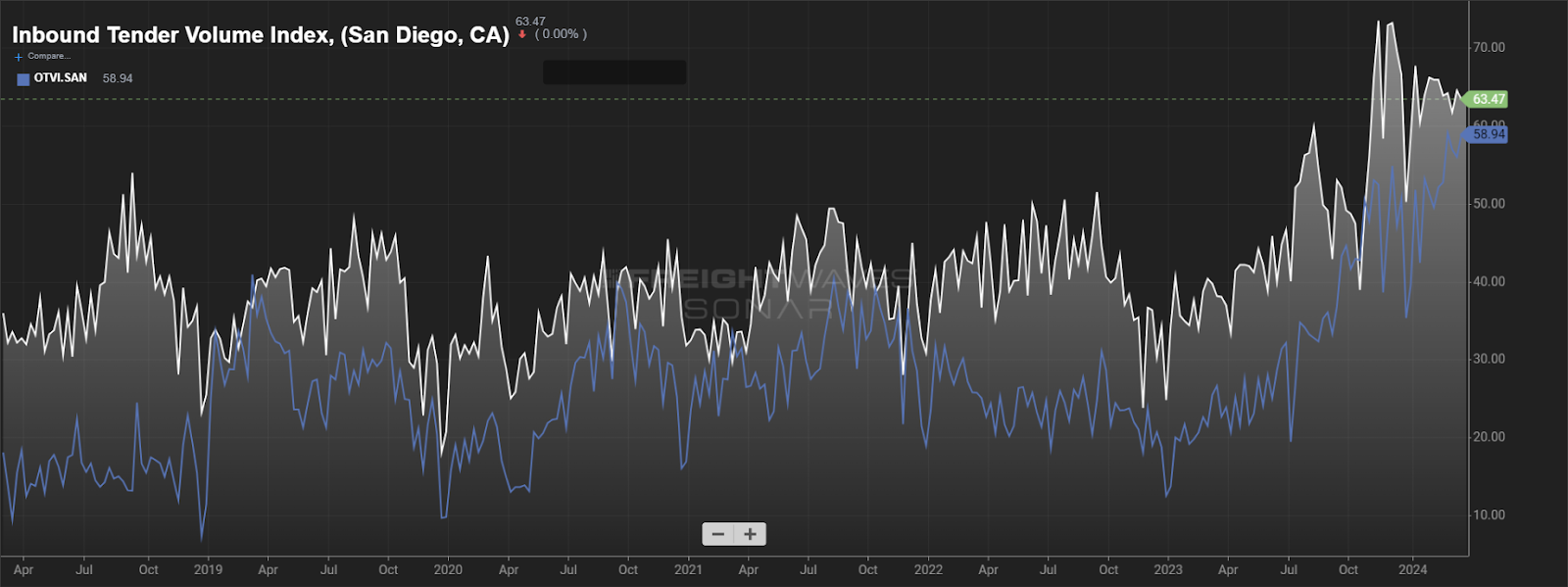
It’s within 10 miles of the Otay Commercial Port, situated between San Diego — which has already seen a marked increase in truckload volumes in recent years, particularly in the last one — and Tijuana. It’s also just slightly more than 12 miles from the San Ysidro Commercial Port, bridging San Ysidro, California, with Tijuana.
Mexico has seen a surge in imports from China in recent years. According to Xeneta, China exported 60% more containers to Mexico this January than it did in January 2023.
RELATED: Is Mexico becoming the new China?
Analysts believe U.S. e-commerce consumption and the de minimis exemption for imports below $800 in value are fueling this. While Section 321 would also apply to ocean cargo shipped from China directly to the U.S., Mexico has become increasingly attractive for warehousing and fulfillment purposes.
The geographical benefit of Mexico’s proximity to the U.S. is compounded by the robust manufacturing and export services infrastructure supported by Mexico’s IMMEX program. The program facilitates streamlined processes for foreign companies to import materials, manufacture goods and then export them, often to the U.S., while enjoying tax and duty exemptions.
These elements combine to create an attractive proposition for Chinese businesses looking to maximize efficiency in their supply chains and minimize costs associated with tariffs and long-distance shipping.
China’s rising exports to Mexico
When a U.S. consumer buys something on Amazon from a Chinese storefront, the order sets in motion a fairly sophisticated chain of events. A notification of the order is sent to the seller, who could be operating directly from China or via a warehouse in Mexico.
Upon receiving the order, the seller prepares the item for shipment. If the product is located in China, it might first be sent in bulk to Mexico, leveraging the strategic advantages offered by Mexico’s logistics infrastructure and trade agreements. More likely is that if the Chinese shipper wants to take advantage of Section 321, the shipper has already warehoused the inventory in Mexico.
Each item destined for the U.S. is then individually packaged and valued at less than $800 to ensure it meets the criteria for duty-free entry. This valuation is key, so for more expensive, multipart products, it sometimes makes sense to ship multiple boxes in order to distribute value.
The packaged goods are then transported to the U.S.-Mexico border, either directly from a Mexican warehouse or after arriving in Mexico from China. At the border, the consignments are subject to inspection by CBP. Thanks to the precise labeling and adherence to the Section 321 rule, these packages typically qualify for expedited customs processing.
Once cleared through customs, the shipments enter the U.S. logistics network and are directed next to distribution centers strategically located across the country. Here, the packages are sorted and dispatched for final delivery.
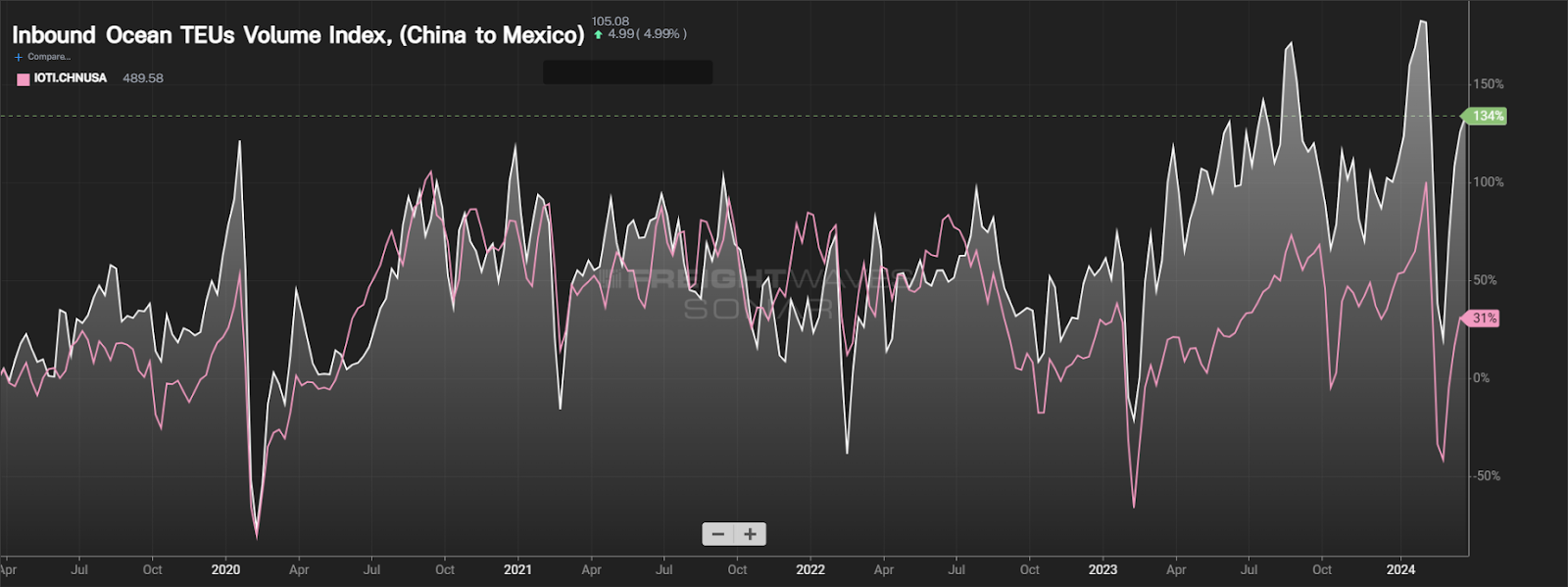
While Chinese exports both to the U.S. and to Mexico have shown strong growth over the past five years, the latter trade lane’s growth since the middle of 2022 far surpasses the former. The Inbound Ocean TEUs Volume Index from China to the U.S. (IOTI.CHNUSA) shows a 31% increase since late-March 2019, while that same index from China to Mexico (IOTI.CHNMEX) shows a massive 134% climb over the same period.
While it is difficult to say definitively what is driving this growth, some of it is likely related to tariff skirting. An additional cause could be the ongoing investment in Mexico’s manufacturing infrastructure. It’s possible that this nearshoring development requires injections of raw materials from Asia.
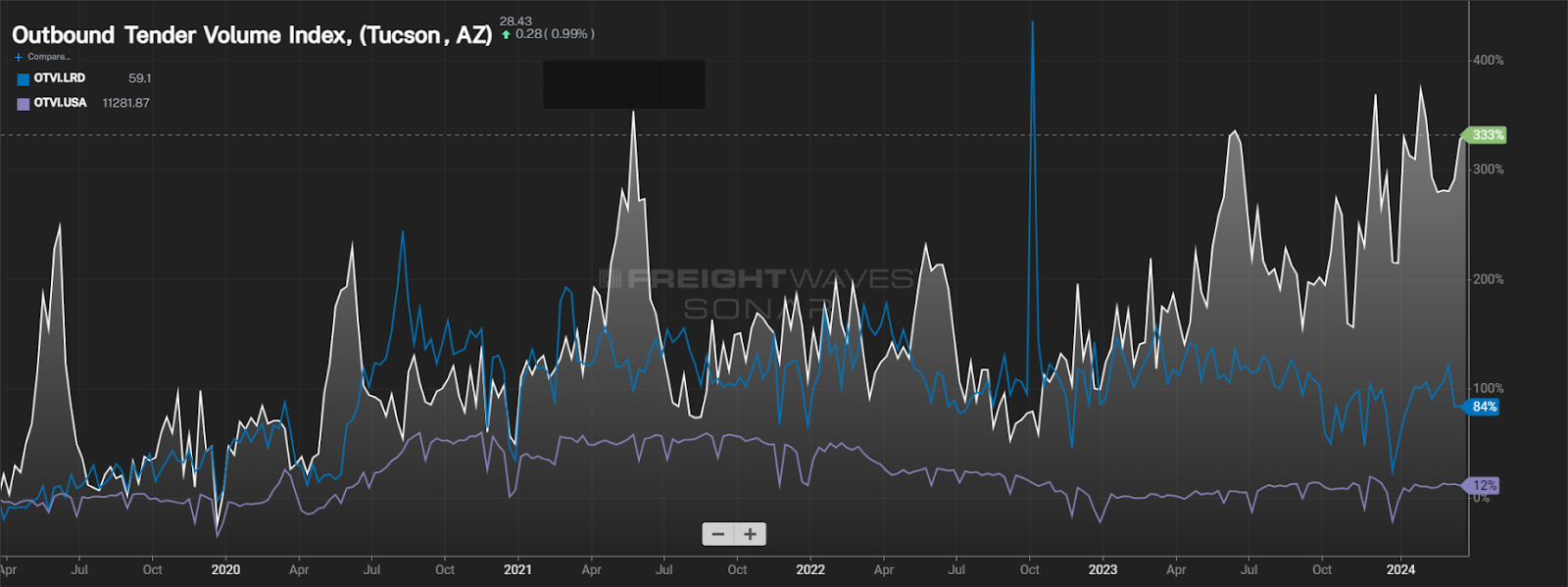
Border markets like those of Laredo, Texas, and Tucson, Arizona, have outpaced the average truckload demand growth for the U.S. in aggregate since 2019. This trend is likely to continue, barring legislative or executive change.
Will it continue?
The trade war between the U.S. and China began in 2018, when then-U.S. President Donald Trump imposed comprehensive tariffs on Chinese goods, citing unfair trade practices. This move set off a reciprocal imposition of tariffs, leading to a significant escalation. The U.S. targeted $550 billion worth of Chinese products. In response, China placed tariffs on $185 billion worth of U.S. goods.
A temporary truce was reached with the signing of the Phase One Deal in January 2020. This agreement aimed to ease the tariff war through commitments to decrease tariffs, boost trade purchases and address contentious issues such as intellectual property theft and technology transfer. The trade war’s impact was widespread, and its breadth and scale have drawn comparisons to historic protectionist measures, such as the Smoot-Hawley Tariff Act of 1930.
Trump’s recent campaign trail statements, vowing to levy a 100% tariff on cars produced in Mexico by Chinese firms if he wins reelection, shed new light on the complex interplay of international trade and economic strategy.
While the immediate reaction may be to view the circumvention of U.S. tariffs by Chinese entities through Mexico as a loss to the U.S. treasury, this could also be framed as a broader, more strategic benefit to the U.S.
The shift of Chinese manufacturing and trade flows toward Mexico carries with it potential for profound economic transformation in the region. The gradual buildup of production capacity, spurred by Chinese investment and the relocation of manufacturing activities, hints at a future in which Mexico becomes an increasingly robust and capable trade partner.
RELATED: US-Mexico cross-border trade totaled almost $800B in 2023
This evolution could lead to a reduction in U.S. reliance on more distant and potentially unstable global trade lanes, which are susceptible to disruptions from geopolitical tensions or global supply chain crises. Strengthening Mexico’s economy and its manufacturing sector could render North America’s supply chain more resilient, providing the U.S. with a stable and reliable source of goods from a neighboring country.
This increased trade between the U.S. and Mexico could partially offset revenue lost due to tariff avoidance. Furthermore, a prosperous Mexico contributes to regional stability and security, which is highly valuable given the shared border.
In this light, the long-term strategic advantages of fostering a stronger, more economically capable Mexico could well justify the short-term losses incurred from tariffs that are not collected on Chinese goods.
Brokerage Compliance Symposium
The day before F3. Every compliance issue you face - fraud exposure, carrier liability, FMCSA rules, cargo theft, insurance gaps - navigated by attorneys and operators defining best practices in a changing industry.
F3 Awards Dinner
The night before F3. FreightTech100 companies honored. FreightTech 25 and Shipper of Choice winners revealed live. Cocktail reception into dinner and live music - 300 industry leaders in one purpose-built room.
F3: Future of Freight Festival
Industry-defining keynotes, rapid-fire technology demos, and industry leaders networking in experiences across Chattanooga - plus the inaugural F3 Awards Dinner featuring the FreightTech and Shipper of Choice reveals.
The day before F3. Every compliance issue you face - fraud exposure, carrier liability, FMCSA rules, cargo theft, insurance gaps - navigated by attorneys and operators defining best practices in a changing industry.
The Signal at Chattanooga Choo Choo • Chattanooga, TN Register NowThe night before F3. FreightTech100 companies honored. FreightTech 25 and Shipper of Choice winners revealed live. Cocktail reception into dinner and live music - 300 industry leaders in one purpose-built room.
The Signal at Chattanooga Choo Choo • Chattanooga, TN Register NowIndustry-defining keynotes, rapid-fire technology demos, and industry leaders networking in experiences across Chattanooga - plus the inaugural F3 Awards Dinner featuring the FreightTech and Shipper of Choice reveals.
The Signal at Chattanooga Choo Choo • Chattanooga, TN Register Now