








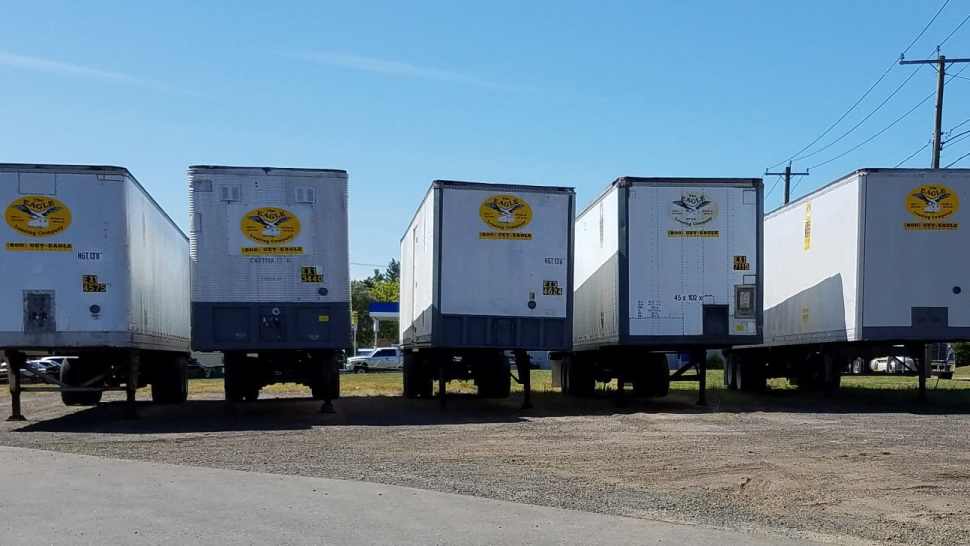
Could trailers serve as the power source for electric tractors?
Is a trailer just a box on wheels or potentially a portable battery charger? That is one of the questions that could be answered through continued innovation of commercial vehicles. Rick Mihelic of Mihelic Vehicle Consulting talked about where future innovation may come from during a Stifel conference on Wednesday titled, “Envisioning Future Commercial Vehicles.”
“If most of the energy power is [stored] in the trailer, you could talk about extending the range,” he said. “The tractor drops that trailer and picks up another trailer that is now fully charged and goes to drop that at a regional outlet. At the third outlet, he drops that trailer and picks up another fully charged trailer. It requires rethinking the shipping lanes.”
In essence, electric tractors could theoretically have unlimited ranges running this type of operation.
To achieve that vision, Mihelic said that innovators need to, and will, look beyond just innovating the tractor-trailer and seek innovations throughout the freight system. Technnology advances could occur in zero-emissions vehicles, fuel cell technology, battery technologies, hydrogen fueling infrastructure, regulatory changes such as size and weight limits, and automatic data mining.
“Added technologies to vehicles typically add to [vehicle] costs,” he noted. “There is no free ride in transportation … Ultimately, in the long run, efficiency gains and cost savings must be found to offset any added tech cost.”
As an example, Mihelic noted some price premiums that were added to commercial vehicles: $7,900 for engine efficiency; $1,300 for low rolling resistance tractor; $10,100 for tractor aerodynamics; and $12,100 for lightweighting the tractor.
Mihelic explained the typical dynamics of the freight market – there are generally 3 trailers for every tractor; one-third of the operating cost is the driver, one-third fuel and one-third equipment; net vehicle miles travelled are increasing; and freight per vehicle is increasing but annual miles per truck are decreasing.
“There are a lot of different reasons [for decreasing miles per truck],” Mihelic said. “One assumption is hours of service rules are affecting it, you have changes in the marketplace, you have congestion and additional vehicles on the roads…there’s no definitive single answer to that.”
There are some solutions, he said, that incorporate using existing equipment more efficiently or combining technology and equipment in innovative ways.
“If you look at Canada, they are running two 53-foot trailers and doing it quite safely,” Mihelic said. “So, there are some opportunities to use existing technology and do so safely.”
That leads to the potential of platooning.
“Every freight transporter has seen growth in freight capacity except for trucking,” Mihelic said. “The 80,000-pound truck is [still the 80,000-pound truck]. … There are significant cost savings here l think. You’re ultimately removing one-third of the driving cost in the driver of that second vehicle which allows you to make investments in autonomous systems.”
Mihelic noted that we could reach a point where a platoon is led by a vehicle with a driver, but trailing vehicles are autonomous.
Mihelic also suggested that an innovator might develop a longer freight trailer that can take advantage of autonomous technologies. “What happens if we combine all of these systems into an innovative system, could we get to an automated road train? I think we can,” he said.
That’s why Mihelic believes innovation needs to happen throughout the freight system. Areas that could see innovation include the driver, regulations, energy sources, warehouses, factories and congestion/traffic in addition to better use of equipment.
“Innovators will move beyond the constraint of redesigning a single truck and they will move on to innovating in the entire freight system,” he said.
Going back to the concept of a trailer serving as a portable charging unit, Mihelic talked about the innovation throughout the system that could make that possible. Showing a picture of a warehouse, Mihelic wondered if the 900,000-square-foot roof of the warehouse could be equipped with solar panels. Then, what if the energy created was transferred to trailers sitting in the yard (remember, there are 3 trailers for every truck, meaning a lot of idle trailers). When the tractor is connected to the fully charged trailer, an energy source to power that electric tractor is now available.
In fact, Mihelic said that using 80% of that size roof could potentially power between 60 and 80 electric tractors running 100-mile trips.
What if idle trailers, fully charged with energy, could supply power to the warehouse or sell energy back to the grid? Mihelic said revenue opportunities like this are just waiting for innovation.
Brokerage Compliance Symposium
The day before F3. Every compliance issue you face - fraud exposure, carrier liability, FMCSA rules, cargo theft, insurance gaps - navigated by attorneys and operators defining best practices in a changing industry.
F3 Awards Dinner
The night before F3. FreightTech100 companies honored. FreightTech 25 and Shipper of Choice winners revealed live. Cocktail reception into dinner and live music - 300 industry leaders in one purpose-built room.
F3: Future of Freight Festival
Industry-defining keynotes, rapid-fire technology demos, and industry leaders networking in experiences across Chattanooga - plus the inaugural F3 Awards Dinner featuring the FreightTech and Shipper of Choice reveals.
The day before F3. Every compliance issue you face - fraud exposure, carrier liability, FMCSA rules, cargo theft, insurance gaps - navigated by attorneys and operators defining best practices in a changing industry.
The Signal at Chattanooga Choo Choo • Chattanooga, TN Register NowThe night before F3. FreightTech100 companies honored. FreightTech 25 and Shipper of Choice winners revealed live. Cocktail reception into dinner and live music - 300 industry leaders in one purpose-built room.
The Signal at Chattanooga Choo Choo • Chattanooga, TN Register NowIndustry-defining keynotes, rapid-fire technology demos, and industry leaders networking in experiences across Chattanooga - plus the inaugural F3 Awards Dinner featuring the FreightTech and Shipper of Choice reveals.
The Signal at Chattanooga Choo Choo • Chattanooga, TN Register Now