



Winter doesn’t usually just put trucking companies out of business overnight. It exposes the cracks that were already there.
That’s the core idea behind the Winter Readiness Masterclass we recently held inside Playbook. Not winter as a weather problem—but winter as a stress test on your equipment, your drivers, your cash flow, your dispatch decisions, and your leadership.
When temperatures drop, everything that was loosely managed gets tighter. Everything that was “we’ll deal with it later” shows up all at once. And for small carriers, there’s no buffer between “minor issue” and “parked truck.”
That’s what this session focused on: control.
Not panic. Not over-prepping. Control.
The Business of Winter Is the Business of Downtime
Some carriers think winter costs money because trucks break. That’s not totally true. Winter costs money because trucks stop moving.
In the masterclass, we walked through a simple but uncomfortable example: if a truck averages $1,000 a day in revenue and it’s down for two days waiting on a part, that’s $2,000 gone immediately. Add a driver advance, towing, hotel, missed reload, and a strained customer relationship—and suddenly one frozen fuel line becomes a $3,000–$4,000 hit.
Winter doesn’t drain profits through dramatic failures. It drains them through idle time, delays, and poor planning.
The carriers that survive winter consistently don’t rely on luck or good weather. They plan for slower weeks, higher fuel burn, more idling, and more maintenance friction—and they build discipline around that reality .
Equipment Readiness Isn’t About Fancy Gear — It’s About Timing
Winterizing a truck isn’t complicated. It’s just rarely done early enough.
In the session, we broke equipment readiness into systems—not parts.
Fuel systems need winter blend or anti-gel before the first deep freeze. Tanks should stay at least half full to reduce condensation. Fuel filters need to be replaced ahead of schedule because winter exposes marginal components fast.
Cooling systems fail when hoses that “look fine” crack under freezing pressure. Electrical systems fail when borderline batteries meet cold starts. Air systems fail when moisture freezes in lines that weren’t drained consistently.
None of these failures are surprising. They’re predictable.
Winter readiness is simply addressing predictable failure points before they cost you uptime .
Driver Readiness Is About Confidence, Not Toughness
Winter doesn’t reward bravery. It rewards awareness.
A major theme of the masterclass was shifting drivers from reaction mode to anticipation mode. Watching weather systems daily. Knowing the early warning signs from the truck—sluggish cranking, low air pressure, fuel warnings. Reporting small issues immediately instead of “pushing through.”
We also spent time on winter cab kits—not as a checklist, but as survival planning. Extra clothing, thermal blankets, food, water, traction aids, power banks, fuel treatment—these aren’t optional items. They’re what separate an inconvenience from an emergency when a driver is parked overnight on a closed pass.
Most importantly, winter requires clear decision authority. Drivers need to know when pulling over is the right call—and that they’ll be supported for it. Hesitation is dangerous in winter. Confidence comes from preparation and policy, not bravado .
Maintenance Discipline Becomes Leadership Discipline in Winter
Winter is unforgiving to loose maintenance schedules.
In the class, we emphasized tightening preventive maintenance intervals by 10–15% during winter months. Not just mileage-based PMs, but time-based ones. Idling, cold starts, and accessory loads change how trucks wear.
Daily, weekly, and monthly inspection standards matter more in winter because problems escalate faster. Documentation matters too—not just for compliance, but for control. When something fails, your records tell you whether it was random or repeated.
Winter doesn’t demand perfection. It demands consistency .
Financial Readiness Is the Foundation of Everything Else
One of the hardest parts of winter isn’t the weather—it’s cash flow.
Slower freight, higher expenses, and delayed payments all collide at the same time. In the masterclass, we talked through building a winter cash buffer of two to three weeks of operating expenses per truck. Not in your main checking account, but in a protected reserve.
We also discussed recalculating breakeven for winter conditions. Higher idle time, lower MPG, and more shop visits raise your true cost per mile. If your normal breakeven is $1.85, winter may push it closer to $2.00 or higher. That difference isn’t theoretical—it’s your insurance policy against volatility.
Winter isn’t when you run harder. It’s when you run smarter .
Dispatch, Compliance, and Communication Separate Survivors from Casualties
Winter dispatch sometimes is about weather windows, not just what pops up on load boards. It’s about route planning with backups, building buffer into ETAs, and communicating early when delays happen.
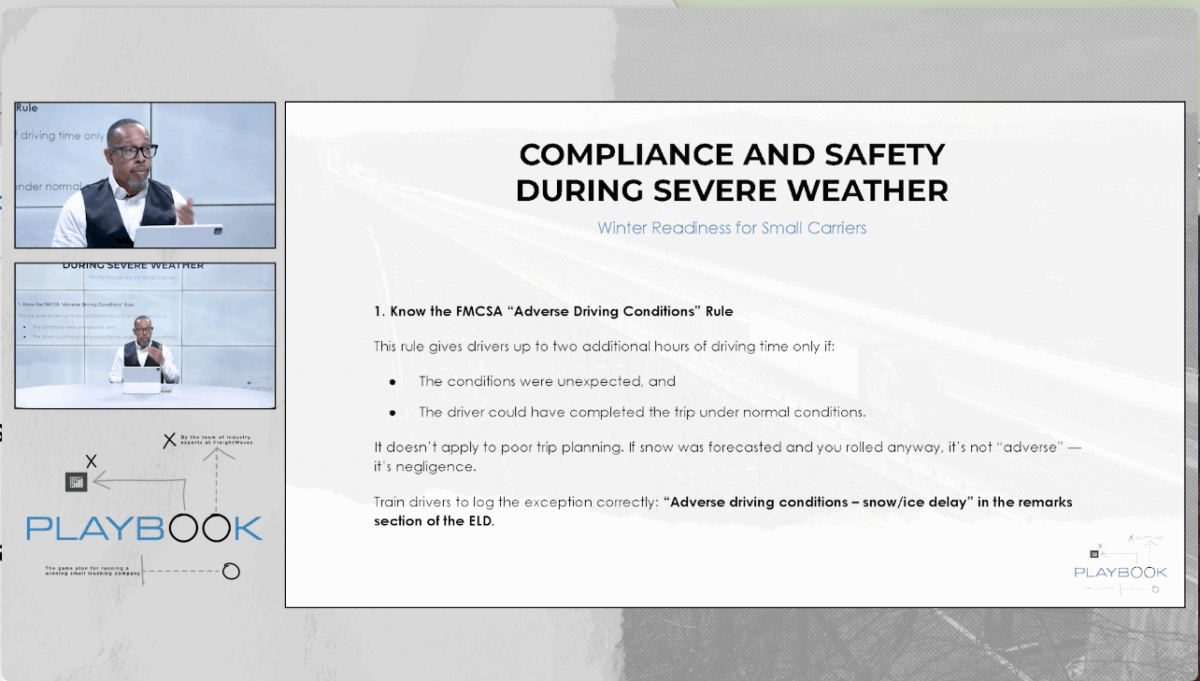
Compliance matters more in winter because mistakes compound. The FMCSA adverse driving conditions rule isn’t a loophole—it’s a narrow exception that requires proper documentation and planning. If snow was forecasted and you rolled anyway, it’s not “adverse.” It’s poor decision-making.
The carriers that protect themselves document everything—weather conditions, delays, communications, and decisions. Not out of fear, but out of professionalism .
Winter Readiness Is About Control
The final message of the class was simple: winter doesn’t control your business unless you let it. Preparation turns chaos into predictability. Systems replace stress. Leadership replaces luck. That’s the difference between operating like a driver and thinking like an owner.
Want the Full Framework?
This article only scratches the surface of what was covered in the Winter Readiness Masterclass.
Inside the Playbook Masterclass Membership, carriers get:
- Full class replays and walkthroughs
- Checklists, templates, and SOPs used in the session
- Practical frameworks you can apply immediately
- Ongoing classes that build from prevention into prediction, including how to use data and AI tools to stay ahead of issues instead of reacting to them
If you’re serious about running through winter with control instead of crossing your fingers, this is where the work happens.
Join the Playbook Masterclass Membership and get access to this session—and everything that comes next.
Brokerage Compliance Symposium
The day before F3. Every compliance issue you face - fraud exposure, carrier liability, FMCSA rules, cargo theft, insurance gaps - navigated by attorneys and operators defining best practices in a changing industry.
F3 Awards Dinner
The night before F3. FreightTech100 companies honored. FreightTech 25 and Shipper of Choice winners revealed live. Cocktail reception into dinner and live music - 300 industry leaders in one purpose-built room.
F3: Future of Freight Festival
Industry-defining keynotes, rapid-fire technology demos, and industry leaders networking in experiences across Chattanooga - plus the inaugural F3 Awards Dinner featuring the FreightTech and Shipper of Choice reveals.
The day before F3. Every compliance issue you face - fraud exposure, carrier liability, FMCSA rules, cargo theft, insurance gaps - navigated by attorneys and operators defining best practices in a changing industry.
The Signal at Chattanooga Choo Choo • Chattanooga, TN Register NowThe night before F3. FreightTech100 companies honored. FreightTech 25 and Shipper of Choice winners revealed live. Cocktail reception into dinner and live music - 300 industry leaders in one purpose-built room.
The Signal at Chattanooga Choo Choo • Chattanooga, TN Register NowIndustry-defining keynotes, rapid-fire technology demos, and industry leaders networking in experiences across Chattanooga - plus the inaugural F3 Awards Dinner featuring the FreightTech and Shipper of Choice reveals.
The Signal at Chattanooga Choo Choo • Chattanooga, TN Register Now