




China and the U.S. may have pulled back from their mutually destructive tariff war, but as reported in FreightWaves, this is unlikely to stop the continued migration of multinational corporations (MNCs) from China as they seek to diversify risk and avoid tariffs.
However, the difficulties of moving output and building new supply chains should not be underestimated. In a survey conducted by Reslience360, 12.9% of shipper respondents said the cost of moving production out of China would be greater than the cost of tariffs, while 11.7% said the time it would take to relocate would be too long.
“Moving supply chains is an intensive undertaking and not one that all companies will take on unless the economics make compelling sense,” said Olivia Cashin, Head of Value Added Services, DHL Global Forwarding Asia Pacific.
“Whilst several MNCs have contingency plans in place, most are taking a wait-and-see approach given the volatility of the trade climate.”
Infrastructure challenge
DHL has accompanied MNC clients on feasibility study trips to various locations in Asia to try to ascertain the suitability of moving their supply chains. “There are several factors that need to be considered including existing infrastructure,” said Cashin.
These include “availability, frequency and capacity of road, air and ocean freight networks, ease of access to raw materials and semi-finished goods, skilled labor (especially in the high-tech sectors), social and political stability, friendly business policies, government subsidies and incentives in some cases, availability and stable supply of resources such as power supply, water, etc.”
She added, “These are some of the real and opportunity costs that have to be considered when relocating any supply chains.”
According to Cashin, where MNCs move to in Asia is often determined by their industry vertical. “Different markets possess strengths in specific sectors,” she said. “For example, consumer and FMCG sectors are strong in Indonesia, automotive in Thailand, textiles in Vietnam, etc.
“[While this bodes] well for the availability of skilled labor, they are also at different stages of development when it comes to infrastructure.”
FTZs and tax regimes
Another consideration is the availability of free trade zones (FTZs), bonded warehouses and international transportation for the movement of products to function. These facilities have limited availability in certain markets, which acts as a deterrent to manufacturer migration, according to Cashin.
“Tax regimes in Asia are also highly complex and hyper-localized, making the import and export of goods a minefield to navigate, which makes it ever more crucial for organizations to partner with a knowledgeable logistics services provider that can help navigate the multiple challenges,” she added.
“In short, it depends on the goods produced. The business, social and political climate plays a role too as evident by the ongoing U.S.-Sino trade dispute.
“Note that several original equipment manufacturers (OEMs), especially those in the high-tech and semi-conductor sectors, are operating out of Taiwan too, which has the ready infrastructure and labor to support manufacturing operations.”
Trade war truce no panacea for MNCs
As reported in FreightWaves, despite the difficulties of moving manufacturing out of China, with no guarantees that the tariff war will end any time soon and with the benefits of diversification becoming clearer, supply chain insiders expect further migration of production out of China to other parts of Asia.
Dr. Raymon Krishnan, President of Singapore-headquartered The Logistics & Supply Chain Management Society, said the “ABC or ‘Anywhere But China’ movement” started as far back as 2011 and had been given fresh impetus by the trade war.
“Regardless as to whether a trade deal will be reached between the two countries, this need for diversification will continue into 2020,” he added.
Trans-Pacific shipping downturn
The drift of OEMs away from China is already having a major impact on the trans-Pacific trade. Rolf Habben Jansen, chief executive officer of container shipping giant Hapag-Lloyd, told FreightWaves that as a result of the U.S.-China trade war, volumes from China to the U.S. had “definitely come down” this year. However, the carrier has seen “markets like Vietnam, Indonesia and especially India to the U.S. develop very well.”
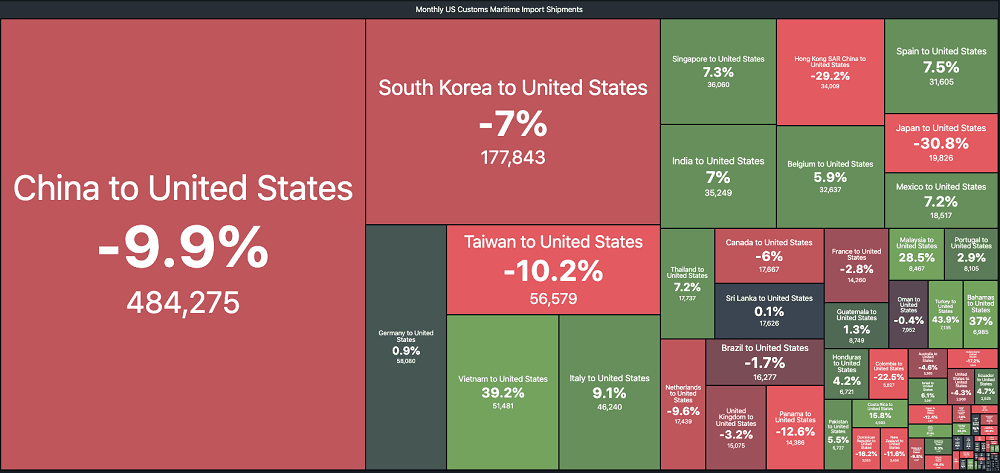
Yet volume gains elsewhere in Asia have not saved the trans-Pacific trade this year. China’s exports to the U.S. were down 23% year-over-year in November with the trade war “sucking the life” out of the trans-Pacific trade, container volumes exported out of Asia in retreat and volumes shipped from Asia to North America expected to decline for the first time in a decade.
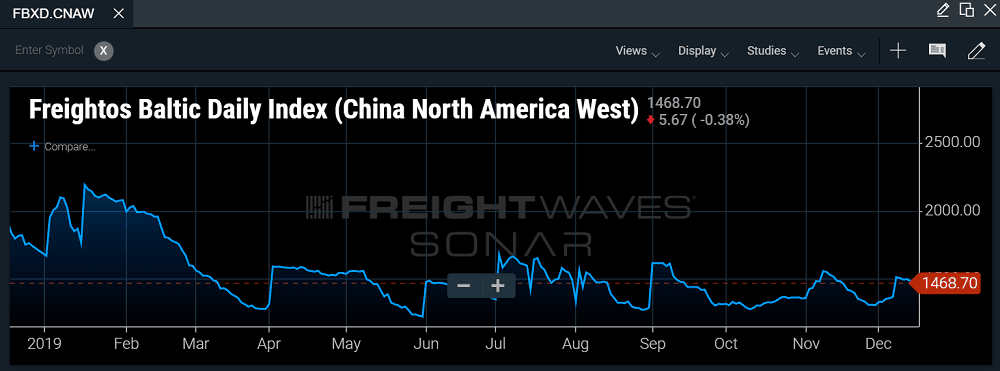
This has weighed heavily on liner spot freight rates through most of 2019, with China-U.S. West Coast prices currently 20% lower than a year ago, according to Freightos (see SONAR below).
As reported in FreightWaves, the Dec. 13 trade truce struck by the U.S. and China is unlikely to boost volumes. “The new agreement, with details still sketchy at the moment, will do little to boost eastbound trans-Pacific container volumes in the short run,” noted Alphaliner.
More FreightWaves and American Shipper articles by Mike
Brokerage Compliance Symposium
The day before F3. Every compliance issue you face - fraud exposure, carrier liability, FMCSA rules, cargo theft, insurance gaps - navigated by attorneys and operators defining best practices in a changing industry.
F3 Awards Dinner
The night before F3. FreightTech100 companies honored. FreightTech 25 and Shipper of Choice winners revealed live. Cocktail reception into dinner and live music - 300 industry leaders in one purpose-built room.
F3: Future of Freight Festival
Industry-defining keynotes, rapid-fire technology demos, and industry leaders networking in experiences across Chattanooga - plus the inaugural F3 Awards Dinner featuring the FreightTech and Shipper of Choice reveals.
The day before F3. Every compliance issue you face - fraud exposure, carrier liability, FMCSA rules, cargo theft, insurance gaps - navigated by attorneys and operators defining best practices in a changing industry.
The Signal at Chattanooga Choo Choo • Chattanooga, TN Register NowThe night before F3. FreightTech100 companies honored. FreightTech 25 and Shipper of Choice winners revealed live. Cocktail reception into dinner and live music - 300 industry leaders in one purpose-built room.
The Signal at Chattanooga Choo Choo • Chattanooga, TN Register NowIndustry-defining keynotes, rapid-fire technology demos, and industry leaders networking in experiences across Chattanooga - plus the inaugural F3 Awards Dinner featuring the FreightTech and Shipper of Choice reveals.
The Signal at Chattanooga Choo Choo • Chattanooga, TN Register Now