




FreightWaves Classics is sponsored by Old Dominion Freight Line — Helping the World Keep Promises. Learn more here.
Widespread adoption of the ZIP code can largely be attributed to a cartoon letter carrier.
The U.S. Postal Service introduced the Zone Improvement Plan as a means to more efficiently sort and route mail. According to the U.S. Postal Service Office of Inspector General, the five-digit code system was launched in 1963 but was based off of a system proposed in 1943. It divided up big cities into postal zones, which consisted of only two digits and were called “local zone numbers.”
Postal inspector Robert Moon submitted a proposal a year later in 1944 to create a national three-digit code system for each area to be assigned to a specific processing hub represented by sectional center codes. He believed that it was “necessary for the post office to keep up with the mail volume after WWII.” Moon consistently submitted proposals to management until finally Postmaster General Edward Day learned of it and became interested in the idea.
According to the Office of Inspector General, Day combined Moon’s idea for the three-digit processing code with the existing two-digit local zones, creating the five-digit ZIP code we know today. But this didn’t come to fruition until 1962, after a thorough introductory campaign to get the public onboard with the new concept.
In October 1962, Day introduced the ZIP code with a cartoon to convey “speedy delivery.” Mr. ZIP was an illustrated mail carrier, drawn in a body position to show that he was delivering mail fast.
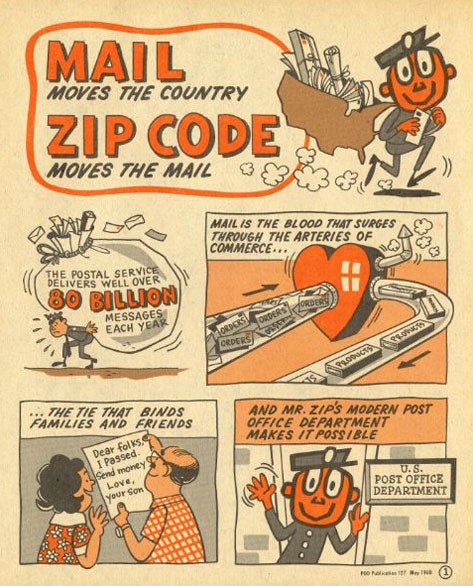
The cartoon introduced the coding system by boasting its ability to increase accuracy and speed for mail delivery, which would allow for limited need to increase rates. The Office of Inspector General said the campaign can be credited with much of the ZIP code’s success. Mr. ZIP’s campaign was widespread, featured in promotional materials in post offices throughout the U.S., decals on Postal Service vehicles, bags and buttons and even in jingles.
The Postal Service even introduced a public service announcement video with a famous singing group at the time, The Swingin’ Six.
Mr. ZIP did his job well, and the Postal Service achieved nearly 100% compliance with ZIP codes. The cartoon was retired in 1983. According to Britannica, that same year the nine-digit ZIP code, named ZIP+4, was introduced.
The ZIP+4 code included four extra digits after a hyphen to speed up automated sorting operations, now that new technology had entered the scene. The first two numbers of the new code specify a specific sector like a group of streets or group of large buildings. The last two numbers denote a small area within that group, known as a segment. This could mean one side of a city block or a single floor in a large building.
Since its inception, the ZIP code has gone beyond its aim of optimizing sorting processes and is now a part of the culture for Americans. The benefits of the code in the digital age today significantly help to streamline mailing efforts in the age of round-the-clock parcel deliveries.
FreightWaves Classics articles look at various aspects of the transportation industry’s history. Click here to subscribe to our newsletter!
Have a topic you want me to cover? Email me at bjaekel@www.freightwaves.com or follow me on Twitter.
Brokerage Compliance Symposium
The day before F3. Every compliance issue you face - fraud exposure, carrier liability, FMCSA rules, cargo theft, insurance gaps - navigated by attorneys and operators defining best practices in a changing industry.
F3 Awards Dinner
The night before F3. FreightTech100 companies honored. FreightTech 25 and Shipper of Choice winners revealed live. Cocktail reception into dinner and live music - 300 industry leaders in one purpose-built room.
F3: Future of Freight Festival
Industry-defining keynotes, rapid-fire technology demos, and industry leaders networking in experiences across Chattanooga - plus the inaugural F3 Awards Dinner featuring the FreightTech and Shipper of Choice reveals.
The day before F3. Every compliance issue you face - fraud exposure, carrier liability, FMCSA rules, cargo theft, insurance gaps - navigated by attorneys and operators defining best practices in a changing industry.
The Signal at Chattanooga Choo Choo • Chattanooga, TN Register NowThe night before F3. FreightTech100 companies honored. FreightTech 25 and Shipper of Choice winners revealed live. Cocktail reception into dinner and live music - 300 industry leaders in one purpose-built room.
The Signal at Chattanooga Choo Choo • Chattanooga, TN Register NowIndustry-defining keynotes, rapid-fire technology demos, and industry leaders networking in experiences across Chattanooga - plus the inaugural F3 Awards Dinner featuring the FreightTech and Shipper of Choice reveals.
The Signal at Chattanooga Choo Choo • Chattanooga, TN Register Now