








Services for trucking are based on either long-term contractual agreements or short-term spot market transactions. The underlying dynamics between contract and trucking spot rates for trucking are similar to other financial markets, especially commodities markets such as fuel, metals and gold.
Contract rates
Contract rates, which comprise roughly 80% of the trucking market, are based on an agreement between a shipper of goods and a transportation provider (asset or non-asset based) for a specific origin and destination and an estimated volume. Contracted rates are usually non-binding agreements based on estimated shipping volumes by the shipper and a per-mile rate quoted by the transportation provider. These contracted freight rates can be broken or adjusted at any time by either party and are often referred to as paper rates.
An example of contracted rates would be a consumer packaged goods (CPG) company that ships its products in dry vans from the manufacturing facility to the distribution centers of its wholesale customers. The forecasted volumes of shipments should be predictable with intermittent periods of seasonality. Since the volumes and lanes are consistent, frequent and forecastable, a contracted trucking rate with predictable rates makes the most economic sense for both the company shipping the goods and the transportation provider that is offering capacity.
Contractual rate agreements vary in length and are customized between shippers, brokers and carriers, but they tend to average three to six months in duration. As trucking market volatility increases, contractual agreements tend to go through a rebidding process by either the shipper or the transportation provider depending on which way spot rates move.
Contract trucking rates are heavily influenced by recent spot market movements. If spot rates are currently above contract rates, there tends to be upward pressure on current and future contractual rates for as long as this relationship holds. Said differently, spot market rates are a leading indicator for contract rates both to the upside and the downside. In this sense, current contract rates can be thought of as spot rates from the relatively recent past. FreightWaves’ survey data indicates that when spot and contract rates diverge by more than 10% (on a per mile basis) for a one- to three-month period, new contractual agreements are often negotiated in order to mark-to-market the purchased cost of transportation.
Spot rates
Spot rates, which make up the remaining 20% of the trucking market, are based on the current supply and demand for trucks and are for one-time or inconsistent load volumes for specific origins and destinations. The spot market is significantly more volatile than the contract market because spot trucking rates are negotiated on a lane-by-lane, load-by-load basis and load specifications can vary wildly. Spot market loads are often same-day loads from shippers who offer loads at inconsistent times or on low traffic, inconsistent lanes.
An example of a spot market rate would be for a custom equipment manufacturer that ships its custom-designed and fabricated equipment to job sites across the United States. In such a scenario, the volumes are low, timing is inconsistent and the destinations vary. When the equipment is ready for delivery, it then has to be matched with a truck on short notice. The shipper will then purchase the trucking capacity on the spot market and will pay spot rates.
Spot market rates are determined by the ratio of the number of loads in the market compared to the number of trucks available to move this freight. When load volumes are high and truck capacity is tight, spot rates tend to rise. Conversely, when load volumes are falling and truck capacity increases (or is held constant), spot rates tend to decline.
Every trucking market can be highly volatile when measured across hours, days and weeks because inbound and outbound freight volumes are dynamic and nonlinear.
Some final factors to consider that often impact both contract and spot rates include the type of commodity being transported (high or low value), the delivery time frame (faster is more expensive), the weight of the freight (heavier is more expensive), the specialization required by the carrier (e.g. transporting wind turbines) and whether the freight is being delivered into a headhaul or backhaul market. The latter characteristic influences pricing per mile as delivering freight into headhaul markets costs less because it is much easier for a carrier to obtain a load after delivery of the original load. On the contrary, delivering freight into a backhaul market is more expensive because carriers often have trouble finding a return load and must deadhead empty miles on the way to their next load.
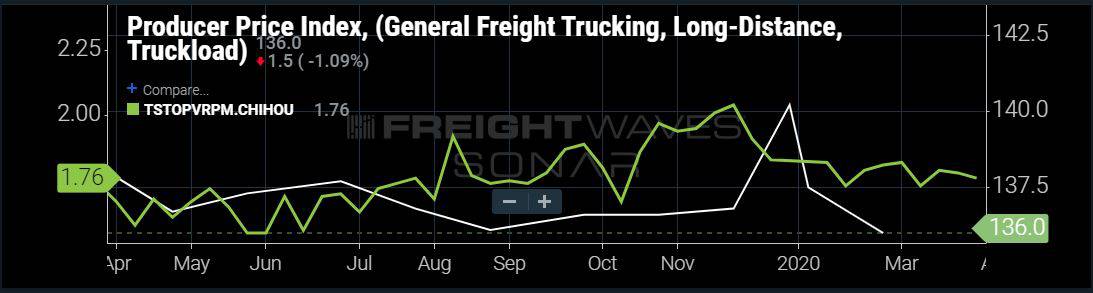
Trucking rates and 150,000 indexes are updated every day to SONAR. If you are interested in learning more about SONAR or scheduling a demo, click here.
Brokerage Compliance Symposium
The day before F3. Every compliance issue you face - fraud exposure, carrier liability, FMCSA rules, cargo theft, insurance gaps - navigated by attorneys and operators defining best practices in a changing industry.
F3 Awards Dinner
The night before F3. FreightTech100 companies honored. FreightTech 25 and Shipper of Choice winners revealed live. Cocktail reception into dinner and live music - 300 industry leaders in one purpose-built room.
F3: Future of Freight Festival
Industry-defining keynotes, rapid-fire technology demos, and industry leaders networking in experiences across Chattanooga - plus the inaugural F3 Awards Dinner featuring the FreightTech and Shipper of Choice reveals.
The day before F3. Every compliance issue you face - fraud exposure, carrier liability, FMCSA rules, cargo theft, insurance gaps - navigated by attorneys and operators defining best practices in a changing industry.
The Signal at Chattanooga Choo Choo • Chattanooga, TN Register NowThe night before F3. FreightTech100 companies honored. FreightTech 25 and Shipper of Choice winners revealed live. Cocktail reception into dinner and live music - 300 industry leaders in one purpose-built room.
The Signal at Chattanooga Choo Choo • Chattanooga, TN Register NowIndustry-defining keynotes, rapid-fire technology demos, and industry leaders networking in experiences across Chattanooga - plus the inaugural F3 Awards Dinner featuring the FreightTech and Shipper of Choice reveals.
The Signal at Chattanooga Choo Choo • Chattanooga, TN Register Now