









Growth in last-mile delivery for big and bulky e-commerce items has slowed by half because stagnant home sales mean people are ordering fewer large-ticket discretionary items like furniture and appliances, cutting into profit margins, according to a report from Armstrong & Associates and the National Home Delivery Association.
Armstrong & Associates estimated the $10.6 billion market for residential delivery of oversized and heavyweight items will grow at a 5.1% compound annual rate through 2027, down from 10.6% over the past eight years, reaching an estimated value of $12.3 billion. Winning service providers will be those that can best execute core, commoditized services such as white-glove delivery, time-definite, returns and in-home assembly.
The expansion continues to be driven by major retailers and e-commerce platforms, including Amazon, Wayfair, Home Depot and Lowe’s, which have made large-format products central to their online offerings. Many third-party logistics providers (3PLs) support them, primarily utilizing independent contractors and freight brokerage operations, but the work is more complex and cost-intensive than for final-mile couriers in parcel networks who simply drop off packages at doorsteps, or in mailboxes.
As more consumers purchase cumbersome products online, carriers face growing pressure to provide not just transportation to the curb, but a premium, in-home delivery experience that may include setup, installation, and even haul-away services, while keeping costs under control, the report said.
Demand for exercise equipment, mattresses, furniture and other large items is closely tied to switches in living locations. When people and businesses move, they tend to upgrade items, or add new ones to fill larger spaces.
Housing turnover hit a 30-year low last year, according to real estate brokerage Redfin, dampening consumer demand. Only 28 homes out of every 1,000 changed hands, a 38% drop from the 2021 frenzy, when 44 per 1,000 homes sold, and 44% below the pre-pandemic pace. Two factors are behind the plunge in home sales: soaring prices, which are tied to limited supply and rising material costs that make homes too expensive for most people; and homeowners with sub-5% mortgage rates who are reluctant to move because the average 30-year fixed mortgage rate is in the mid-to-high 6% range.
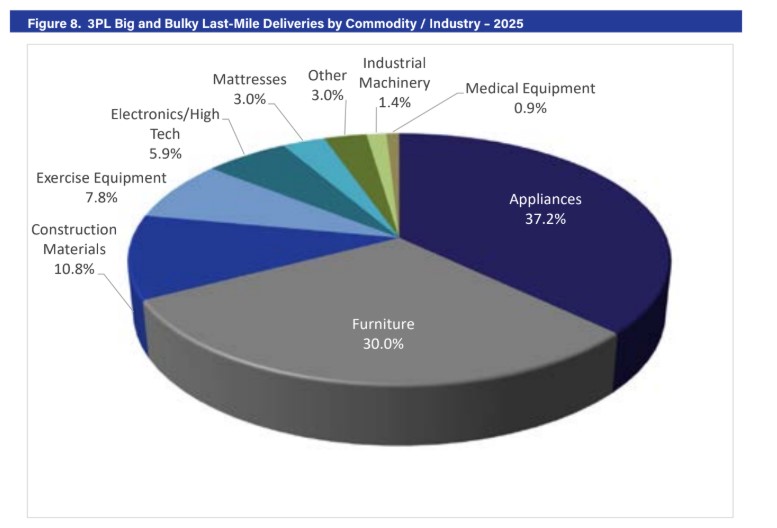
The Trump administration’s tariffs on aluminum and steel imports have also raised the cost of appliances and acted as a further drag on demand.
While housing-correlated demand is soft, carriers are seeing solid growth in delivery of construction materials to small contractors.
Profit compression
Transportation from a distribution or fulfillment center to a customer’s doorstep can account for 30% to 40% of total transportation costs. Revenue per shipment in this segment typically falls below traditional less-than-truckload averages, with less than $100 per shipment being common, the authors said. However, total revenue varies significantly based on service level. High-touch deliveries, such as full-room setup with installation, can generate up to $450 per shipment, while basic curbside or threshold deliveries may yield as little as $70.
Delivering oversize goods presents distinct logistical challenges requiring specialized solutions. These items typically require two-person delivery teams, specialized equipment such as lift gates, dollies, or ramps, and longer delivery times at each stop, contributing to significantly higher operational costs. Additional complexities arise from issues such as missed delivery windows, item damage, and access constraints, including narrow staircases or multi-story buildings, further complicating the delivery process.
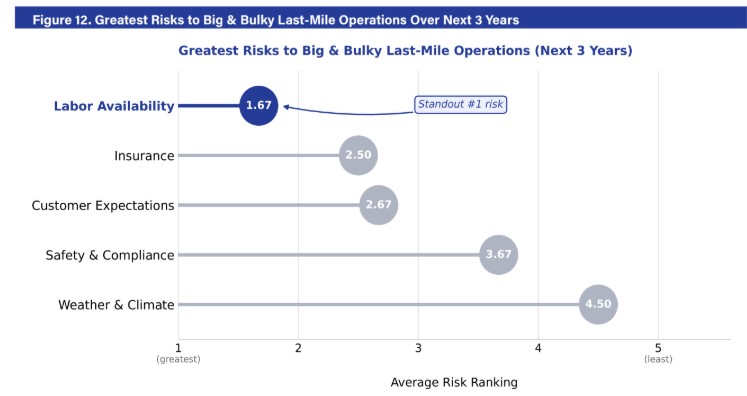
The spike in the price of diesel fuel since the Iran war is also eating into the bottom line. Carriers surveyed by Armstrong & Associates also cited cost concerns from the rising cost of cargo insurance and less-than-truckload capacity scarcity in the middle-mile to warehouses. The biggest long-term worry, by far, is labor availability because rising wages in other industries, like construction and hospitality, pull away similar workers while the federal enforcement on unauthorized commercial license holders is forcing many drivers to exit the industry.
The shortage of independent contractors and the decline of new entrants continues to drive reliance on freight brokerage to secure last-mile capacity, the report said, although it is unclear how many brokers actually participate in the big and bulky sector.
Gross margins in big and bulky delivery have dipped from 28.9% in 2022 to 27.5% last year, the report said.
Big and bulky 3PLs are responding to profit pressures by increasing prices, using technology like dynamic scheduling systems and routing software and computer-vision damage assessment to improve efficiencies, expanding networks and investing in warehouse sortation capability. Some are focusing on dedicated services and high-volume clients rather than chasing market share.
Also, strategically positioning inventory closer to end customers through smaller, decentralized forward stocking locations has enhanced on-time service and delivery consistency for retailers such as Wayfair, in partnership with subsidiary CastleGate Logistics, and Home Depot Pro.
With home delivery seen as a commodity, a small number of 3PLs are offering more creative, value-added services to include, weekend delivery, enabling retail clients to operate outside of traditional warehouse footprints, leveraging dedicated truckload partners that have 53-foot trailers and 26-foot box trucks to handle entire moves, and offering specialized repair services for fitness equipment, massage chairs and wine coolers.
But “competitive differentiation in big and bulky will not come from which services an operator offers. It will come from how well those services are executed. That sets up the technology-adoption story: real-time tracking, AI-driven demand forecasting, flexibility and specialization are where the actual competition is happening,” Armstrong & Associates said.
Top big and bulky last-mile delivery companies with a national footprint include RXO Last Mile ($1.2 billion in gross revenue), Ryder E-commerce and Last Mile Services ($983 million gross revenue, up 9.1% vs 2024, although further analysis indicates the last-mile portion is about a third that amount), and J.B. Hunt Final Mile Services ($824 million gross revenue, down 9.5% y/y). Emerging companies include Deliveright and Frayt.
A looming competitive threat for delivery providers is vertical integration by large retailers and marketplaces, such as Wayfair integrating CastleGate Logistics, Lowe’s $8.8 billion deal for Foundation Building Materials in 2025, and Amazon offering its in-house logistics capabilities through Amazon Supply Chain Services.
In response, independent logistics companies are combining into private equity-backed multi-region platforms positioned to absorb shipper overflow capacity and invest in technology at scale. Labor scarcity, insurance costs and rising operating costs will push smaller, regional operators to consider mergers and acquisitions, or exit the business.
“Over the next 12 to 24 months, the operators that pull ahead will be those that execute reliably, deploy technology with discipline rather than as a marketing layer, deepen the long-tenured shipper relationships that already define this segment, and build the scale needed to compete with vertically integrated retailers for the remaining third-party volume. Operators that do not adapt on those dimensions will fade out of the addressable market,” the Armstrong report predicted.
Click here for more FreightWaves/American Shipper stories by Eric Kulisch.
Write to Eric Kulisch at ekulisch@freightwaves.com.
RELATED STORIES:
Brokerage Compliance Symposium
The day before F3. Every compliance issue you face - fraud exposure, carrier liability, FMCSA rules, cargo theft, insurance gaps - navigated by attorneys and operators defining best practices in a changing industry.
F3 Awards Dinner
The night before F3. FreightTech100 companies honored. FreightTech 25 and Shipper of Choice winners revealed live. Cocktail reception into dinner and live music - 300 industry leaders in one purpose-built room.
F3: Future of Freight Festival
Industry-defining keynotes, rapid-fire technology demos, and industry leaders networking in experiences across Chattanooga - plus the inaugural F3 Awards Dinner featuring the FreightTech and Shipper of Choice reveals.
The day before F3. Every compliance issue you face - fraud exposure, carrier liability, FMCSA rules, cargo theft, insurance gaps - navigated by attorneys and operators defining best practices in a changing industry.
The Signal at Chattanooga Choo Choo • Chattanooga, TN Register NowThe night before F3. FreightTech100 companies honored. FreightTech 25 and Shipper of Choice winners revealed live. Cocktail reception into dinner and live music - 300 industry leaders in one purpose-built room.
The Signal at Chattanooga Choo Choo • Chattanooga, TN Register NowIndustry-defining keynotes, rapid-fire technology demos, and industry leaders networking in experiences across Chattanooga - plus the inaugural F3 Awards Dinner featuring the FreightTech and Shipper of Choice reveals.
The Signal at Chattanooga Choo Choo • Chattanooga, TN Register Now