




Accelerating growth in warehousing employment to support new e-commerce distribution networks has been a key theme in transportation and logistics for the past decade. While trucking carriers have sometimes struggled to find qualified drivers and grow their fleets, warehousing employment has exploded.
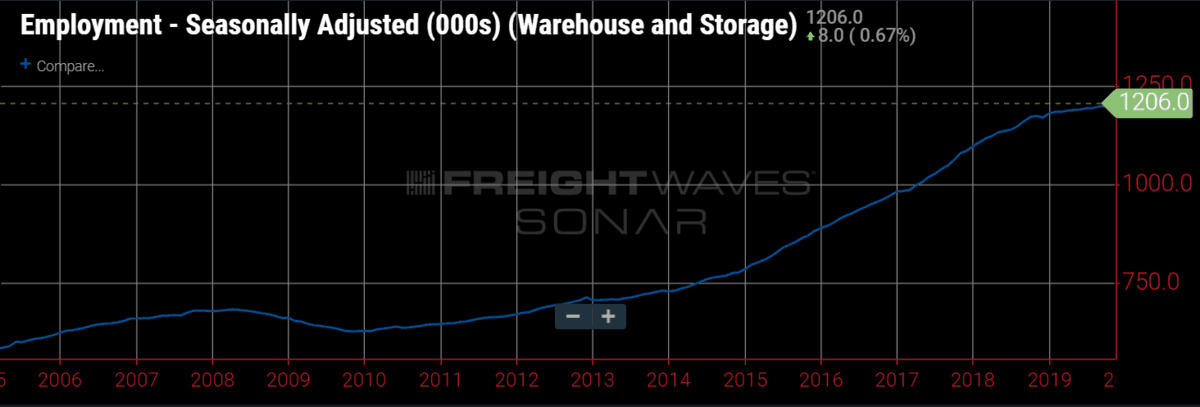
From 2011 to 2018, warehousing employment grew at an 8% compound annual growth rate. But this year, growth in warehousing employment stalled, gaining only 2.7% compared to the year prior. Why?
FreightWaves’ Passport Research team pored over the data and investigated some of the relevant factors.
First, we don’t believe that warehousing employment growth slowed due to a tight labor market in the overall economy. Unemployment has been below 4.5% since March 2017, yet 2018 was a high-growth year for warehousing jobs.
Furthermore, wages for warehouse workers grew 3.67% year-over-year in October compared to a growth rate of 3.18% for all hourly workers. Although on a longer time scale (from 2011), warehouse wages grew slower than all hourly wages, in the past year they’ve grown faster. In 2019, warehousing jobs should have become more attractive relative to general blue-collar work, not less attractive. Therefore, the issue doesn’t lies with wages.
The rate of new construction in major markets has been more mixed, but in cities like Atlanta, Houston and Los Angeles, millions of square feet of capacity are being added every quarter. It should be noted, however, that Deloitte has forecasted a cooling-off in industrial real estate markets for the next three years, but keep in mind this is a second-derivative calculation. Deloitte’s thesis is that inventory will catch up to demand, not that new construction itself will halt – it’s the gap between supply and demand (and therefore price volatility) that is expected to narrow.
The fastest growing warehousing markets in terms of square footage completed in the second quarter of 2019 were Atlanta, Phoenix, Harrisburg, Cincinnati, Charlotte and Houston, each of which accelerated its completions in excess of 500% compared to completions in the previous quarter. Those markets correlate with major freight markets pretty well, indicating that real estate markets are still connected to demand fundamentals.
“From 2010 to 2018, demand for [Last Touch and City distribution] accelerated from prior cycles, while availability rates fell to new lows of about 6% and 7% for Last Touch and City, respectively,” Prologis researchers wrote in November.
The FreightWaves team believes that a confluence of factors, including labor conditions, stricter requirements for picking and packing accuracy, and the need for higher warehouse throughput, has created an inflection point for warehouse automation. The world’s first completely robotic warehouse opened in 2018, and Amazon has facilities staffed by 800 or more robots in the United States.
Not only has robotic performance of tasks like picking a variety of objects improved, but costs have come down. Just as importantly, the financing of robotic labor has become more flexible. At the Armstrong & Associates 3PL Summit in Chicago in October, warehouse operators said that they were already sourcing flex labor from robotics dealers offering affordable short-term leases. Adding 150 robots to a warehouse operation during peak season has become easier than hiring 250 human workers, and it makes sense in situations where it’s less about cost and more about simply getting the work done.
According to ABI Research, there were already 2,500 robotic-powered warehouses by the end of 2018 in the United States alone. This number is projected to increase to 23,000 by 2025.
Meanwhile, Amazon already has more than 100,000 robots working in its 233 million square feet of warehousing space.
In the case of warehousing in 2019, a more intensive focus on automation – at least in some cases driven by tight labor markets, higher wages, the falling cost of robots – has not yet begun eliminating industry jobs. Instead, jobs growth is merely slowing.
While the crowded, high-throughput e-commerce fulfillment centers built in cities are likely to be increasingly automated, there are warehousing sectors that should continue to see robust employment growth. As the fresh food delivery industry grows, refrigerated and frozen warehousing – environments where robots are less effective – should continue to hire aggressively, especially to the extent that the food products are irregularly shaped and sensitive to bruising.
FreightWaves staff believe that the warehouse robotics space is beginning to mature, especially with the emergence of platform companies providing operating systems and interconnectivity between enterprise software and robotic systems. SVT Robotics is one such company – its mission is to be “the fastest, simplest way to connect any company to any robot.”
Those third-party companies will have the effect of expanding the total addressable market for warehouse robotics by allowing warehouse operators without sophisticated automation technology to deploy robots. In some ways, this process will be similar to how cloud computing drastically reduced the cost of enterprise software for small businesses.
We’ll know the warehouse employment/automation trend is playing out if we continue to see a decoupling of e-commerce volumes and warehousing employment data going forward.
Brokerage Compliance Symposium
The day before F3. Every compliance issue you face - fraud exposure, carrier liability, FMCSA rules, cargo theft, insurance gaps - navigated by attorneys and operators defining best practices in a changing industry.
F3 Awards Dinner
The night before F3. FreightTech100 companies honored. FreightTech 25 and Shipper of Choice winners revealed live. Cocktail reception into dinner and live music - 300 industry leaders in one purpose-built room.
F3: Future of Freight Festival
Industry-defining keynotes, rapid-fire technology demos, and industry leaders networking in experiences across Chattanooga - plus the inaugural F3 Awards Dinner featuring the FreightTech and Shipper of Choice reveals.
The day before F3. Every compliance issue you face - fraud exposure, carrier liability, FMCSA rules, cargo theft, insurance gaps - navigated by attorneys and operators defining best practices in a changing industry.
The Signal at Chattanooga Choo Choo • Chattanooga, TN Register NowThe night before F3. FreightTech100 companies honored. FreightTech 25 and Shipper of Choice winners revealed live. Cocktail reception into dinner and live music - 300 industry leaders in one purpose-built room.
The Signal at Chattanooga Choo Choo • Chattanooga, TN Register NowIndustry-defining keynotes, rapid-fire technology demos, and industry leaders networking in experiences across Chattanooga - plus the inaugural F3 Awards Dinner featuring the FreightTech and Shipper of Choice reveals.
The Signal at Chattanooga Choo Choo • Chattanooga, TN Register Now