A war of words is heating up over U.S. exports, particularly food exports — and the outcome of that clash could affect U.S. containerized imports as well.
Reports first surfaced in late October that carriers were rushing containers back empty from California to Asia to serve lucrative headhaul trades instead of loading U.S. export cargoes.
Federal Maritime Commission (FMC) Chairman Michael Khouri warned in December: “We are looking into all potential responsive actions, including a review of whether ocean carriers’ actions are in full compliance with the Shipping Act.”
California government officials informed the FMC last Thursday that “the operations of our agricultural sector, which relies heavily on export markets, are being heavily affected.” They blamed carrier practices “related to detention and demurrage charges, export container availability and container-return practices.”
California officials asked the FMC to compel carriers to suspend or reduce detention and demurrage charges, cancel congestion surcharges, and enhance notifications on empty-container receiving locations.
The World Shipping Council (WSC) and the Pacific Merchant Shipping Association (PMSA) countered that the proposed cure is worse than the disease.
In response to California’s letter to the FMC, the shipping groups responded on Tuesday that “the adoption of these proposals would make congestion and intermodal equipment availability worse, not better.”
Exporters face ‘terrible’ situation
“Imports into the U.S. are at an all-time high but exports are dropping like a rock,” said Flexport Vice President Anders Schulze during a webinar last week. “The ratio of U.S. imports to exports is increasing to a level we’ve never seen before — it’s now more than 3 to 1.”
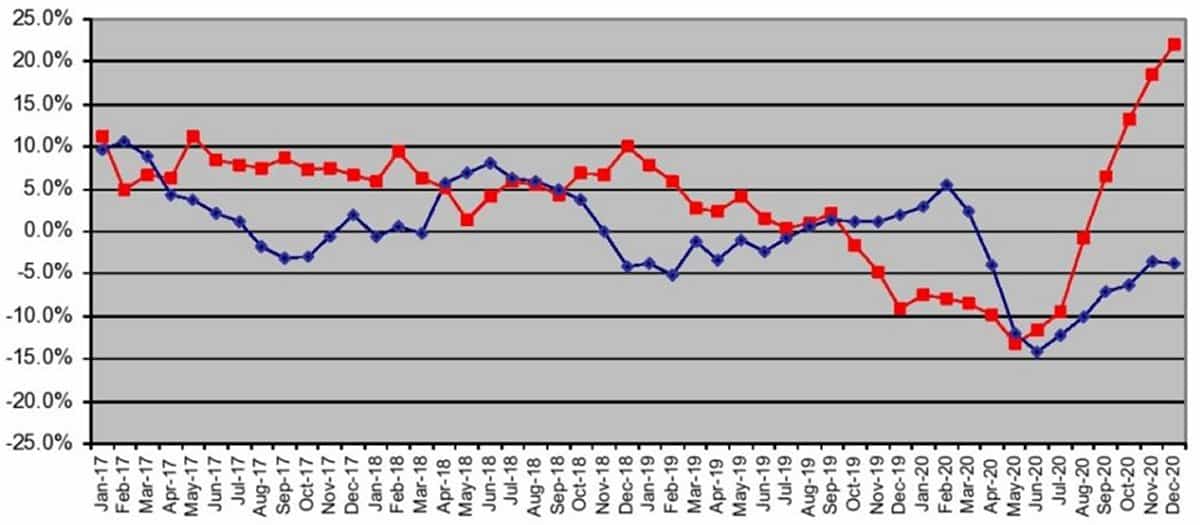
Three-month trailing average of year-on-year change in imports versus exports at top U.S. ports. Imports red, exports blue. (Chart: McCown Report)
Consultant John McCown recently analyzed import and export flows through the top 10 U.S. ports. He found that the year-on-year change in the three-month trailing average as of December was up 22% for imports and down 4% for exports. The divergence is “striking,” said McCown.
Bloomberg reported that the global food trade is being “upended by the container crisis.”
It said that the competition for scarce containers is not only impairing food exports from America, but also from Thailand, Canada, India and Vietnam.
American Shipper asked Agriculture Transportation Coalition (AgTC) Executive Director Peter Friedmann about the current situation for exporters during an interview on Wednesday. “It’s terrible,” he responded. “Terrible as in losing sales, losing customers and losing profits after you pay significant penalties when you don’t deliver on time.
“A number of members [of Congress] are set to take action,” asserted Friedmann, who said that the crisis has led to “upset [FMC] commissioners, upset exporters, upset governors and upset congressmen.”
Carriers: Cutting fees equals more congestion
According to the WSC, which represents carriers, and PMSA, which represents terminal operators, congestion and equipment shortfalls are driven by COVID changes to consumer behavior, not carrier and terminal practices.
“Everyone experiencing these unprecedented conditions has been impacted by the business challenges, costs and delays resulting from the pandemic and its demand surge,” they said. “It is simply not the case that agricultural exporters in California are being singled out for disparate treatment in the intermodal supply chain.”
The groups also cited statistics showing that December exports of California almonds, walnuts and pistachios actually increased substantially year-on-year.
Regarding California officials’ proposal to suspend or reduce detention and demurrage and other charges, the groups maintained that “this would create a disincentive for cargo interests to move import cargo off of marine terminals or to promptly … unload cargo from containers and return those containers for further use.”
They argued that this would reduce container availability for both importers and exporters — and create even more port congestion.
Friedmann lambasted the WSC and PMSA rebuttal as “old and tired.”
“It’s a little easy for ocean carriers and terminals to blame everything on COVID,” he said, adding, “This notion that carriers need to charge fees as an incentive is an old song you’ve heard for decades.”
California data on imports, exports, empties
To gauge changes in container flows, American Shipper analyzed the combined monthly throughput at the ports of Los Angeles and Long Beach during the past two years.
The data shows a surge in outbound empty containers as well as loaded import boxes. It does not show a precipitous decline in export volumes, which appear relatively steady over time despite the recent outcry over lack of container availability.
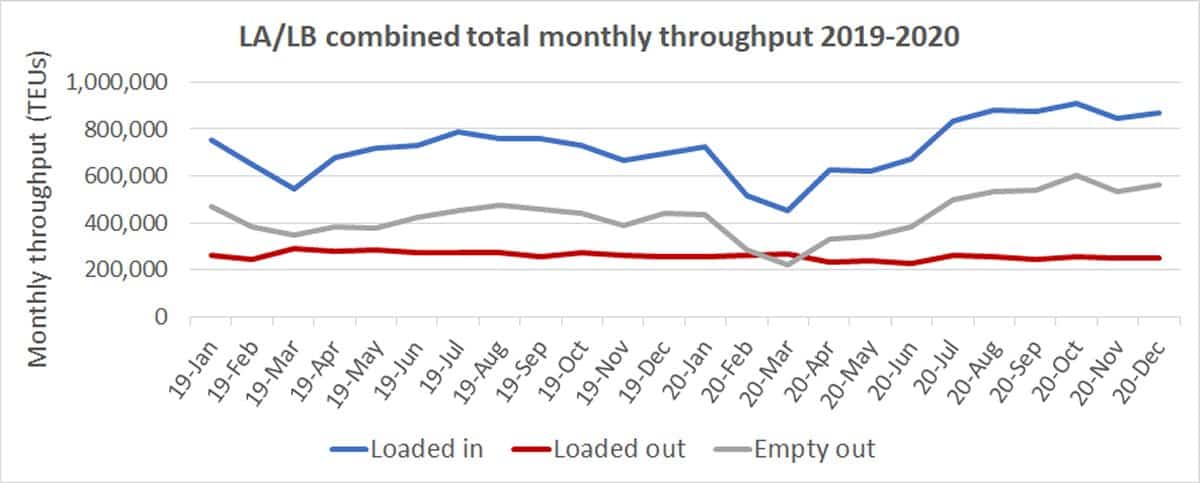
In July-December, loaded inbound containers to Los Angeles/Long Beach jumped, as did empties going westbound, while loaded outbound boxes were down only marginally. Over the past two years, combined exports volumes through the ports have been relatively flat.
During H2 2020, monthly loaded inbound containers to Los Angeles/Long Beach averaged 869,130 twenty-foot equivalent units (TEUs), 3.4 times average monthly loaded outbound volumes of 254,161 TEUs. Outbound empties averaged 544,833 TEUs, 2.1 times exports.
In July-December, combined Los Angeles/Long Beach loaded inbound TEUs rose 19% versus the same period in 2019. Empty outbound container volumes rose in parallel, by 23%. Outbound loaded volumes fell 4% year-on-year.
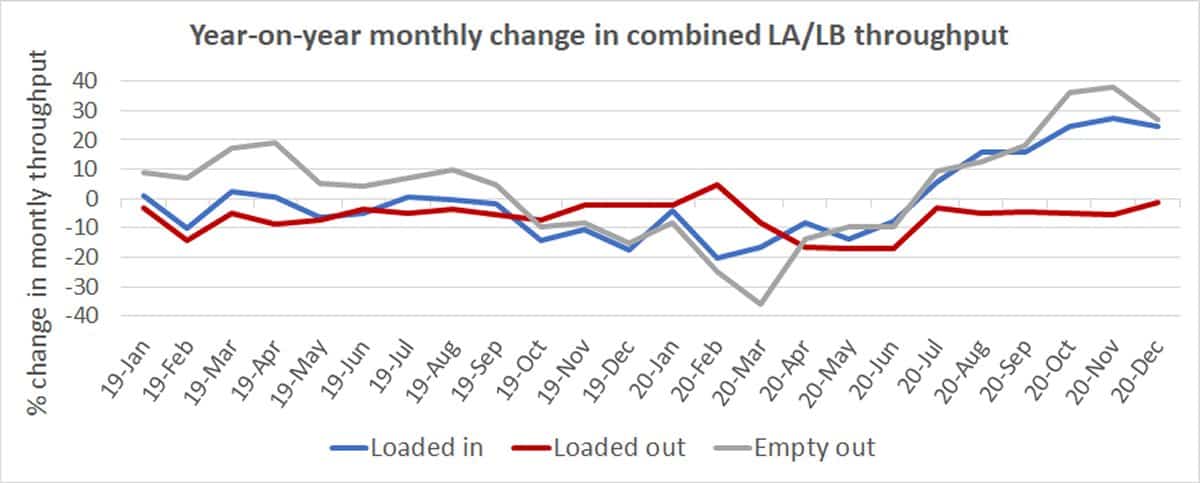
This data shows that the rise in empty outbound containers is being fueled by higher imports, as the surging volume of arriving boxes is turned around in Los Angeles/Long Beach and sent back to China. While export volumes are down, they’re not “dropping like a rock.” Click for more FreightWaves/American Shipper articles by Greg Miller
MORE ON CONTAINERS: Importers face massive hike in ocean contract costs: see story here. Trans-Pacific trade crashes into max-capacity ceiling: see story here. COVID outbreak could cripple California container ports: see story here. Inside California’s colossal container-ship traffic jam: see story here.
Brokerage Compliance Symposium
The day before F3. Every compliance issue you face - fraud exposure, carrier liability, FMCSA rules, cargo theft, insurance gaps - navigated by attorneys and operators defining best practices in a changing industry.
F3 Awards Dinner
The night before F3. FreightTech100 companies honored. FreightTech 25 and Shipper of Choice winners revealed live. Cocktail reception into dinner and live music - 300 industry leaders in one purpose-built room.
F3: Future of Freight Festival
Industry-defining keynotes, rapid-fire technology demos, and industry leaders networking in experiences across Chattanooga - plus the inaugural F3 Awards Dinner featuring the FreightTech and Shipper of Choice reveals.
The day before F3. Every compliance issue you face - fraud exposure, carrier liability, FMCSA rules, cargo theft, insurance gaps - navigated by attorneys and operators defining best practices in a changing industry.
The Signal at Chattanooga Choo Choo • Chattanooga, TN Register NowThe night before F3. FreightTech100 companies honored. FreightTech 25 and Shipper of Choice winners revealed live. Cocktail reception into dinner and live music - 300 industry leaders in one purpose-built room.
The Signal at Chattanooga Choo Choo • Chattanooga, TN Register NowIndustry-defining keynotes, rapid-fire technology demos, and industry leaders networking in experiences across Chattanooga - plus the inaugural F3 Awards Dinner featuring the FreightTech and Shipper of Choice reveals.
The Signal at Chattanooga Choo Choo • Chattanooga, TN Register Now