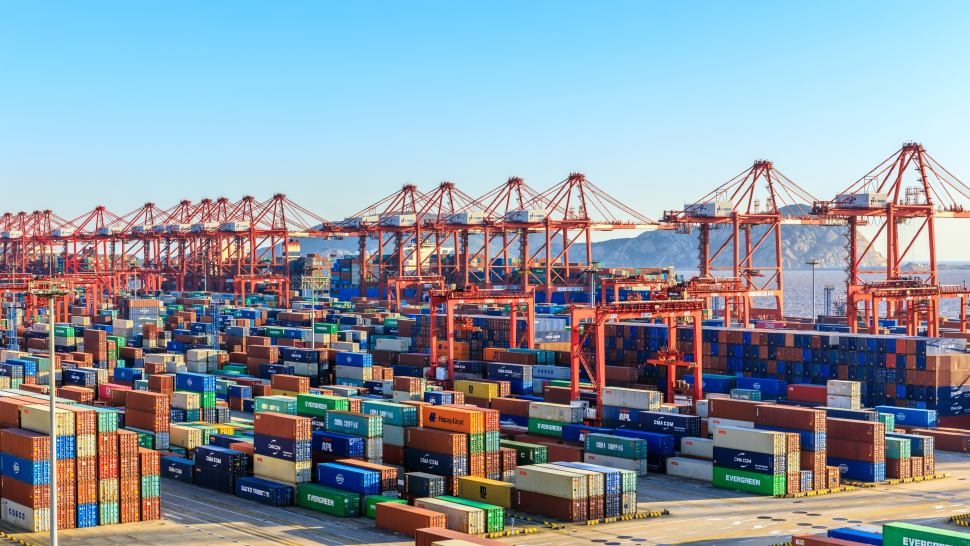
Logistics managers are feeling far from “dynamic” about the latest COVID spread being reported in the Chinese cities of Gansu, Shanghai, Guangxi, Guangdong and Henan.
The highly infectious BA.5 variant has been detected in seven cities and many areas are implementing the requirement of having two nucleic acid testing within three days under China’s “dynamic zero-COVID” policy, which aims to eliminate outbreaks as soon as they appear. In a note to clients, Worldwide Logistics wrote, “It seems that the high temperature in summer can’t stop the virus spreading. China is still facing a critical COVID situation.”
We have been here before and we know what the impact will be. Drayage will get hammered again and the delivery of raw materials or finished goods will slow. And it will only be a matter of time until we hear from companies about the holes in their manufacturing lines.
“Trucking is the most important aspect in the supply chain,” explained Akhil Nair, senior vice president of all products for Asia-Pacific for Seko Logistics. “Because of the nature of logistics within China, everything is a type of integrated cargo. Raw materials and finished products move from one area to another before they hit a seaport. And what happens is that trucking is the one aspect of the supply chain that is immediately impacted by lockdowns. This creates congestion and then delays.”
The global supply chain has seen these delays in the past in the key cities of Guangdong and Shanghai, and the results have been damaging. The ripple effects of a drayage slowdown are felt from raw materials to the delivery of the container at the port.
SONAR’s chart shows the delays between a vessel’s departure date and a vessel’s arrival date from China to the U.S.

The only saving grace to the situation is the decrease in future manufacturing orders between 20% and 30% on select items like furniture and appliances. SONAR’s Ocean Booking Volume Index shows how this decrease is impacting ocean orders.

While the impact of the Shanghai shutdown is still fresh in participants’ minds in the world of trade, Guangdong may not be.
About 30% of China’s exports and approximately one-third of the world’s production of shoes, textiles and toys are manufactured in the region, producing around $300 million worth of goods.
Some of the country’s largest companies — Huawei Technologies, appliance group Midea, Tencent Holding and electric vehicle builder BYD — are located in Guangdong. Headlines of the failure of the promised “closed system” were prolific in the last round of testing and lockdowns. Yet despite these hurdles, the optimism about Chinese manufacturing doesn’t waver. Honda Motor recently announced the building of its newest electric vehicle factory in the province with its joint venture in China with Guangzhous Automobile Group.
Commodities such as steel are also under pressure.
In the Henan Province, in the city of Wugang, a wide and thick steel plate production manufacturer, the Wuyang Iron & Steel Co., was shuttered for several days because of the latest COVID flare-up. Its products are exported to the United States, Japan and other countries.
So what kind of trucking delays will supply chain managers have to build into their already broken timeline? At least a week, according to Nair.
“What happens is, if a particular district or area goes into a lockdown, the drivers basically have to go through a nucleic acid test or a PCR test. And with that, that usually takes between 24 and 72 hours,” Nair said. “So even if they’re negative, they still have to wait until the results come and that leads to further delays.
“That being said, let’s say you’re negative when you pick up the cargo but you’re moving on a route and perhaps you’ve stopped at a truck stop. God forbid but you turn positive. At the next place, when you’re crossing over to the next province, you can be asked to test again. Now that’s another 24 to 72 hours. So a normal truck route that will take a day or two can take as long as up to a week in some cases if you have the misfortune of getting stopped multiple times.”
This layering of districts only adds to the complexity and creates a “shortage” of drivers, Nair explained to American Shipper.
“In some cases, when there’s a lockdown or a high number of cases in a place like Shanghai, other districts around do not want to accept truck drivers from that area for pickups, and therefore, the economies of scale or the optimization of your truck fleet is completely thrown out the window. So additionally you need more trucks to be able to cater to things at this point.”
Logistics managers like Nair tell their clients this is the new normal. Being nimble and flexible is key to navigating the challenges.
“Trucking is basically the first aspect and the biggest aspect that will impact future supply chains in China,” Nair said. “I don’t believe that this is going to go away anytime soon.”
Brokerage Compliance Symposium
The day before F3. Every compliance issue you face - fraud exposure, carrier liability, FMCSA rules, cargo theft, insurance gaps - navigated by attorneys and operators defining best practices in a changing industry.
F3 Awards Dinner
The night before F3. FreightTech100 companies honored. FreightTech 25 and Shipper of Choice winners revealed live. Cocktail reception into dinner and live music - 300 industry leaders in one purpose-built room.
F3: Future of Freight Festival
Industry-defining keynotes, rapid-fire technology demos, and industry leaders networking in experiences across Chattanooga - plus the inaugural F3 Awards Dinner featuring the FreightTech and Shipper of Choice reveals.
The day before F3. Every compliance issue you face - fraud exposure, carrier liability, FMCSA rules, cargo theft, insurance gaps - navigated by attorneys and operators defining best practices in a changing industry.
The Signal at Chattanooga Choo Choo • Chattanooga, TN Register NowThe night before F3. FreightTech100 companies honored. FreightTech 25 and Shipper of Choice winners revealed live. Cocktail reception into dinner and live music - 300 industry leaders in one purpose-built room.
The Signal at Chattanooga Choo Choo • Chattanooga, TN Register NowIndustry-defining keynotes, rapid-fire technology demos, and industry leaders networking in experiences across Chattanooga - plus the inaugural F3 Awards Dinner featuring the FreightTech and Shipper of Choice reveals.
The Signal at Chattanooga Choo Choo • Chattanooga, TN Register Now