



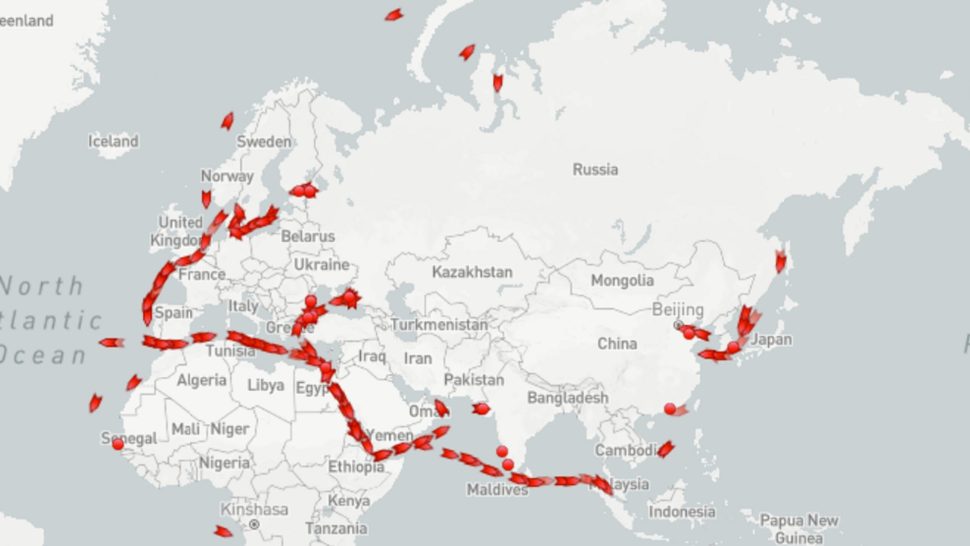
It took a while but it finally happened: The U.S. Treasury Department has begun sanctioning tankers transporting Russian crude oil valued above the West’s price cap.
Since Dec. 5, 2022, the Group of Seven nations, members of the European Union and Australia have barred their countries’ marine service providers from working with tankers carrying Russian crude priced above $60 per barrel. Tankers carrying crude above the cap that use G-7, EU or Australian services have been threatened with sanctions.
The price cap was designed to allow Russian crude to continue to flow to world markets while simultaneously forcing Russian crude to be sold at a discount, curtailing profits to the Kremlin.
Skepticism on the price-cap scheme has been mounting for months, because Russian crude pricing was clearly above $60 per barrel and no punitive action was being taken.
The Treasury Department’s Office of Foreign Assets Control (OFAC) finally pulled the sanctions trigger on Thursday, blacklisting two tankers and their holding companies and sending a warning shot across the bow of the broader maritime industry.
“Today’s action demonstrates our continued commitment to reduce Russia’s resources for its war against Ukraine and to enforce the price cap,” said Wally Adeyemo, deputy secretary at the Treasury Department. He affirmed that the U.S. “will continue to take actions” to enforce the cap.
The U.S. announcement was accompanied by a joint statement and advisory from the “Price Cap Coalition,” comprising countries of the G-7 and EU, plus Australia.
Higher prices, higher volumes
Russian Urals crude breached the price cap in mid-July and has traded above $60 per barrel ever since. As of Wednesday, Urals crude loading in the Russian Black Sea port of Novorossiysk was at $76.42 per barrel, according to price-reporting agency Argus. Urals loading in the Russian Baltic Sea port of Primorsk was at $75.32 per barrel.
Russian ESPO crude loaded at the country’s Pacific port of Kozmino has traded above the cap ever since the sanctions policy was put in place over 10 months ago. It was at $83.70 on Wednesday, according to Argus.

“Given recent price movements, the Coalition is focusing on supporting compliance and enforcement of the policy,” the Price Cap Coalition said on Thursday.
Not only has Russia been getting higher prices for its crude, its export volumes have been rising. Revenues flowing to the Russian government are up on both price and volume.
According to Kpler, which uses ship-tracking data to gauge volumes, Russia’s seaborne crude exports have averaged 3.57 million barrels per day in October to date.
That’s up 14% from the recent low point in July, when monthly seaborne exports averaged 3.13 million barrels per day.

2 tankers blacklisted
Traditionally, OFAC has not sought to regulate compliance by sanctioning a large number of companies all at once. Rather, it initially sanctions a small number of players with the expectations that others will fall in line, then gradually goes after more targets if behavior doesn’t change.
OFAC sanctioned the tanker SCF Primorye for transporting Russian Urals crude priced at over $75 per barrel from Novorossiysk, and the tanker Yasa Golden Bosphorus for transporting Russian ESPO crude priced at over $80 per barrel from a Russian Pacific port, presumably Kozmino.
The Treasury Department confirmed that both tankers “used U.S.-based service providers while transporting the Russian-origin oil.”
No U.S. individuals or U.S.-incorporated companies can do business with these vessels or their owners going forward.
According to ship-information database Equasis, the 2009-built, 158,070-deadweight ton (DWT) SCF Primorye is managed by Dubai, UAE-based Sun Ship Management and flagged by Liberia, the world’s largest ship registry. The Liberian Registry is headquartered in Virginia.
The SCF Primorye previously sailed in the fleet of Russia’s Sovcomflot, according to data from MarineTraffic. Management of multiple Sovcomflot tankers was transferred to Sun in the wake of sanctions. The sanctioned tanker is currently owned by Dubai-based Lumber Marine.
Both the SCF Primorye and Lumber Marine have been placed on OFAC’s “blocked” list. Any entity that owns 50% of Lumber Marine or the ship is also blocked.
The 2007-built, 115,867-DWT Yasa Golden Bosphorus is managed by Turkey’s Yasa Tanker, insured by U.K.-based Britannia P&I and flagged by the Marshall Islands Registry, according to Equasis. The Marshall Islands Registry, the world’s third-largest ship registry, is managed by Virginia-headquartered International Registries Inc. (IRI).
The Yasa Golden Bosphorus was sold by trading group Vitol in 2019, according to MarineTraffic data. Its current owner is Turkey-based Ice Pearl Navigation Corp., which has been blocked by OFAC along with the ship and any company that owns 50% or more of either the ship or Ice Pearl Navigation.
Click for more articles by Greg Miller
Related articles:
- Sanctions on Russian crude and diesel exports are failing
- Russian crude prices have breached the G-7 price cap. Now what?
- Profiting from sanctions: Shipping premiums surge for Russian oil
- One year later: How Ukraine-Russia war reshaped ocean shipping
- China-Russia vs. US-EU: How global shipping is slowly splitting in two
- Price cap on Russian crude could soon face its biggest test
- European tanker owners make a fortune off Russian oil trade
- Welcome to the dark side: The rise of tanker shipping’s ‘shadow fleet’
Brokerage Compliance Symposium
The day before F3. Every compliance issue you face - fraud exposure, carrier liability, FMCSA rules, cargo theft, insurance gaps - navigated by attorneys and operators defining best practices in a changing industry.
F3 Awards Dinner
The night before F3. FreightTech100 companies honored. FreightTech 25 and Shipper of Choice winners revealed live. Cocktail reception into dinner and live music - 300 industry leaders in one purpose-built room.
F3: Future of Freight Festival
Industry-defining keynotes, rapid-fire technology demos, and industry leaders networking in experiences across Chattanooga - plus the inaugural F3 Awards Dinner featuring the FreightTech and Shipper of Choice reveals.
The day before F3. Every compliance issue you face - fraud exposure, carrier liability, FMCSA rules, cargo theft, insurance gaps - navigated by attorneys and operators defining best practices in a changing industry.
The Signal at Chattanooga Choo Choo • Chattanooga, TN Register NowThe night before F3. FreightTech100 companies honored. FreightTech 25 and Shipper of Choice winners revealed live. Cocktail reception into dinner and live music - 300 industry leaders in one purpose-built room.
The Signal at Chattanooga Choo Choo • Chattanooga, TN Register NowIndustry-defining keynotes, rapid-fire technology demos, and industry leaders networking in experiences across Chattanooga - plus the inaugural F3 Awards Dinner featuring the FreightTech and Shipper of Choice reveals.
The Signal at Chattanooga Choo Choo • Chattanooga, TN Register Now