







Proponents of a long-standing effort to raise the national standard for twin trailers from 28 feet to 33 feet have added an incentive they will use to try and get some of their staunchest opponents on board – a high-tech safety equipment mandate.
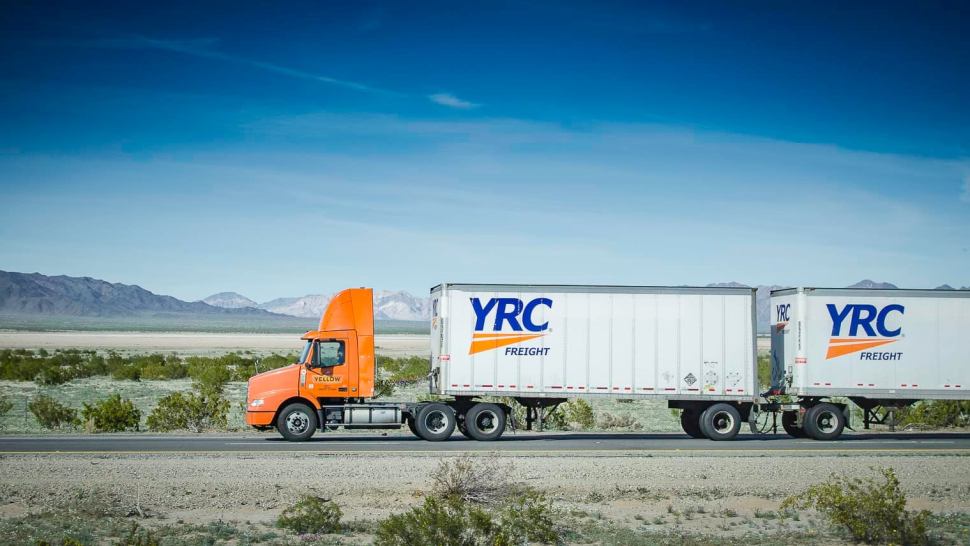
The Americans for Modern Transportation Coalition, which represents major less-than-truckload (LTL) market participants such as FedEx [NYSE: FDX], UPS [NYSE: UPS], XPO Logistics [NYSE: XPO], Amazon [NASDAQ: AMZN], and YRC Freight [NASDAQ: YRCW] are telling lawmakers in Washington, D.C., that their proposal will now require that tractors pulling twin 33-foot trailers (“Twin 33s”) must be equipped with four safety requirements: speed limiters set at 68 mph; on-board video event recorders; electronic stability control; and automatic emergency braking.
The new requirements elevate past efforts by the proposal’s supporters which, while pointing to the safety benefits of moving more freight with fewer trucks, also relied heavily on the potential for efficiency gains and cost savings.
“There’s no safety advocate out there that doesn’t want these kinds of devices on every truck in the country,” Randy Mullett, the coalition’s executive director, told FreightWaves.
“But particularly in an Administration that’s pretty anti-regulatory, the notion that you’re going to get through such a sweeping safety mandate is not likely anytime soon. So putting these technology requirements in as a carrot for twin 33s will mean companies like FedEx and UPS making large equipment purchases, which will likely cause equipment costs to drop, and eventually many of these tractors ending up in the secondary markets. These safety upgrades can get deeper penetration into the full trucking fleet more than anything we can do short of a mandate for all trucks.”
The new safety incentives are included in a June 10 letter sent to the leaders of the Highways and Transit subcommittee of the U.S. House Transportation & Infrastructure Committee, which is holding a trucking industry hearing on June 12.
Scheduled to attend the hearing are representatives of Advocates for Highway and Auto Safety, which opposes measures allowing bigger, heavier trucks on the road.
“Longer and heavier trucks are less safe and more damaging to our infrastructure,” the group has asserted, citing a study by the U.S. Department of Transportation finding that introducing double 33s nationally would result in 2,478 bridges requiring strengthening or replacement at an estimated one-time cost of $1.1 billion.
Mullett’s coalition counters that allowing twin 33s will result in 3.1 billion fewer truck miles traveled each year, “greatly reducing the impact on roads and bridges with less congestion at no cost to taxpayers.”
His group also claims that twin 33-foot trailers “perform better than many other truck configurations on four critical safety measures,” including stability and rollover. Adopting them would result in 4,500 fewer truck accidents annually and 53.2 million hours saved due to less congestion, they contend.
The heavy lift it will take to get safety advocates on the side of twin 33s – even with the upgraded proposal – is matched by the railroads, a powerful lobby opposed to any measure they see as potentially giving up even a small pricing advantage.
But while the productivity gains made possible by increasing the national standard for twin trailers by five feet could save carriers and customers an estimated $2.6 billion in lower shipping costs, supporters of the measure claim it would also only affect an estimated 1 percent of freight on the road.
“It’s like Blackberry saying to Congress, please don’t develop an iPhone because it will hurt my business,” Mullett says. “It doesn’t make any sense.”
Brokerage Compliance Symposium
The day before F3. Every compliance issue you face - fraud exposure, carrier liability, FMCSA rules, cargo theft, insurance gaps - navigated by attorneys and operators defining best practices in a changing industry.
F3 Awards Dinner
The night before F3. FreightTech100 companies honored. FreightTech 25 and Shipper of Choice winners revealed live. Cocktail reception into dinner and live music - 300 industry leaders in one purpose-built room.
F3: Future of Freight Festival
Industry-defining keynotes, rapid-fire technology demos, and industry leaders networking in experiences across Chattanooga - plus the inaugural F3 Awards Dinner featuring the FreightTech and Shipper of Choice reveals.
The day before F3. Every compliance issue you face - fraud exposure, carrier liability, FMCSA rules, cargo theft, insurance gaps - navigated by attorneys and operators defining best practices in a changing industry.
The Signal at Chattanooga Choo Choo • Chattanooga, TN Register NowThe night before F3. FreightTech100 companies honored. FreightTech 25 and Shipper of Choice winners revealed live. Cocktail reception into dinner and live music - 300 industry leaders in one purpose-built room.
The Signal at Chattanooga Choo Choo • Chattanooga, TN Register NowIndustry-defining keynotes, rapid-fire technology demos, and industry leaders networking in experiences across Chattanooga - plus the inaugural F3 Awards Dinner featuring the FreightTech and Shipper of Choice reveals.
The Signal at Chattanooga Choo Choo • Chattanooga, TN Register Now