









The first quarter could mark the last round of bad earnings reports from truckload carriers as supply has meaningfully contracted and demand is emerging from a three-year-plus downslide. Equity analysts cut numbers heading into earnings season, but sentiment around full-year 2026 results still skews positive even as war-related fuel headwinds loom.
Following peak season, the first quarter is typically the seasonally weakest of the year, with weather often presenting an added headwind. The 2026 first quarter saw two major winter storms resulting in numerous terminal closures and operational delays. Further, a surge in diesel fuel prices negatively impacted carrier results in the period.
Fuel price surge presents Q1 headwind, but likely Q2 tailwind
Large carriers have ample fuel recovery mechanisms in place, but the one-week lag leads to short-term margin compression when prices are on the way up. Also, surcharges rarely cover deadhead, out-of-network miles or idle time.
Carriers can make money buying fuel in bulk (at wholesale prices) while setting surcharges at retail prices. However, many carriers only purchase a small percentage of fuel in bulk, with a much larger portion being purchased at retail truck stops through negotiated volume discounts. (Knight-Swift Transportation (NYSE: KNX) purchased only 10.9% of its fuel in bulk last year.)
Retail fuel prices increased sequentially in the last 11 weeks of the first quarter, moving 56% higher (nearly $2 per gallon) from trough to peak. However, lagging surcharges could provide a tailwind in the second quarter if prices moderate or possibly recede.
An inflationary fuel environment can be demand-destructive to consumer spending. The higher prices are also a headwind in rate negotiations, as shippers’ budgets contemplate the total cost of transportation (inclusive of fuel). The diesel price shock, however, will spur further capacity attrition as a much larger portion of the fragmented TL universe works in the spot market with little protection via surcharges.
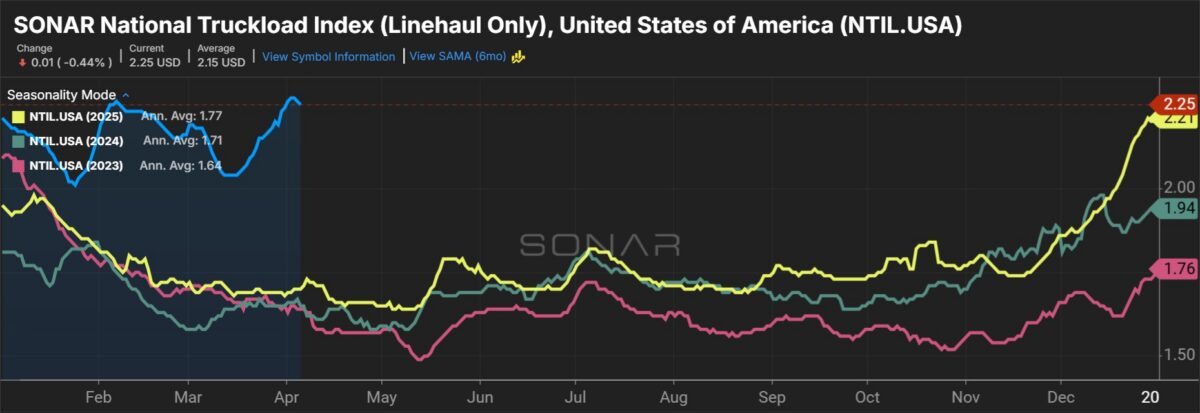

Estimates move lower for last time?
Analysts trimmed numbers heading into first-quarter reports due to the magnitude of this year’s storms and near-term headwinds created by the surge in fuel costs. Weather was abnormally severe in the South—a region less accustomed to handling inclement weather—resulting in extended downtime across carrier networks.
Morgan Stanley (NYSE: MS) analyst Ravi Shanker cut first-quarter TL earnings-per-share estimates by low- to high-single-digit percentages on Monday. However, he maintained a positive outlook for the space, leaving full-year numbers largely untouched, as English-language proficiency requirements, non-domiciled CDL restrictions, a crackdown on ELD providers and forced closures of driver schools have tightened supply.
“All eyes will be on Supply side industry updates for 2026 as 1Q numbers will be likely sidelined by weather and war,” Shanker said in a note to clients. … “The good news is that the momentum that the sector saw exiting 2025 continued into 1Q despite fears that the December strength was temporarily driven by peak season and weather.”
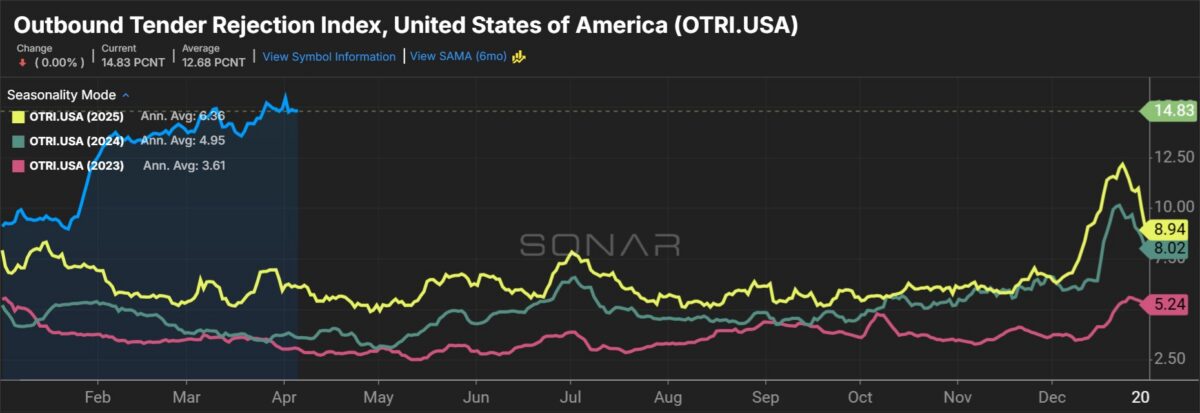
He also noted a “line of sight to the end of tariffs,” which derailed a potential recovery for the space last year. March manufacturing data was positive for a third straight month after three years of mostly negative readings.
The Purchasing Managers’ Index registered a 52.7 reading, which was 30 basis points ahead of February. (A reading above 50 signals expansion, while one below 50 indicates contraction.) The index has averaged 49.6 over the past 12 months, 210 bps ahead of the benchmark representative of “an expansion of the overall economy.” The new orders subindex—an indicator of future activity—remained expansionary as well.
Ongoing capacity contraction coupled with returning demand could push contractual rate increases from a mid-single-digit range currently to high-single digits later in the year.
Deutsche Bank (NYSE: DB) analyst Richa Harnain also cut first-quarter numbers due to operational delays, which more negatively impacted utilization in one-way networks, and “severe fuel price volatility.” However, the bulk of the cuts appear to be tied to the fuel surcharge lag. She maintained her favorable outlook for the industry this year.
“Our 2H optimism is based on the view that ongoing capacity reductions in the trucking market—accelerating now by working capital pressure on smaller operators from high fuel costs—will lead to a more favorable rate environment for all modes,” Harnain said.
She flagged elevated energy prices as a potential drag on consumer demand.
“Nevertheless, we maintain that weakening demand is the most significant risk for the group over the medium-term…particularly as rising oil prices could fuel inflation and dampen spending on goods.”
Both analysts slightly raised estimates for the less-the-truckload carriers they follow as LTL carrier surcharge percentages step higher as fuel prices increase. The fuel tailwind for LTL carriers will likely be more pronounced starting in the second quarter.
The first-quarter earnings season begins on Apr. 15 when J.B. Hunt Transport Services (NASDAQ: JBHT) reports results after the market closes.
Brokerage Compliance Symposium
The day before F3. Every compliance issue you face - fraud exposure, carrier liability, FMCSA rules, cargo theft, insurance gaps - navigated by attorneys and operators defining best practices in a changing industry.
F3 Awards Dinner
The night before F3. FreightTech100 companies honored. FreightTech 25 and Shipper of Choice winners revealed live. Cocktail reception into dinner and live music - 300 industry leaders in one purpose-built room.
F3: Future of Freight Festival
Industry-defining keynotes, rapid-fire technology demos, and industry leaders networking in experiences across Chattanooga - plus the inaugural F3 Awards Dinner featuring the FreightTech and Shipper of Choice reveals.
The day before F3. Every compliance issue you face - fraud exposure, carrier liability, FMCSA rules, cargo theft, insurance gaps - navigated by attorneys and operators defining best practices in a changing industry.
The Signal at Chattanooga Choo Choo • Chattanooga, TN Register NowThe night before F3. FreightTech100 companies honored. FreightTech 25 and Shipper of Choice winners revealed live. Cocktail reception into dinner and live music - 300 industry leaders in one purpose-built room.
The Signal at Chattanooga Choo Choo • Chattanooga, TN Register NowIndustry-defining keynotes, rapid-fire technology demos, and industry leaders networking in experiences across Chattanooga - plus the inaugural F3 Awards Dinner featuring the FreightTech and Shipper of Choice reveals.
The Signal at Chattanooga Choo Choo • Chattanooga, TN Register Now