




Trucking carriers continue to exit the market, citing a variety of reasons including the regulatory environment, low rates, inflated wages and high insurance costs. To date, there is little to suggest that capacity has bled off enough to materially affect spot rates – most of the discussion with private and public third-party logistics providers this summer has been around very loose capacity.
That may be changing. Market data and anecdotes from freight brokers now suggest that enough trucking capacity has exited the industry to support a floor under the spot market. Price, of course, is a function of both supply (trucking capacity) and demand (freight volumes), and the supply side is the hardest to get a handle on.
FreightWaves is aware that capacity is continuing to leave the market, that the supply of trucks is decreasing, not increasing, both directly and indirectly. Publicly announced carrier shutdowns continue at a steady clip. Truckers are defaulting on fuel card payments at an accelerating pace.
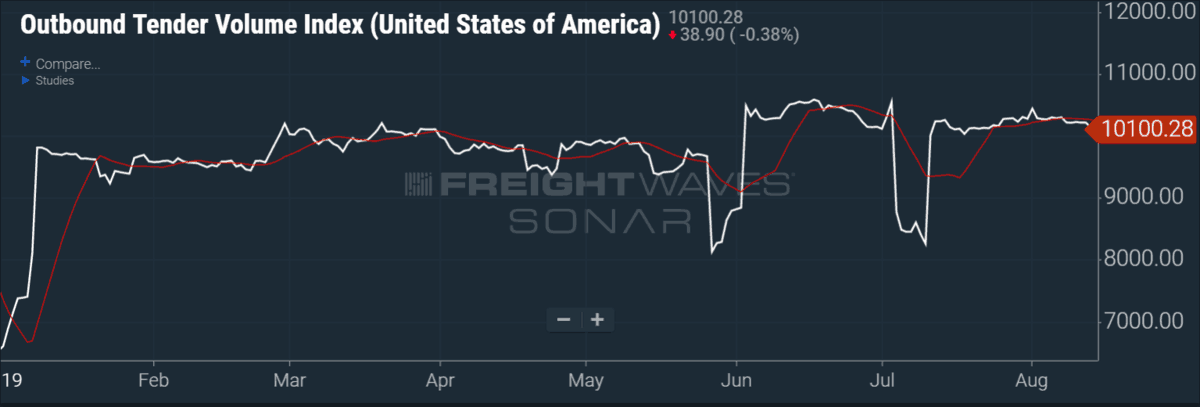
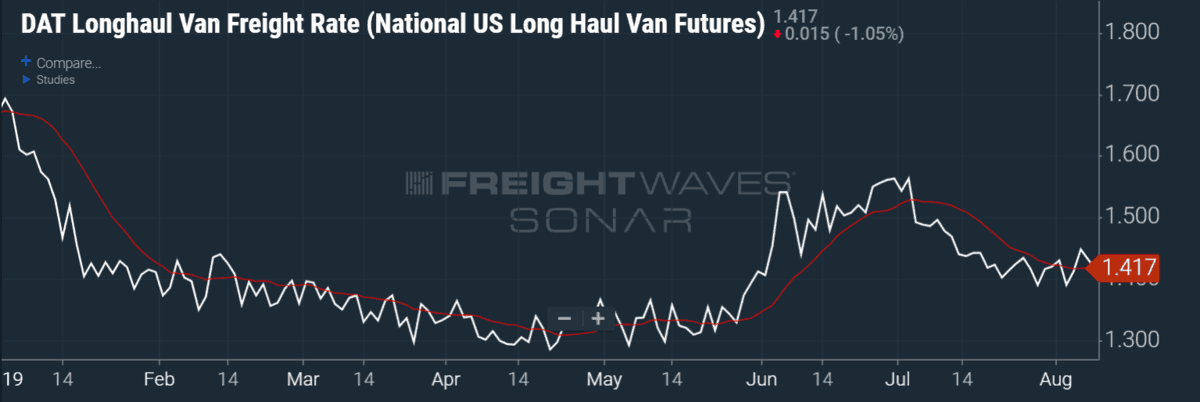
Meanwhile, volumes have softened slightly (OTVI.USA) — though are still up two percent year-over-year — while spot rates remain steady (DATVF.VNU). If demand has fallen incrementally but price has not, that’s an indirect signal that supply must also still be falling.
For those readers following our ‘freight recovery’ thesis, we first broached this idea on July 31 and found new evidence to support it on August 13 (link below).
Earlier this week, a freight brokerage executive reached out to FreightWaves with a vivid anecdote of exactly how contracting capacity supports higher rates.
“A very large shipper sent this to us yesterday, updating our spot on the routing guide,” the broker wrote in a text message, before quoting the message from the shipper. “‘The awarded carrier we had assigned to these lanes went out of business. You are the next provider in line,’” the shipper’s message said.
In other words, the shippers’ primary carrier priced the lane so aggressively it ran itself out of business. FreightWaves is not suggesting that running those specific lanes under operating cost caused the failure of the company, but it speaks to the kind of business results that can be experienced by transportation providers choosing to compete on price.
Regardless, the result is that the cheapest carrier went out of business and the shipper then had to move the secondary provider up the routing guide, presumably at the same rate that got the provider put into the second position. Capacity left the market and the price the shipper is paying, at least on those lanes, has increased. While it’s just an anecdote, it’s the first concrete example of a loss of capacity that has supported higher rates.
Other brokers are reporting that carriers are less willing to go into unfavorable markets and that they are taking losses on lanes they may have underbid. This week there has been data on $1,000 loser loads consistently going into the Northeast, Phoenix and Florida. What’s most instructive about that data is that those markets are well-known backhaul markets that are unattractive to carriers. Many carriers delivering into Phoenix deadhead into the more fertile pastures of Southern California’s Los Angeles and Ontario markets. Trucks hauling into Florida have to drive empty back north to the panhandle or Georgia to find good freight.
The structural set-up of those markets hasn’t changed, and in fact they have probably gotten a bit worse as produce harvests move into more northerly states. What has changed, apparently, is that carriers have discovered they have a little more pricing power when it comes to hauling freight into deep backhaul markets.
Notably, the capacity bleed-off or rate support reflected in tender rejections (OTRI.USA) has yet to be seen. For freight brokers, the buy side is tightening, not the sell side. Brokers are loathe to give back loads after a long period of soft volumes that lasted through May; they’re accepting the freight, but it’s taking them longer to cover the loads and they’re paying more than they want to.
The Trucking Freight Futures market on the Nodal Exchange still expects a healthy pop in spot rates going into the fourth quarter. On Wednesday, August 13, the setup for a strong volume surge out of the West Coast and the forward curve for trucking spot rates from Los Angeles to Dallas (FWD.VLD) was covered here. Since then, railroads have cut intermodal rates on nearly every major lane by an average of $0.09 per mile. That raises the prospect for solid intermodal volumes into the middle of the country.
The chart for trucking spot rates from Chicago to Atlanta (DATVF.CHIATL) as well as the forward curve (FWD.VCA) are displayed on the chart below:
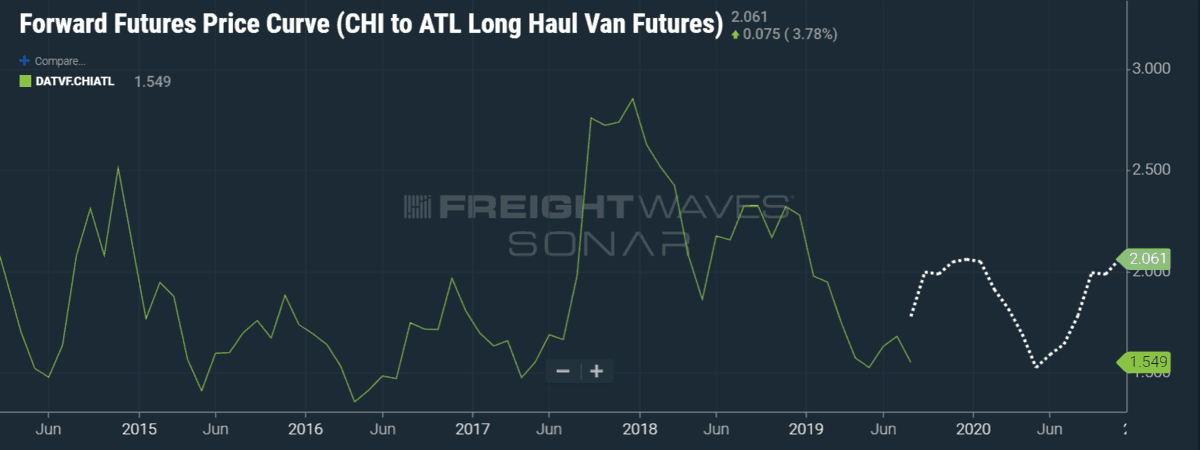
Current spot rates are at $1.55/mile, while futures contracts for the lane are being bid at $2.05/mile in November and $2.06/mile in December. Notably, intermodal rates for the same lane (INTRM.CHIATL) are well above current trucking spot rates at $1.86/mile.
Expect intermodal and trucking spot to converge over the next few months; spot prices have room to run up and intermodal should come down, depending on how much freight CSX and Norfolk Southern want to compete for.
Brokerage Compliance Symposium
The day before F3. Every compliance issue you face - fraud exposure, carrier liability, FMCSA rules, cargo theft, insurance gaps - navigated by attorneys and operators defining best practices in a changing industry.
F3 Awards Dinner
The night before F3. FreightTech100 companies honored. FreightTech 25 and Shipper of Choice winners revealed live. Cocktail reception into dinner and live music - 300 industry leaders in one purpose-built room.
F3: Future of Freight Festival
Industry-defining keynotes, rapid-fire technology demos, and industry leaders networking in experiences across Chattanooga - plus the inaugural F3 Awards Dinner featuring the FreightTech and Shipper of Choice reveals.
The day before F3. Every compliance issue you face - fraud exposure, carrier liability, FMCSA rules, cargo theft, insurance gaps - navigated by attorneys and operators defining best practices in a changing industry.
The Signal at Chattanooga Choo Choo • Chattanooga, TN Register NowThe night before F3. FreightTech100 companies honored. FreightTech 25 and Shipper of Choice winners revealed live. Cocktail reception into dinner and live music - 300 industry leaders in one purpose-built room.
The Signal at Chattanooga Choo Choo • Chattanooga, TN Register NowIndustry-defining keynotes, rapid-fire technology demos, and industry leaders networking in experiences across Chattanooga - plus the inaugural F3 Awards Dinner featuring the FreightTech and Shipper of Choice reveals.
The Signal at Chattanooga Choo Choo • Chattanooga, TN Register Now