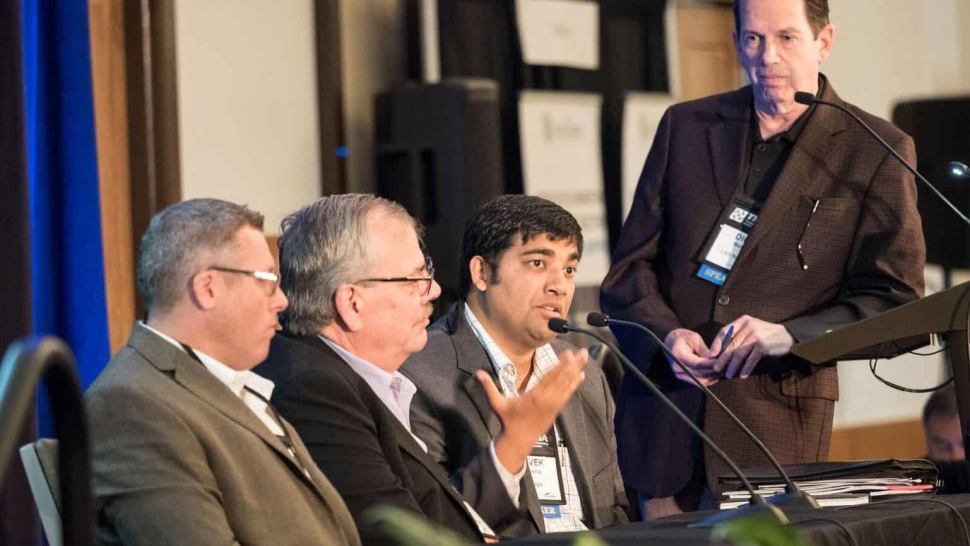
In a panel of shippers at the annual meeting of the Transportation Marketing & Sales Association, there was plenty of talk about what for a carrier to get int the front door of a potential customer.
But one old-fashioned way received some kudos: it’s good to know a guy.
Troy Turner, the logistics procurement manager at food processor Unilever, said the quickest way into the door is a recommendation from another shipper that Unilever has a relationship with. “Sometimes at events like this, you can get connected with somebody who says, ‘we work with this carrier, and you may want to take a look at it,'” Turner said. “It’s a vote of confidence and it helps a lot.”
Scott Grady, the president of Rush Trucking–a carrier, but part of a group of companies that features shippers also–said he receives 250 to 300 emails a day and among those are pitches from potential partners. Helping to sort that out can often be relationships already established through the company’s current customer list, Grady said.
But even though those endorsements were for far more traditional networking, the other recommended approaches heard on the panel also involved what might be considered the human touch.
“Instead of coming in with a 20 or 25 minute sales pitch, what we’re looking for is, are you used to doing the type of business that we have?” Grady said in discussing what he wants to hear from potential vendors. Grady said Rush wants to see the company’s capacity and data to back it up, laid out with supporting documentation. “The 20-minute sales pitch of ‘I want to come in and fix everything'” doesn’t work” as well as being able to answer those issues, Grady added.
Grady’s firm, Rush Trucking, is part of a group that is both shipper and carrier, so he’s seen the current transport market from both sides. The current market has resulted in some carriers who are “chasing the temporary spike in dollars and think about what it is doing to their overall market share.” But Grady said the company is more interested in a “long term partner strategy” with a company that “has got to be willing to work within that relationship, so the value goes in both directions.”
“There needs to be a value not just over the next 24 to 36 months but also to ensure that there is enough money in there to make sure the supplier is whole and profitable and has a low turnover rate,” Grady said. “We can not afford to have people who don’t understand requirements.”
He discussed one facility in his network where each of his docks has a turnover on average about every hour and 15 minutes. “We can’t have people now showing up,” he said. “It will stack things up. So all those things are considered. If you don’t have a partnership with your carrier you are going to end up failing and that is key on our side.”
The goal, of course, is to land the designation of “shipper of choice.” Panel moderator Dick Meltzer of delivery service LSO said that hot buzzword is sort of like sex in junior high school: “Everybody is talking about it but hardly anybody is doing it.”
Turner talked about one unidentified carrier that, as he said, “when I tender a load to them, I can go to bed at night.” “In the event there are challenges, they will let us know,” he said. “They will reach out to us. This supplier are also the ones that I can throw them a curve ball. If I find an unusual hazmat location where I need to take something from point A to point B, they can find it for us.”
The more niche player on the panel was Vivek Syania, Americas transportation logistics manager for Google. As he conceded, he often meets people who wonder why Google needs such a position. It is a niche need, he said, and it is focused primarily on the logistics of deploying equipment to Google’s many data centers.
But while that is different from the type of needs for the shipment of ice cream and frozen meals–two staples in the Unilever family of offerings–Syania said many of the needs in the “pitch” are the same. “I think there should be one whole session where you take the time out to understand what the network needs are before you give a big bang solution,” he said.
The unique niche that Google holds often results in potential vendors changing their approach, and it isn’t likely to work. Syania said many vendors assume that all a Google logistics manager like him want to hear is about technology. “They think we are going to be falling head over heels on every tech solution, and that is not the case,” he said. “Others are trying to figure out how tech augments their business, but we are grappling with scale,” likening the Google growth rates to those of a startup.
Syania said Google is focused on such issues as artificial intelligence. “We give a lot of thought to data analytics as much as we give to operations, and that is something people catch on to pretty late,” he said.
The discussion with Google is also likely to be focused on long-term capabilities as much as current needs, Syania added. Most potential vendors are challenged to look at what Syania described as “the bigger picture, which is three to five years out.” But Google will want to work with companies that can “sit down and look creatively…and talk about where your organization is going.”
On another issue, Turner said Unilever has attempted to contribute to issues surrounding hours of service by opening its doors to some of its facilities as parking spots. “We opened our doors and our asphalt and allowed drivers to park on our facility,” Turner said. “It was so well received that the drivers knew if they were o the Unilever route, they had a place to park. It is definitely being spoken in the hallways of Unilever, and now we are saying, how do we embrace technology so we can get them in and out faster?”
He also said Unilever is concerned about sustainability, and a potential vendor who can show that part of the supply chain is going to be on trucks fueled by CNG or LNG, or hauled intermodal, would be a plus in the company’s eyes.
Brokerage Compliance Symposium
The day before F3. Every compliance issue you face - fraud exposure, carrier liability, FMCSA rules, cargo theft, insurance gaps - navigated by attorneys and operators defining best practices in a changing industry.
F3 Awards Dinner
The night before F3. FreightTech100 companies honored. FreightTech 25 and Shipper of Choice winners revealed live. Cocktail reception into dinner and live music - 300 industry leaders in one purpose-built room.
F3: Future of Freight Festival
Industry-defining keynotes, rapid-fire technology demos, and industry leaders networking in experiences across Chattanooga - plus the inaugural F3 Awards Dinner featuring the FreightTech and Shipper of Choice reveals.
The day before F3. Every compliance issue you face - fraud exposure, carrier liability, FMCSA rules, cargo theft, insurance gaps - navigated by attorneys and operators defining best practices in a changing industry.
The Signal at Chattanooga Choo Choo • Chattanooga, TN Register NowThe night before F3. FreightTech100 companies honored. FreightTech 25 and Shipper of Choice winners revealed live. Cocktail reception into dinner and live music - 300 industry leaders in one purpose-built room.
The Signal at Chattanooga Choo Choo • Chattanooga, TN Register NowIndustry-defining keynotes, rapid-fire technology demos, and industry leaders networking in experiences across Chattanooga - plus the inaugural F3 Awards Dinner featuring the FreightTech and Shipper of Choice reveals.
The Signal at Chattanooga Choo Choo • Chattanooga, TN Register Now