








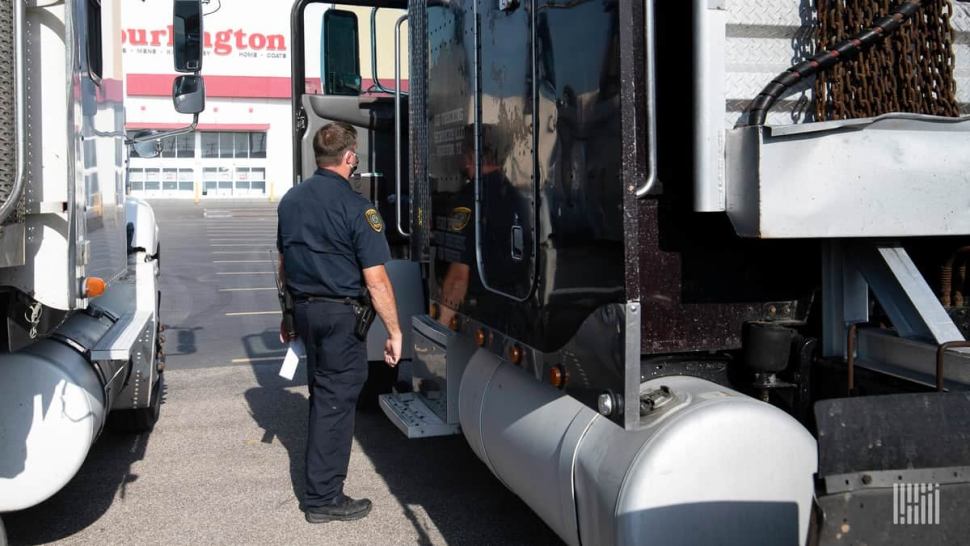

Jennifer pulled her 53-foot rig into the highway weigh station for what she assumed was the standard enforcement stop. While she had only been driving on her own for about six months, Jennifer had gone through a number of these routine checks.
This one was different. The enforcement officer asked to see her ELD data. Jennifer was prepared: She had been trained by her fleet on how to handle the situation and provided the officer all the necessary information. Hoping the stop would go smoothly, Jennifer expected to get back on her way quickly to make her last delivery that week before a few days at home with her family.
The stop lasted more than a few minutes as the officer questioned Jennifer on why she had been driving for 8 hours, 25 minutes without stop. Jennifer stumbled for her answer, which ultimately centered on a combination of road construction and congestion due to rush-hour traffic traveling through Atlanta.
The officer was unimpressed and slapped Jennifer with an hours-of-service (HOS) violation for driving more than eight hours straight without a required 30 minutes away from the wheel. Jennifer and her company would take a hit to their safety records, both get Compliance, Safety, Accountability (CSA) points and, if audited, could face HOS fines ranging into the thousands of dollars.
Why did this happen?
The assumption could be that Jennifer is a bad driver who ignores safety regulations, or perhaps she wasn’t properly trained on HOS rules. That may not be the case. A deeper understanding of what caused Jennifer’s situation is needed. Like many of the top CSA BASIC violations, Jennifer’s HOS violation could have been avoided if her carrier understood the root cause.

As Jennifer’s employer looked deeper into her records, it realized that Jennifer had regularly been exceeding HOS driving limits by not taking the required 30-minute break. To find the answer, the carrier turned to the Safety Management Cycle (SMC) and J. J. Keller & Associates’ “5 Why’s” approach.
The SMC is a model that assesses a company’s risk profile. It includes policies and procedures, roles and responsibilities, qualifications and hiring, training and communication, monitoring and tracking, and meaningful action. Combined with the 5 Why’s, the SMC helped the carrier get to the root cause of Jennifer’s driving-break violations.
“A motor carrier needs to identify the variables that it has control over that contributed to a recurring safety violation. Without this knowledge, the violation is likely to happen again,” explained J. J. Keller’s Transport Safety Editor Kathy Close. “Often root-cause analysis leads to an ‘a-ha’ moment for motor carriers and provides a remedy to ongoing violations that is simpler than they first thought.”
Close said a carrier that implements root-cause analysis with the 5 Why’s model and compares to the SMC will ultimately get to the origin of the problem. It could be any of the six spokes in the SMC, but finding cause allows the carrier to fix the underlying problem, leading to less operational risk and better compliance with safety regulations.
Root-cause analysis also identifies inefficient operations. J. J. Keller offers a “5 Why’s Model for Determining Root Cause” worksheet to provide guidance to carriers.
Starting with the first of the five, the carrier’s safety director began to identify why Jennifer was continually violating HOS rules.
- Why did this event take place? In this particular instance, Jennifer exceeded the allowable driving time limit of eight hours.
- Why did she operate beyond the allowable eight-hour drive time? Jennifer stated that she was running behind due to construction-related traffic congestion in the Atlanta area during her seventh hour of driving.
- Why didn’t she stop before the road construction? Jennifer stated that she was unaware there was construction in the area.
- Why was she not aware of the road construction? Jennifer said she didn’t think about checking state transportation websites along her route for possible construction or other potential delays.
- Why didn’t she look at all the variables when looking at her dispatch route? Jennifer said that while she had been driving for six months, she didn’t remember receiving training on route planning and how to identify potential delays.
A motor carrier needs to identify the variables that it has control over that contributed to a recurring safety violation. Without this knowledge, the violation is likely to happen again Often root-cause analysis leads to an ‘a-ha’ moment for motor carriers and provides a remedy to ongoing violations that is simpler than they first thought.
Kathy Close, transport safety editor, J. J. Keller & Associates
In Jennifer’s case, answering the 5 Why’s not only helped the safety director provide proper training to her so she could avoid future HOS violations due to this lack of knowledge; but it led the carrier to discover a gap in its new-hire driver training program. The result is that new-hire training was revised to include instruction on proper trip planning, and training exercises were added to ensure new drivers learned how to use atlases, state websites and other tools to identify potential issues along dispatched routes.
“Monitoring and tracking is a key component of the safety management cycle,” Close said. “If these mechanisms are not in place, fleet professionals can’t know if changes within their safety program are effective and reducing violations.”
Close advised that carriers assign personnel to handle frequent errors identified in a root-cause analysis. In this case, in addition to the carrier adding new educational content to the training program, it assigned personnel to review route plans for dispatch, including potential fuel and break locations over a two-week period to ensure dispatch was providing reasonable routes. This included monitoring of both new and existing drivers who were unable to meet on-time delivery standards or saw consistent patterns of HOS violations to ensure the violations were not due to trip planning.
Additional policies were put into effect to ensure drivers and dispatch communicated about delays in an efficient and productive manner, and dispatchers were put through hours-of-service training so they better understood the statutory limitations drivers face on the road.
Root-cause analysis is not only a tool for hours-of-service violations, but can be used to assess any safety or regulatory issues in a carrier’s operation.
“Consistent and frequent roadside inspection violations are a symptom that a motor carrier’s safety program isn’t functioning properly,” Close said. “The safety management cycle, along with the root-cause analysis, provides a model to diagnose and treat the source of the problem.”
Click for more articles by Brian Straight.
You may also like:
Entry-level driver training rule changes game for behind-the-wheel safety
The 5 stages of successful driver coaching
Electronic recordkeeping: Are you falling behind?
Clearinghouse reporting reveals deficiencies in carrier drug and alcohol programs
Brokerage Compliance Symposium
The day before F3. Every compliance issue you face - fraud exposure, carrier liability, FMCSA rules, cargo theft, insurance gaps - navigated by attorneys and operators defining best practices in a changing industry.
F3 Awards Dinner
The night before F3. FreightTech100 companies honored. FreightTech 25 and Shipper of Choice winners revealed live. Cocktail reception into dinner and live music - 300 industry leaders in one purpose-built room.
F3: Future of Freight Festival
Industry-defining keynotes, rapid-fire technology demos, and industry leaders networking in experiences across Chattanooga - plus the inaugural F3 Awards Dinner featuring the FreightTech and Shipper of Choice reveals.
The day before F3. Every compliance issue you face - fraud exposure, carrier liability, FMCSA rules, cargo theft, insurance gaps - navigated by attorneys and operators defining best practices in a changing industry.
The Signal at Chattanooga Choo Choo • Chattanooga, TN Register NowThe night before F3. FreightTech100 companies honored. FreightTech 25 and Shipper of Choice winners revealed live. Cocktail reception into dinner and live music - 300 industry leaders in one purpose-built room.
The Signal at Chattanooga Choo Choo • Chattanooga, TN Register NowIndustry-defining keynotes, rapid-fire technology demos, and industry leaders networking in experiences across Chattanooga - plus the inaugural F3 Awards Dinner featuring the FreightTech and Shipper of Choice reveals.
The Signal at Chattanooga Choo Choo • Chattanooga, TN Register Now