








Greg Miller
Monday, October 7, 2019
Supertanker rates stratospheric as market ‘goes bonkers’
VLCC rates are now at or near $100,000 per day, courtesy of U.S. sanctions targeting China’s COSCO.
VLCC rates are now at or near $100,000 per day, courtesy of U.S. sanctions targeting China’s COSCO.

The transfer of production out of China to avoid U.S. tariffs of up to 25% is having a tangible impact on global trade flows.

U.S. sanctions targeting a subsidiary of China’s COSCO Shipping could have far-reaching consequences.

Flexport’s head of airfreight believes a small bump in demand out of Asia could result from new U.S. tariffs, while higher fuel prices will push up air cargo costs.

Borderlands is a weekly rundown of developments in the world of United States-Mexico cross-border trucking and trade. This week: San Antonio secures $1.2B deal with manufacturers; United States ends Mexican tomato investigation; Otay Mesa adds industrial park along US-Mexico border; CBP seizes $1M worth of drugs at the Pharr International Bridge. Proximity to Mexico helps San […]
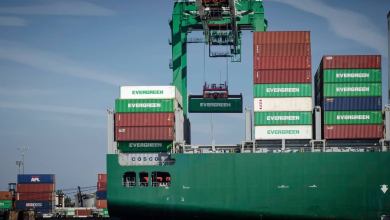
BIMCO says there are “several indications” that goods are being shipped from the Far East to Europe and then transshipped to the U.S. East Coast to avoid tariffs.
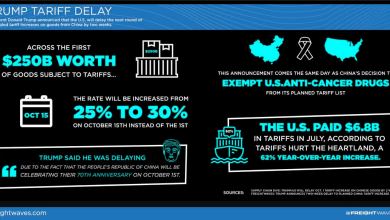
President Trump announced that the U.S. will delay the next round of scheduled tariff increases.

The announcement comes after Beijing announced its first round of tariff exemptions for U.S. goods earlier in the day.

Come on ride the ragin’ rollercoaster! First, Target tells suppliers to eat higher tariff-related costs, and Zach Strickland tells us why this has been one of the toughest freight cycles on record, and more.

The U.S. Department of Commerce recently issued 31% tariffs on structural steel imports from Mexico and 141% tariffs on steel from China. U.S. officials made a determination that producers in both Mexico and China had dumped fabricated structural steel on the U.S. market at prices below fair market value, hurting the U.S. steel industry. “The […]

How tariffs played a role in Amazon deforestation.

How Flexport is managing the challenges of todays air cargo environment
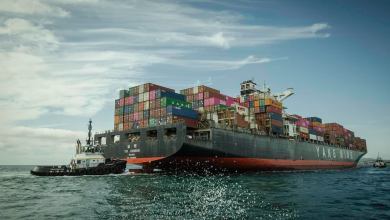
The trade war with China has altered international shipping patterns, which has started to shift freight volumes to the East Coast.

Asia-U.S. container rates are still not showing peak-season strength, but optimism remains.

Can listed shipping shares break out of their slump before the U.S.-China trade dispute is resolved?

North Asia revenues were down 8.5 percent, but EXPD improved productivity.

ISM data in both the service sector and manufacturing sector suggest the economy is slowing and recent tariffs could make things worse
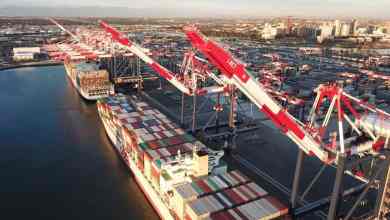
Drewry says it expects a brief spike in transpacific freight rates to the U.S. West Coast following President Trumps threat to impose a new round of tariffs on imports from China.
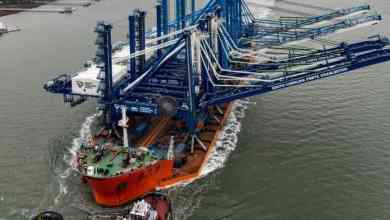
Ports are asking that Chinese-made container cranes be excluded from the list of products on which President Trump has threatened a 10 tariff.

Warehousing markets have just recovered from the last round of tariffs and there is not a lot of slack.

On this historic WTT, Chad returns and joins Dooner on this odyssey of freight. We have breaking news about Trump’s new tariffs against China. Plus, K Ratio joins us to talk freight futures, JP returns to defend his earnings over/under title, and we celebrate our first-ever live stream on LinkedIn! Bang your little cowbell for […]
The new tariffs, announced a day after the Fed cut rates, will affect mostly consumer goods.

Flexport’s customers have seen average landed unit costs rise by 30 percent due to tariffs.

It may have gotten lost in the United States’ trade war with China and immigration battle with Mexico, but President Donald Trump’s steep tariffs on all imported steel and aluminum were lifted on May 17. With the change in the Trump Administration’s policy, Canada and Mexico received a reprieve on steel and aluminum coming from […]

On WTT’s July Fourth spectacular, we are covering all the latest headlines and focusing on the shadow world of fireworks with market expert Henry Byers. Ashutosh Prasad of Koi Reader spends 5 Good Minutes with us, Emily hosts another round of Big Deal Little Deal, and our readers sound off about 65 mph speed caps […]

Dry bulk shipping could be a winner following the ceasefire in the trade war between the U.S. and China.

No single country can absorb the trade flow from China to the U.S., and likely contenders are already growing faster than capacity.

The Trump administration is considering levying tariffs on the remaining $300 billion of Chinese exports to the United States so far unaffected by duties. Freight Intel, FreightWaves’ proprietary research group, has just published a study warning that such a move would disrupt trade flows far beyond what has occurred so far. Freight Intel Group research […]

President suggests he’s willing to impose levies on Canada and Mexico during appearance with Prime Minister Justin Trudeau.

Donald Broughton explains the harm that tariffs can do to the economies of the United States, the country(ies) that tariffs are imposed on and the global economy.

President Donald Trump said he has called off plans to impose tariffs on Mexico, tweeting on Friday night that the Mexican government has “agreed” to stem the flow of Central and South American migrants into the United States. Mexico “has agreed to strong measures to stem the tide of Migration through Mexico, and to our […]

Today on FreightWaves NOW, we bring you the economic data that supports a broad slowdown. We examine the Laredo markets and analyze whether or not carriers really are pulling freight forward ahead the promised tariffs. Also, we’re on the move with (Phil) Moody with the latest on the FreightWaves LIVE event.

Market expert Donald Broughton writes about the numerous consequences of a U.S. Mexico trade war and the damage that will be done on both sides of the border.

Plus: Gold miner hatches plan to avoid tariffs

For the first time in its 168-year history, Port Laredo is No. 1. Laredo surpassed Los Angeles as the nation’s busiest trade hub, including airports, seaports and international border crossings. Port Laredo did $20.09 billion in trade during the month of March (according to the latest Census Bureau numbers available and analyzed by WorldCity), while […]

Brian Mulroney, an architect of NAFTA’s precursor, says the trade deal will withstand Trump’s latest tariffs.

Market expert Henry Byers examines the U.S.-Chinese trade war and its impact on imports and the broader economy.

Market expert writes about how current trade issues between the U.S. and China, the U.S. and Mexico and the U.S. and the EU may disrupt supply chains and cause economic problems.

Flexport hired a former White House trade and economic advisor in a bid to harness research from the digital first forwarder’s datasets and to help customers navigate the shifting sands of trade. The San Francisco-based company named Dr. Phil Levy as its first Chief Economist. Dr. Levy, who earned a Ph.D. in economics from Stanford […]

President Trump’s recent announcement of tariffs on Mexico marks a sharp departure from previous moves with potentially disastrous results for U.S. businesses and supply chains

As U.S.-China trade tensions escalate, data appears to be pointing to a volume slowdown.
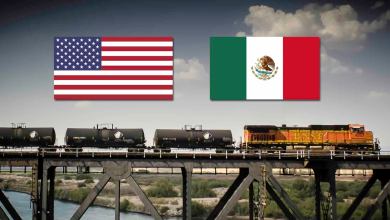
e railroad industry is “concerned” about a possible disruption of the North American supply chain should the U.S. impose tariffs on imports from Mexico. But for now, the rail industry is taking a wait-and-see stance.

Today on FreightWaves NOW, we discuss the promise of the Mexico tariffs from a volume, rate, and oil perspective.

While the degradation was seen across most sectors, the transports are seeing outsized declines.

The supply chain has become a pawn in the battle over immigration, and freight businesses are the ones who will be hurt.

Tariffs starting June 10 at 5 percent to escalate to 25 percent by October 1.

If a trade war pares GDP growth, OPEC cuts may be extended, weighing tanker rates.

Manufacturers’ new orders for durable goods declined in April, and details suggest more trouble ahead for freight demand in the economy

Improved vessel utilisation is the key to maintaining profitability in what is expected to be a challenging market according to Soren Skou, Chief Executive Officer of Maersk (Nasdaq OMX: MAER). The company has maintained a tight rein on capital expenditure over the past year with no large terminal projects or costly new ships ordered and […]

FreightWaves CEO Craig Fuller says he hopes he is wrong, but data is showing the freight market is heading into a recession. Who will feel the impact and the facts and figures surrounding Fuller’s prediction.

Volumes took a nosedive after the tariffs increased and are starting to recover slightly, but the damage may already be done.

Today on FreightWaves Now, we are seeing crazy times with volatility. It’s still snowing in the Sierras and storming in the midwest. Volumes have fallen off a cliff right when we should expect them to climb, and is any activity happening with freight pulling forward ahead of the tariffs?

The trade war between China and the U.S. is having a noticeable impact on freight markets. Shippers and carriers are struggling to adapt.

Today on FreightWaves Now, we have snow in the Sierras and trouble in the midwest. Ports on both coasts prepare for another pull forward ahead of tariffs as the trade war rhetoric escalates.

Beijing has sworn to institute countermeasures to combat a huge increase in tariffs, from 15 percent to 25 percent, that have been imposed by Washington on $200 billion worth of a wide range of Chinese goods. A set of high-level, last-minute, talks yesterday to postpone or prevent the tariffs failed.

U.S.-China trade tariffs war is heating up; Asian oil importers have not stopped importing oil from Iran; Uber has a staunch rival in Ola across the Indian market.

White House makes sudden u-turn on tariff truce, upsetting calm in financial markets. President Donald Trump ended the spring truce in the U.S.-China trade war this weekend, with threat to go forward with higher tariffs on $200 billion of Chinese imports. He also upped the ante with a promise to add tariffs on another $325 […]
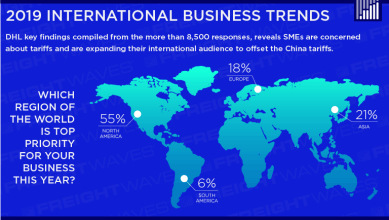
The following findings were compiled by DHL from more than 8,500 responses.
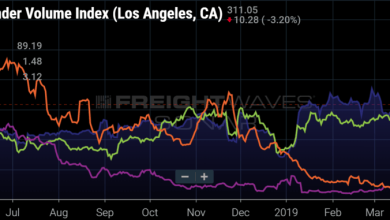
The inbound container flows had a big impact to freight volumes in the port cities of Savannah and Los Angeles this past year.

The U.S. is proposing $11 billion in tariffs on European Union goods because of allegations that Airbus received that amount of subsidies when it launched the Airbus 380, thereby harming U.S. interests. Read Jesse Cohen’s explanation of the articles proposed for tariffs and what the tariffs might do to the air cargo and maritime industries.

Talks between the U.S. and China have made significant progress over the last several weeks, and the two sides appear to be closer to a deal than at any time over the past several months. However, while the restoration of positive trade relations will help the trade outlook, other factors are likely to keep trade growth subdued going forward.
Political tensions in the Washington-Beijing bilateral relationship are making the China-based U.S. business community uneasy. Tariffs are being blamed for driving business confidence down, decreasing investment and for re-routing Asia-Pacific supply chains.
The U.S. trade deficit in goods widened to a record in December 2018 as a sizeable decline in goods exports was paired with a jump in goods imports. This reversed the decline in the deficit from the previous month, and the drop in goods exports sent yearly growth into negative territory for the first time in over two years.

Stifel’s head of equity strategy thinks the stock market will be weak for the next decade and that the federal government will default on debt unless it can force access into Chinese markets.

Marten Transport and other public truckload companies could make a good stock investment if historical trends hold, says an analyst from Stephens.

Foxconn Technology Group (OTC US: FXCNY) created more uncertainty for its suppliers on Friday when it announced that it’s recommitting to building a liquid crystal display monitor (LCD) factory in Mount Pleasant, Wisconsin according to the Wall Street Journal.

Missing USDA data on wheat stockpiles has traders reacting cautiously.

In partnership with Slync… There are numerous reasons to be worried about the health of global trade and the goods economy, even though, in our view, a full-on macro-economic recession in the United States is still unlikely.

U.S. Chamber of Commerce president Tom Donohue threw down $25,000 for ideas on how to pay for infrastructure. And told Washington to open back up.

The U.S. – China trade war continues to disrupt freight movements into the new year.

The third week of the partial Federal government shutdown is impacting U.S. agriculture. Without full funding, the U.S. Department of Agriculture (USDA) is not providing some real-time information, full financial support, or some critical services for farmers and ranchers.

China announced wide-sweeping changes to its import and export tariffs over the Christmas break; Australia-based expert China-watchers are divided as to Beijing’s motivations and what it might mean for Australia. Photo: Shutterstock.

U.S. equity futures tumbled and stocks slumped across Europe and Asia after evidence of slowing Chinese growth dashed investor hopes for an upbeat start to 2019.

EU guns towards a new regulation that forces fleets to provide minimum wages to drivers; OPEC meets today over oil price turmoil and production ceiling; China agrees to resume U.S. soybean and LNG imports.

As far as investors are concerned, the trade war is effectively back on.

It seemed like the stuff of posturing and hot air. It was hard to see anything substantive changing from the weekend meetings of the G20 nations in Argentina. Will something more than kicking-the-can come from the concessions?

Executives from MoLo, Steam, and Arrive gave insight into the complexity of West Coast freight market volatility, which goes beyond tariffs, and talked about how brokerages and shippers are responding.

In a normal year, the Port of Oakland stands out from other U.S. ports for exporting more than it imports. Not this year.

EPA is looking to update pollution regulations for commercial trucks after 20 years; oil prices fall to one-year lows; U.S. import levels have declined slightly across all major retail container ports.

The U.S.-China trade war has brought misery to the thriving U.S. lobster industry, which is now feeling the heat of an additional 25% tariff that Beijing slapped on its live and processed lobster exports to China.

More of the same. That was the consensus in a quick informal poll of listeners to FTR’s State of Freight webinar on Thursday when they were asked what the most likely outcome was for the U.S. economy in 2019.

While most of the new trade deal with Mexico and Canada is an update to NAFTA, there is a paragraph inserted into the agreement that could disrupt cross-border trade via truck.

Head of FMCSA and largest U.S. truck trade group say California attempting to preempt federal regulations.

Capacity constraints, strong demand, and chaotic tariff-related traffic pushed transpacific containers rates to new heights, but the current inbound container surge, unrelated to consumer demand, will create a steeper drop off in Q1 2019.

Trump government looks to phase out IMO2020 sulfur cap regulations; Shanghai Composite Index crashes by 3%; Amazon revisting cities for finalizing HQ2.

Despite an exceptionally strong year for trailer orders, Wabash National’s stock took a hit when the company guided downward for its Q3 results, blaming higher input costs and labor issues.

Concerns over a global trade war have eased this morning, as Canada agreed late Sunday to join a trade deal between the US and Mexico. The deal makes modest revisions to the previous North American Free Trade Agreement (NAFTA), and clears up some of the uncertainty surrounding the trade environment.

The US trade deficit in goods widened for the third consecutive month in August as another decline exports was paired with a modest increase in imports. The total value of traded volume fell for the month, but remains generally strong relative to last year.

$200B of tariffs imposed on Chinese imports today; the 4PL era is here; China cancels further trade talks; Germany’s maritime fleet shrinks by 1/3; air cargo not yet feeling tariff pain; oil rallies.

Utility solar projects see growth as prices of imported Chinese solar panels fall despite Trump tariffs; no-deal Brexit could see higher mortgage rates even if housing prices tumble; Chinese car market is weakening and it is troubling major-OEMs.

The ports of LA and Long Beach witness a fall in imports due to upcoming tariffs; Hurricane Florence is now a Cat 2 storm; California passes bill that would make its electricity carbon-free by 2045.

Tariffs Hurt the Heartland sends a letter to Congress today, F1 inspires air taxi development, and more in Today’s Pickup.

Survey data from the manufacturing sector improved significantly in August, in a sign that activity continues at a strong pace after robust growth in the 2nd quarter.

Maersk foresees a $2 billion increase in fuel costs due to sulfur-emissions cap; U.S. consumers might witness increase in car prices after U.S.-Mexico deal; Indonesia is seeing a tremendous growth in ecommerce; German car manufacturers are facing a battery production crisis.

Transpacific container rates post gains; United States and Mexico try to reach an agreement on the automotive trade; what Amazon did last week; Lloyd’s of London rethinks marine insurance; Mexico City’s new airport has uncertain future; tanker market faces added pressure from US-China spat.

Uber Freight is gobbling up $500M per year; the US and China hit each other with a new round of tariffs; Georgia Ports extends its inland intermodal network; Saudi Arabia’s Aramco IPO indefinitely delayed; cannabis supply chains mature; Houston is now an oil exporter.

The trade tariffs spat between the U.S. and the rest of the world is having consequences at home, as importers and consumers have to contend with the rise in product prices in the country.
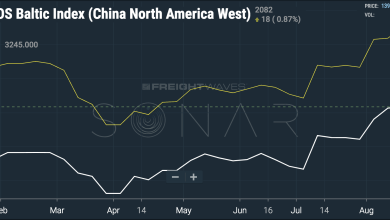
Transpacific container rates continue to gain momentum; UPS files blockchain patent applications; Uber is uncertain about self-driving cars; Elon Musk doubles-down on ‘no sleep’; cautious optimism for US-China trade talks lifts equities markets; container lines expect profits in the back half of 2018.

Springfield, Illinois hits Walmart with a $50k fine for allowing truck parking. Safeway delivery drivers make history with a newly ratified union contract. We interview Senator Bob Corker about Trump’s tariffs. 162 transportation and logistics companies make the 2018 Inc. 5000 list. JP and Chad discuss all this and more on this week’s episode.