




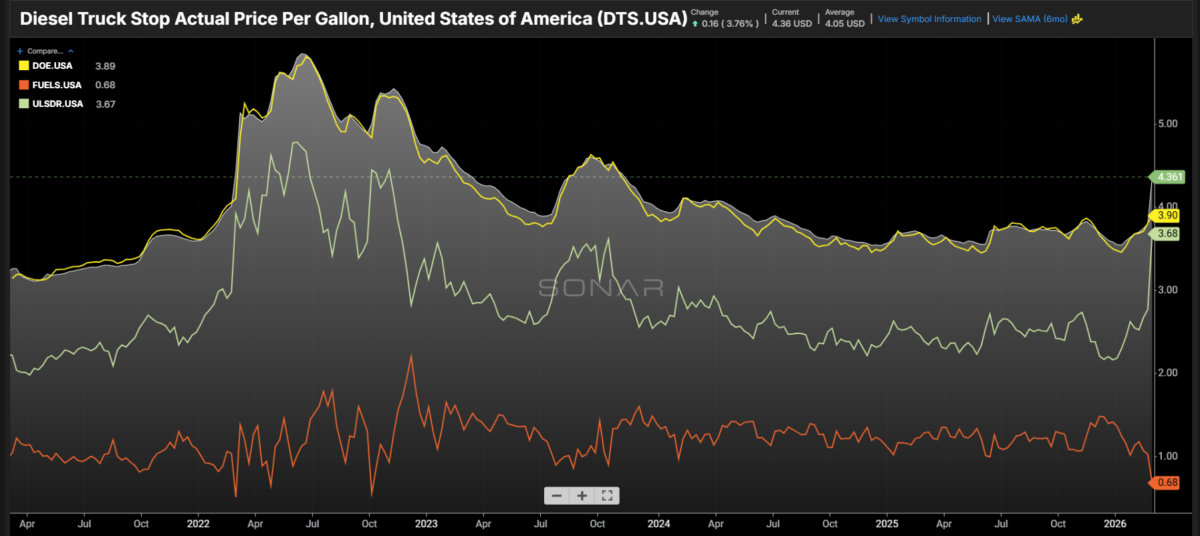
Chart of the Week: Diesel Truck Stop Price per Gallon, Dept of Energy average weekly price of diesel, Utlra-low Sulpur Diesel Rack Price, Retail to Wholesale Fuel Spread – USA SONAR: DTS.USA, DOE.USA, ULSDR.USA, FUELS.USA
Wholesale diesel prices (ULSDR, light green) jumped more than 30% last week, while retail prices (DTS daily in white and DOE weekly in yellow) increased by more than 14%. The velocity of these price changes may be more impactful than the absolute cost, which as of Friday remained below historical highs. While shippers will undoubtedly feel the pain of rising transportation costs, carriers will also face pressure from the underlying wholesale, or rack, price increases.
Fuel typically accounts for roughly 20–25% of the total cost of truckload transportation, though this share can fluctuate depending on how expensive or cheap fuel becomes. From a shipper’s perspective, rapid increases in fuel prices can wreak havoc on budgets. For carriers, fuel is a critical component of operating expenses that must be actively managed.
The latest disruption in the oil market is the most significant since Russia’s invasion of Ukraine in early 2022. It is also the first large-scale disruption since OPEC voluntarily constrained supply in the summer of 2023. That event proved relatively short-lived, as prices moderated later that fall.
For most trucking carriers, fuel is largely a pass-through cost, typically recovered through a fuel surcharge tied to the weekly average diesel price published each Monday by the DOE. Most fuel surcharge tables assume a fuel efficiency of roughly 6.5 to 7 miles per gallon. There is also usually a fixed amount of fuel embedded in the base transportation rate, which generally covers the cost of fuel up to about $1.00 to $1.50 per gallon. As a result, most surcharge tables begin around this level and increase incrementally as diesel prices rise.
Many large fleets have purchasing agreements with fuel suppliers that allow them to buy fuel in bulk at or slightly above the wholesale price. While this may appear to be an arbitrage opportunity on the surface, many carriers use this spread to offer more competitive pricing when the market is balanced and capacity is relatively loose—as has largely been the case over the past three years.
When wholesale prices rise faster than the average retail price, it compresses the buffer created by the spread between retail and wholesale diesel—labeled FUELS in orange on the chart. The smaller this spread becomes, the less flexibility carriers have to pass fuel costs through effectively. When prices ease, the opposite occurs. Recently, this spread has shrunk from around $1.02 to $0.68 per gallon.
The speed of the change is particularly important, as pricing teams typically adjust rates based on historical data. Many contract rates were likely structured assuming a spread closer to $1.20 per gallon. This means that although rates are increasing through the fuel surcharge mechanism, they may not be improving profitability and could actually be reducing it.
Spot rates tell a different story. Many smaller fleets and owner-operators do not have the volume needed to secure fuel purchasing agreements. Their costs are tied more closely to retail fuel prices, which are passed through to customers more directly and often more quickly.
.
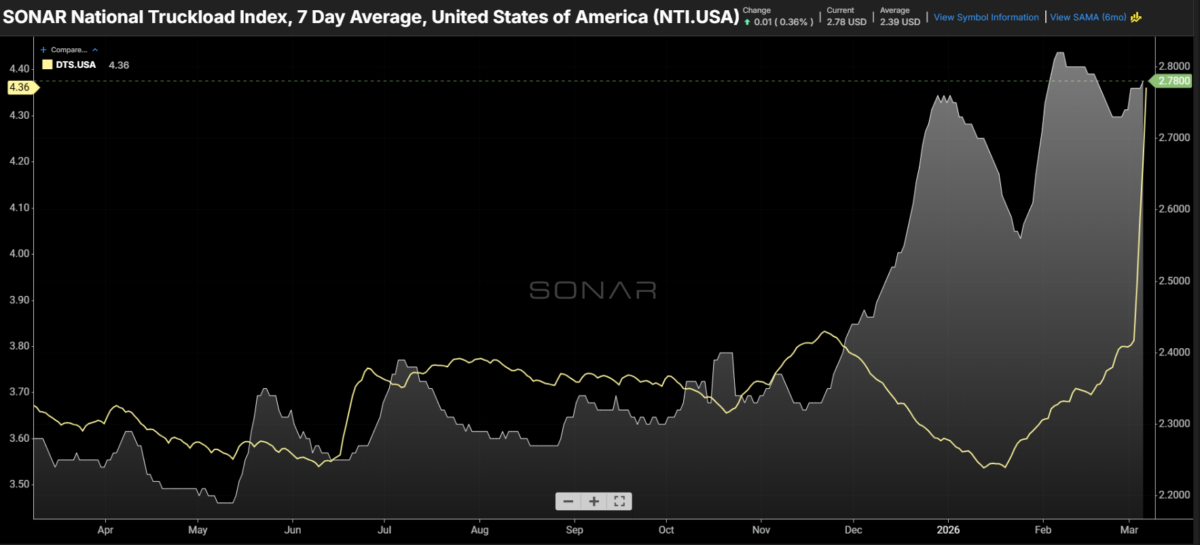
Meanwhile, the trucking market appears to be transitioning toward a tighter environment following a strong holiday season and the disruption caused by Winter Storm Fern. Spot rates (NTI) have been reluctant to decline after the late-January storm crippled transportation networks. Although it is difficult to isolate the direct effect of fuel prices from underlying market dynamics, rising fuel costs appear to have contributed to the recent increase in spot rates. As carriers continue to refuel at higher prices, these pressures could persist.
The trucking industry is no stranger to fuel price volatility, but the timing and magnitude of the current increase present potential challenges for both shippers and carriers. For shippers, the concern is straightforward: higher transportation costs. For carriers, the impact is more nuanced, as margin pressure and operational costs must be balanced against changing market rates.
There are also broader economic considerations. Rising energy costs can eventually inhibit demand if they increase too sharply. Some level of higher fuel prices can support domestic economic activity, as the U.S. is one of the world’s largest oil producers. However, if prices rise too quickly, the resulting inflation and volatility can erode demand in other areas of the economy. As of last week, conditions have not reached that level, but many economists believe the duration of the conflict will be the key factor determining how disruptive this latest geopolitical shock ultimately becomes for supply chains and the broader economy.
About the Chart of the Week
The FreightWaves Chart of the Week is a chart selection from SONAR that provides an interesting data point to describe the state of the freight markets. A chart is chosen from thousands of potential charts on SONAR to help participants visualize the freight market in real time. Each week a Market Expert will post a chart, along with commentary, live on the front page. After that, the Chart of the Week will be archived on FreightWaves.com for future reference.
SONAR aggregates data from hundreds of sources, presenting the data in charts and maps and providing commentary on what freight market experts want to know about the industry in real time.
Brokerage Compliance Symposium
The day before F3. Every compliance issue you face - fraud exposure, carrier liability, FMCSA rules, cargo theft, insurance gaps - navigated by attorneys and operators defining best practices in a changing industry.
F3 Awards Dinner
The night before F3. FreightTech100 companies honored. FreightTech 25 and Shipper of Choice winners revealed live. Cocktail reception into dinner and live music - 300 industry leaders in one purpose-built room.
F3: Future of Freight Festival
Industry-defining keynotes, rapid-fire technology demos, and industry leaders networking in experiences across Chattanooga - plus the inaugural F3 Awards Dinner featuring the FreightTech and Shipper of Choice reveals.
The day before F3. Every compliance issue you face - fraud exposure, carrier liability, FMCSA rules, cargo theft, insurance gaps - navigated by attorneys and operators defining best practices in a changing industry.
The Signal at Chattanooga Choo Choo • Chattanooga, TN Register NowThe night before F3. FreightTech100 companies honored. FreightTech 25 and Shipper of Choice winners revealed live. Cocktail reception into dinner and live music - 300 industry leaders in one purpose-built room.
The Signal at Chattanooga Choo Choo • Chattanooga, TN Register NowIndustry-defining keynotes, rapid-fire technology demos, and industry leaders networking in experiences across Chattanooga - plus the inaugural F3 Awards Dinner featuring the FreightTech and Shipper of Choice reveals.
The Signal at Chattanooga Choo Choo • Chattanooga, TN Register Now