



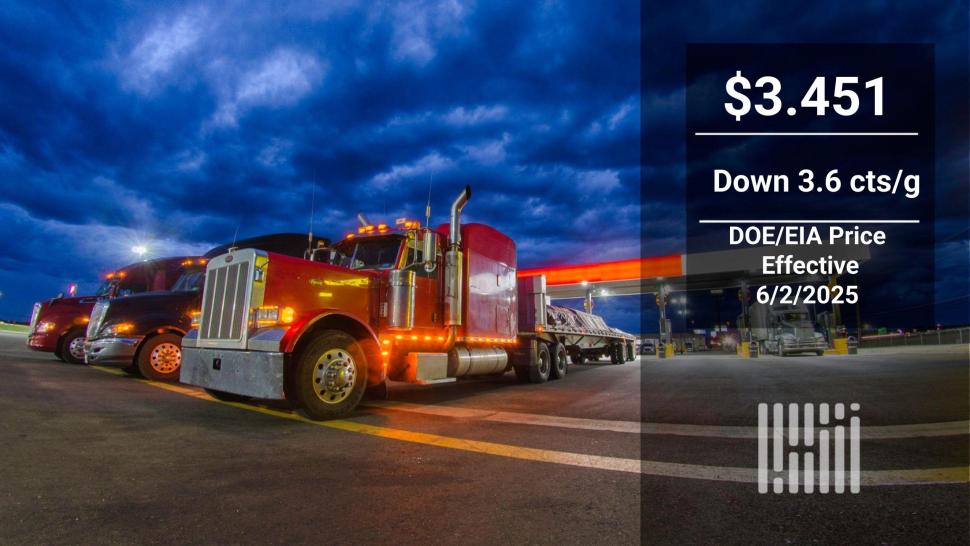
The benchmark diesel price used to set most fuel surcharges fell Monday to its lowest level since September 2021.
The latest average weekly retail diesel price published by the Department of Energy/Energy Information Administration is $3.451 a gallon. It was down 3.6 cents per gallon from the prior week and has now declined seven of the past eight weeks.
On Sept. 20, 2021, the price posted was $3.406 a gallon. Every price since then has been higher than what was posted this week. The next lowest came late last year, when a price of $3.458 a gallon was posted Dec. 9.
Those declines, offset in part by a 6-cent gain from two weeks ago, have taken the DOE/EIA price down 18.8 cents a gallon since the decline started after an April 7 posting of $3.639.
The latest reduction in price comes against a backdrop of futures trading on the CME commodity exchange in ultra low sulfur diesel (ULSD) that has been mostly on a downward trend for almost three weeks, though the first two days of trading this week were significantly higher but would not be showing up yet in retail prices.
From a recent May 14 high settlement of ULSD at $2.2061 a gallon, two steps backward and one step forward brought ULSD down to a settlement of $2.0172 on Friday.
Reacting to OPEC+ meeting
Futures prices moved up Monday despite the weekend news that the OPEC+ group would increase output in July by an additional 411,000 barrels a day, another in a series of increases of that magnitude that have been going on for several months. At this rate, the 2.2 million-barrel-per-day output cut OPEC+ has had in place going back in pieces to 2023 will have been completely unwound by the fall.
ULSD settled at $2.0445 on Monday, a gain of 2.73 cents per gallon despite the increase, which had been expected. Prices Tuesday rose again, settling up 5.54 cents to $2.0999 a gallon.
Long-term slide in demand
Despite the increases in the past two days, the larger picture for U.S. diesel is that the market is being weighed down relative to the crude market by demand that is not just weak in the short term, but is continuing a now-multiyear decline.
The decline in diesel consumption compared to the past 10 years of data for the corresponding time at the end of May is stark.
Consumption of nonjet fuel distillates, a category that is almost 90% ULSD, was 3.65 million barrels a day in the week ended May 23, according to the latest weekly report of the EIA. It’s the third consecutive year that the demand figure for the last week of May was less than in the prior year.
Whether it is because of upticks in intermodal service, better diesel engine efficiency, conversion of heating oil usage to natural gas (because heating oil is in that number) or a series of relatively warm winters in the U.S. Northeast where heating oil is the fuel of choice, the demand figure stands in stark contrast to the 10-year average for May’s final weekly EIA report of 3.92 million barrels a day. Between 2015 and 2018, weekly U.S. nonjet distillate demand regularly topped 4 million barrels per day.
The weakness has pushed the spread between ULSD and world crude benchmark Brent to about 50 cents per gallon in recent days. Outside of a few days in March, that spread has regularly been well above 50 cents this year and was more than 60 cents at the start of 2025. (However, numbers in the 40s were regular occurrences last year.)
The weakening spread means diesel has been on a steeper decline in recent weeks that has not been seen in crude markets. Since that recent May 14 high, Brent was down 2.2% through the Monday settlement, but ULSD is down 7.3%.
That stability in crude was noted Monday in an interview on CNBC with Helima Croft, the managing director and global head of commodity strategy at RBC Capital Markets.
Referring to statements from OPEC that demand for oil remains healthy, Croft said that “they’re saying the market can take these barrels.”
“If you look at where prices are right now, we have not had a major sell-off since OPEC+ announced they were going to start putting more barrels on the market,” Croft said. “We’re not in the 70s, but given all the concerns about the China-U.S. trade war, hanging in in the mid-60s for Brent prices isn’t so bad for a number of countries that have some spare capacity.”
Brent settled Monday at $64.63 a barrel. It last settled above $70 on April 3. Tuesday’s settlement was $65.63b, up $1.
More articles by John Kingston
Georgia tort reform aims to change practices in judicial ‘hell hole’
A Lego approach helps prepare Manhattan Associates’ TMS for tariff chaos
BMO’s Q2 earnings show no improvement in credit conditions for trucking
Brokerage Compliance Symposium
The day before F3. Every compliance issue you face - fraud exposure, carrier liability, FMCSA rules, cargo theft, insurance gaps - navigated by attorneys and operators defining best practices in a changing industry.
F3 Awards Dinner
The night before F3. FreightTech100 companies honored. FreightTech 25 and Shipper of Choice winners revealed live. Cocktail reception into dinner and live music - 300 industry leaders in one purpose-built room.
F3: Future of Freight Festival
Industry-defining keynotes, rapid-fire technology demos, and industry leaders networking in experiences across Chattanooga - plus the inaugural F3 Awards Dinner featuring the FreightTech and Shipper of Choice reveals.
The day before F3. Every compliance issue you face - fraud exposure, carrier liability, FMCSA rules, cargo theft, insurance gaps - navigated by attorneys and operators defining best practices in a changing industry.
The Signal at Chattanooga Choo Choo • Chattanooga, TN Register NowThe night before F3. FreightTech100 companies honored. FreightTech 25 and Shipper of Choice winners revealed live. Cocktail reception into dinner and live music - 300 industry leaders in one purpose-built room.
The Signal at Chattanooga Choo Choo • Chattanooga, TN Register NowIndustry-defining keynotes, rapid-fire technology demos, and industry leaders networking in experiences across Chattanooga - plus the inaugural F3 Awards Dinner featuring the FreightTech and Shipper of Choice reveals.
The Signal at Chattanooga Choo Choo • Chattanooga, TN Register Now