









FreightWaves is providing a forum – Market Voices – for a number of market experts.
Brian Laung Aoaeh writes about the reinvention of global supply chains, from the perspective of an early-stage technology venture capitalist. He is the co-founder of REFASHIOND Ventures, an early-stage venture capital fund that is being built from the ground up to invest in startups creating innovations to refashion global supply chain networks. He is also the co-founder of The Worldwide Supply Chain Federation (The New York Supply Chain Meetup). His background covers the gamut from scientific research, data and statistical analysis, corporate development and investing for a single-family office, and then building an early-stage venture fund from scratch – immediately prior to REFASHIOND. He earned a BA with a double major in mathematics and physics. He holds an MBA. He also is a charter holding member of CFA Institute.
Amazon has changed the retail business. It has changed the cloud computing business. It has also changed the supply chain business, but perhaps not in the way that you think.
On April 9, 2015, Amazon published a blog post on the AWS Blog – “Introducing Amazon Machine Learning.” In the time since, sophisticated artificial intelligence capabilities and tools that make it easy for non-experts to deploy powerful models to solve business problems that were intractable until now have become part of Microsoft Azure, Google Cloud and other public cloud computing services. According to a 2018 report by Stratistics MRC, the market for Machine Learning as a Service (MLaaS) is expected to increase at a compound annual growth rate of 41.2 percent, moving from $679.32 million to $7.62 billion between 2016 and 2023.
Why does this matter?
For the first time, technology startups building innovations that rely on supply chain data can utilize and deploy sophisticated Deep Learning, Natural Language Processing, Speech Recognition, Computational Learning and Real-time Simulation at a fraction of the cost it used to require just to get started.
Concurrently, advances in microprocessor technology have led to a scenario in which data can be collected, analyzed and used to make critical decisions at the point of use – even in situations where poor internet connectivity makes communication between edge devices and public cloud services impossible, at relatively minimal cost. The graph below shows the growth in the number of connected devices globally, from 15 billion in 2015 to an estimated 75 billion in 2025.
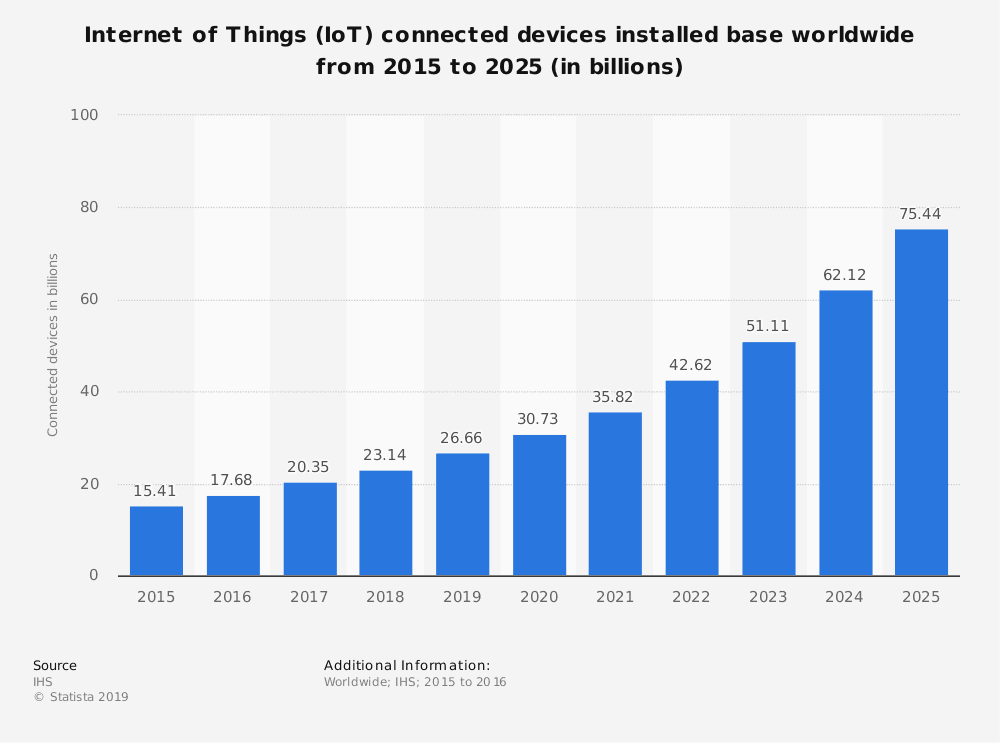
Before 2015 logistics network optimization was only possible for the largest, most sophisticated companies. Since 2015, that has changed. Supply chain logistics networks can now be optimized in real-time, based on proprietary and non-proprietary data, and used to render a decision in a fraction of the time, and at a fraction of the cost it would previously have taken.
This development has led to the beginning of a new era in supply chain management. We are moving out of the age of transactional supply chain management and into the age of cognitive supply chain management. Transactional supply chains are characterized by: a narrow focus on discrete tasks that optimizes processes rather than end-to-end outcomes; static and siloed data that is refreshed at relatively long intervals; local optimization that does not account for global conditions throughout the supply chain network; and reactive decision-making that is also relatively slow. In contrast, cognitive supply chains are characterized by: a focus on optimizing end-to-end outcomes within the supply chain network; data that is dynamic, refreshed in real-time and collaborative; global optimization; and adaptive decision-making that accounts for the cadence at which business operations occur.
Why is this significant?
Manufacturing added $2.38 trillion to the U.S. economy in the fourth quarter of 2018 (durable goods manufacturing contributed $1.33 trillion while non-durable goods contributed $1.05 trillion). Transportation and warehousing added $664.4 billion to the U.S. economy in the fourth quarter of 2018. The U.S. gross domestic product was $20.87 trillion in the fourth quarter of 2018. Manufacturing, transportation and warehousing represent approximately 15 percent of total U.S. economic output. (Source: Bureau of Economic Analysis)
Of the 251,774 manufacturing firms in the U.S. as of 2015, 98.5 percent have fewer than 500 employees and are considered small. (Source: National Association of Manufacturers. Author’s calculations.) This is the opportunity; the portion of that population that is big enough to purchase supply chain network optimization software, but too small to build its own.
According to “How Online Marketplaces Can Power Employment in Africa,” a BCG report, “The cost of getting a product from the factory to an end user within Europe adds around 90 percent to that product’s manufacturing cost. In Africa, logistics adds an average of 320 percent to a manufactured good’s cost.” Consider the implications of supply chain network optimization in all regions of the world.

The opportunity is even more exciting when one realizes that manufacturing is only one of the sectors in which this transformation is taking place. Every aspect of economic production and consumption will be affected by this shift from transactional to cognitive supply chains.
This is why startups building new supply chain logistics software have captured the imagination of venture capitalists recently, leading to the 25x growth in the amount of capital that venture capitalists are deploying in freight tech startups. Some of them are building proprietary products that they use to run their own captive businesses. Others are building platforms that enable their customers’ businesses. That distinction is less exciting than the possibilities this ongoing transition offers investors and entrepreneurs.
Brokerage Compliance Symposium
The day before F3. Every compliance issue you face - fraud exposure, carrier liability, FMCSA rules, cargo theft, insurance gaps - navigated by attorneys and operators defining best practices in a changing industry.
F3 Awards Dinner
The night before F3. FreightTech100 companies honored. FreightTech 25 and Shipper of Choice winners revealed live. Cocktail reception into dinner and live music - 300 industry leaders in one purpose-built room.
F3: Future of Freight Festival
Industry-defining keynotes, rapid-fire technology demos, and industry leaders networking in experiences across Chattanooga - plus the inaugural F3 Awards Dinner featuring the FreightTech and Shipper of Choice reveals.
The day before F3. Every compliance issue you face - fraud exposure, carrier liability, FMCSA rules, cargo theft, insurance gaps - navigated by attorneys and operators defining best practices in a changing industry.
The Signal at Chattanooga Choo Choo • Chattanooga, TN Register NowThe night before F3. FreightTech100 companies honored. FreightTech 25 and Shipper of Choice winners revealed live. Cocktail reception into dinner and live music - 300 industry leaders in one purpose-built room.
The Signal at Chattanooga Choo Choo • Chattanooga, TN Register NowIndustry-defining keynotes, rapid-fire technology demos, and industry leaders networking in experiences across Chattanooga - plus the inaugural F3 Awards Dinner featuring the FreightTech and Shipper of Choice reveals.
The Signal at Chattanooga Choo Choo • Chattanooga, TN Register Now