




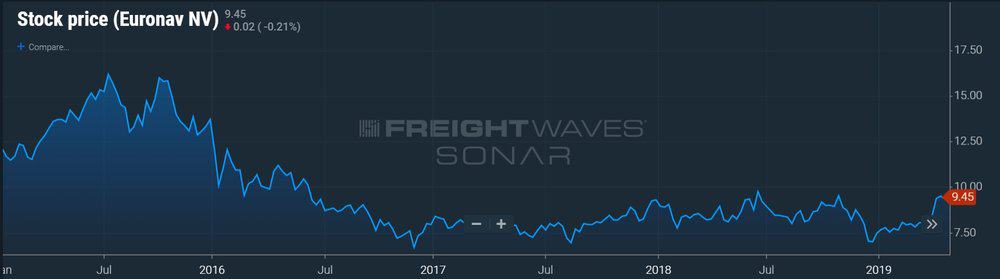
Tanker owner Euronav (NYSE: EURN) continued to face rate weakness in the first quarter of 2019, but the focus of investors is inexorably shifting to the future, and the looming implementation of the 0.5 percent cap on marine fuel sulfur starting January 1, 2020.
Before market-open on April 30, Euronav reported net income of $19.5 million for the quarter, up from a loss of $39.1 million in the first quarter of 2018. Earnings per share of $0.09 were just shy of the analyst consensus forecast of $0.11 per share.
Spot rates for the company’s very large crude carriers averaged $35,195 per day in the first quarter of 2019, on par with fourth quarter 2018 rates despite OPEC production cuts, and up 88 percent from the same period last year, when tanker rates were near historic lows.
During the conference call, incoming chief executive officer Hugo De Stoop highlighted a change in vessel-employment demand, with charterers increasingly focused on spot deals or shorter charters of one to two years.
“The industry is changing,” he said. “Most of the oil majors are becoming ‘short-termists.’ They have made decisions on their priorities, and they are shifting from more of an E&P [exploration & production] perspective to a more trading perspective. And obviously, if you have more of a trading mentality, you focus on the short-term, not the long-term.”
The outlook is for continued rate weakness in the second quarter as a result of ongoing refinery maintenance, followed by strengthening in the second half, partially as a result of the IMO 2020 fuel-sulfur cap being implemented by the International Maritime Organization.
Ships will effectively have to begin using compliant fuel well before the January 1, 2020 deadline in order for their bunker tanks to be free of non-compliant fuel by that date. Euronav expects reduced refinery maintenance and additional refinery throughput in the run-up to IMO 2020, which should increase tanker demand in the second half.
“This is a cliff deadline,” said De Stoop. “If you need to have switched on the first of January, obviously you need to burn whatever HFO [non-compliant heavy fuel oil] you have left before that, which means you will need to start carrying compliant fuel certainly in the last quarter, but depending on the length of voyage, as soon as late in the third quarter.”
At the same time, several tanker companies are seeking to comply with the sulfur cap by continuing to burn heavy fuel oil and installing ‘scrubbers’ to reduce sulfur air emissions. Installations will require ship drydockings, which will reduce tanker capacity on the water and should lead to upward pressure on freight rates.
Euronav cited estimates that up to 2 percent of fleet capacity could be temporarily removed as a result of such drydockings. During the conference call, head of investor relations Brian Gallagher added, “We expect there will be spillover [of drydockings] into the first and second quarters of 2020, probably of the same magnitude as in the fourth quarter of 2019, which should continue to take capacity out of the market and be a tailwind.”
Yet another environment-driven mandate with implications for tanker freight rates is the longer-term goal to cut the shipping industry’s carbon dioxide emissions. De Stoop offered perspective on an aspect of that initiative that Euronav supports – the plan to put a ‘speed limit’ on ships.
“That’s a relatively quick way of reducing carbon dioxide emissions dramatically, because those emissions are exponentially correlated to the speed. Is a speed limit a long-term solution? Absolutely not, because this will not be enough. As far as a long-term solution, you absolutely need to look at the type of fuel you consume. You’re going to need to find alternatives.”
From a business perspective, a globally enforced speed limit for commercial ships would be positive for vessel owners and negative for cargo shippers, because it would reduce the available vessel capacity at sea and increase freight rates.
“Everybody understands it will reduce [vessel] supply, so the market needs to make sure that the supply that remains after adapting the speed is enough for the demand,” said De Stoop.
Asked whether a speed-limit regulation could actually come into play within the next year, or whether it would be further down the road, he replied, “I think it will be discussed at the May meeting [of the IMO].
“If you look at the intermediary deadline in 2030 [to reduce shipping carbon dioxide emissions], quite frankly, you need to do something now – maybe we needed to do something yesterday.
“I don’t believe we have the luxury of waiting, and I think that’s why you see this idea of slowing down the ships gaining momentum. A number of countries have already voiced their favor for slowing down speed.
“So, it could be that some decisions are taken already in May – but as far as when they are applicable, it will take more time. It’s one thing to make a decision, it’s another thing to apply it.”
Brokerage Compliance Symposium
The day before F3. Every compliance issue you face - fraud exposure, carrier liability, FMCSA rules, cargo theft, insurance gaps - navigated by attorneys and operators defining best practices in a changing industry.
F3 Awards Dinner
The night before F3. FreightTech100 companies honored. FreightTech 25 and Shipper of Choice winners revealed live. Cocktail reception into dinner and live music - 300 industry leaders in one purpose-built room.
F3: Future of Freight Festival
Industry-defining keynotes, rapid-fire technology demos, and industry leaders networking in experiences across Chattanooga - plus the inaugural F3 Awards Dinner featuring the FreightTech and Shipper of Choice reveals.
The day before F3. Every compliance issue you face - fraud exposure, carrier liability, FMCSA rules, cargo theft, insurance gaps - navigated by attorneys and operators defining best practices in a changing industry.
The Signal at Chattanooga Choo Choo • Chattanooga, TN Register NowThe night before F3. FreightTech100 companies honored. FreightTech 25 and Shipper of Choice winners revealed live. Cocktail reception into dinner and live music - 300 industry leaders in one purpose-built room.
The Signal at Chattanooga Choo Choo • Chattanooga, TN Register NowIndustry-defining keynotes, rapid-fire technology demos, and industry leaders networking in experiences across Chattanooga - plus the inaugural F3 Awards Dinner featuring the FreightTech and Shipper of Choice reveals.
The Signal at Chattanooga Choo Choo • Chattanooga, TN Register Now