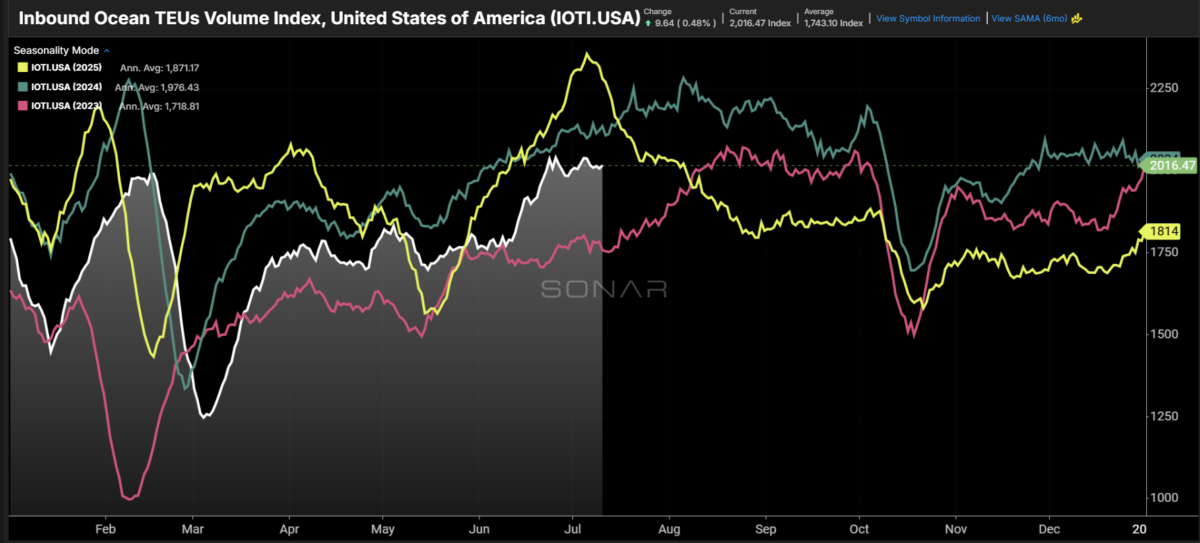
Chart of the Week: Inbound Ocean TEUs Index – USA SONAR: IOTI.USA
The Inbound Ocean TEUs Volume Index (IOTI), which measures bookings of twenty-foot equivalent containers by departure date, has been holding near annual highs for nearly a month. While tariffs are possibly a factor in this seasonally early push, there may be more driving this wave than tariff concerns alone.
The IOTI is down compared to the previous two years, but this shouldn’t be taken as a sign of economic sluggishness. Concerns over service due to the Red Sea closures in 2024 and erratic tariff implementation in 2025 make evaluating those years from a pure demand perspective challenging. This year isn’t without its own nuances, but it’s possibly the most “normal” we’ve seen since before COVID.
A quick recap on tariffs
On February 20, 2026, the Supreme Court ruled that IEEPA does not authorize the president to impose tariffs, invalidating the April 2025 “Liberation Day” reciprocal tariffs as well as the fentanyl-related tariffs on China, Mexico, and Canada. The administration has since issued roughly $20 billion in refunds tied to those tariffs. In response, it pivoted to other legal authorities.
The administration invoked Section 122 of the Trade Act of 1974 to impose a 10% across-the-board surcharge on goods from nearly all countries for 150 days. On May 7, 2026, the Court of International Trade ruled against these tariffs as well, though the decision is under appeal and the tariffs continue to be collected. This surcharge is set to expire July 24, 2026, unless Congress extends it.
Since Section 122 is expiring and courts have been unfriendly to IEEPA-based tariffs, the administration has moved to reconstruct the tariff wall through expanded use of Sections 301 and 232. The forced-labor Section 301 investigation, covering 60 economies (nearly all US imports), proposes tariffs of up to 12.5% and is not yet in effect; USTR held its public hearing on the matter this past week.
USTR will now review the hearing record and decide whether to finalize, modify, or drop the proposed tariffs. There are nuances throughout, especially involving the EU. For freight purposes, July 24 is the date that matters most, since that’s likely when there will be some clarity on what the policy will actually be.
What this means for freight
The average transit time from China to the major West Coast US ports is around or just over two weeks. This means many of the imports departing last week will be landing right around the time of the section 122 expiration. This suggests that orders should start waning in the coming weeks.
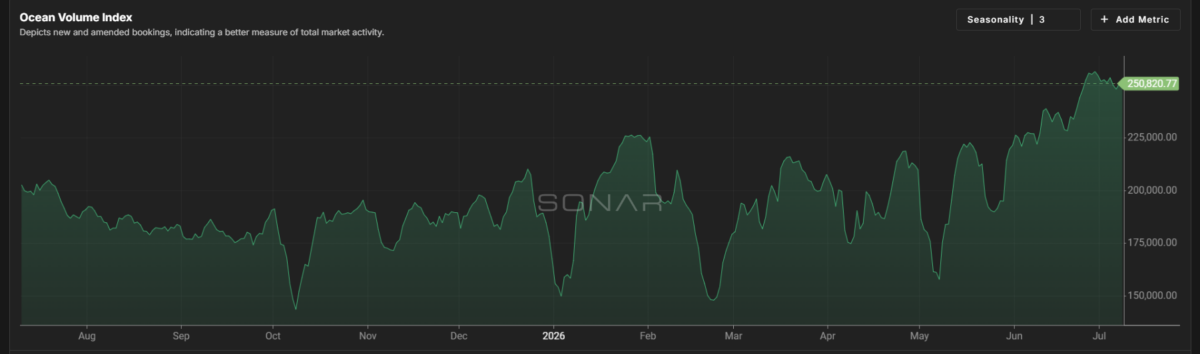
The Ocean Booking Volume Index, which measures both new and amended booking activity by submission date (rather than departure date, like the IOTI), showed a flurry of increased activity over the past two weeks. This supports the case that many shippers were trying to get ahead of new duties.
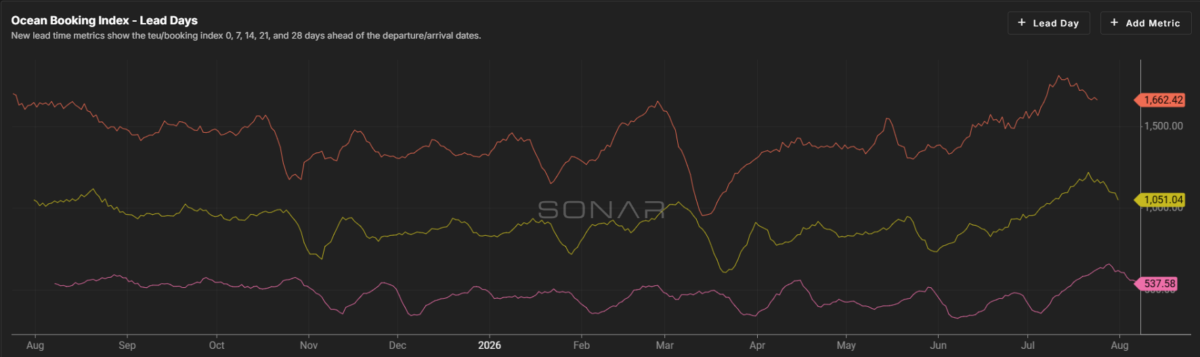
Most container bookings occur within a week of expected departure, and those volumes appear to have peaked this past week. However, there’s still a bulge of orders scheduled 2 to 4 weeks out, suggesting tariffs aren’t the only factor behind the rise in bookings. For instance, orders with a 21-day lead time (yellow) peak around July 21, while orders with a 28-day lead time (pink) peak on July 28. This suggests many shippers are simply restocking or preparing as they typically would for upcoming demand.
On this past week’s episode of Freightonomics, Dr. Zac Rogers, co-author of the Logistics Managers’ Index, said it does appear that many shippers have been caught off guard by consumer resilience. Many economists had expected a more challenging economy earlier in the year due to inflation that never fully materialized.
He noted that retailers were concerned consumers wouldn’t show up after gas prices spiked the way they did in March 2022. Manufacturers and upstream firms, meanwhile, were more worried about not having the components they’d need later in the year, or facing much higher costs, so they ordered early.
This suggests we may be looking at a longer but less pronounced peak-ordering cycle for maritime freight, and that many firms may be growing more bullish about the second half. If maritime demand continues to show strength into August, it will point to a strengthening in goods demand that could catch many businesses off guard and further strain transportation capacity.
About the Chart of the Week
The FreightWaves Chart of the Week is a chart selection from SONAR that provides an interesting data point to describe the state of the freight markets. A chart is chosen from thousands of potential charts on SONAR to help participants visualize the freight market in real time. Each week a Market Expert will post a chart, along with commentary, live on the front page. After that, the Chart of the Week will be archived on FreightWaves.com for future reference.
SONAR aggregates data from hundreds of sources, presenting the data in charts and maps and providing commentary on what freight market experts want to know about the industry in real time.
The FreightWaves data science and product teams are releasing new datasets each week and enhancing the client experience.
To request a SONAR demo, click here.
Brokerage Compliance Symposium
The day before F3. Every compliance issue you face - fraud exposure, carrier liability, FMCSA rules, cargo theft, insurance gaps - navigated by attorneys and operators defining best practices in a changing industry.
F3 Awards Dinner
The night before F3. FreightTech100 companies honored. FreightTech 25 and Shipper of Choice winners revealed live. Cocktail reception into dinner and live music - 300 industry leaders in one purpose-built room.
F3: Future of Freight Festival
Industry-defining keynotes, rapid-fire technology demos, and industry leaders networking in experiences across Chattanooga - plus the inaugural F3 Awards Dinner featuring the FreightTech and Shipper of Choice reveals.
The day before F3. Every compliance issue you face - fraud exposure, carrier liability, FMCSA rules, cargo theft, insurance gaps - navigated by attorneys and operators defining best practices in a changing industry.
The Signal at Chattanooga Choo Choo • Chattanooga, TN Register NowThe night before F3. FreightTech100 companies honored. FreightTech 25 and Shipper of Choice winners revealed live. Cocktail reception into dinner and live music - 300 industry leaders in one purpose-built room.
The Signal at Chattanooga Choo Choo • Chattanooga, TN Register NowIndustry-defining keynotes, rapid-fire technology demos, and industry leaders networking in experiences across Chattanooga - plus the inaugural F3 Awards Dinner featuring the FreightTech and Shipper of Choice reveals.
The Signal at Chattanooga Choo Choo • Chattanooga, TN Register Now