








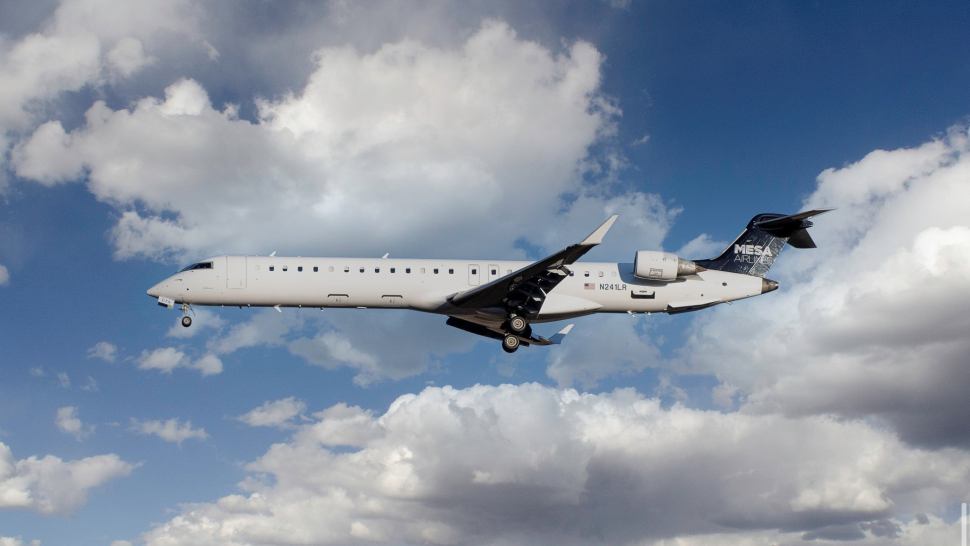
The Federal Aviation Administration last year established optimized profile descents at 42 airports last year with the goal of saving millions of gallons of fuel and reducing CO2 and other emissions. Another benefit is less noise.
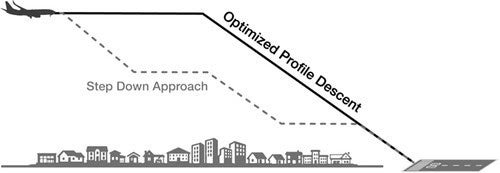
Let’s cut through the technical language. Optimized Profile Descents (OPD) are new flight techniques that allow airplanes to descend from cruising altitude to the runway in a smooth, continuous slope with engines set at near idle. In other words, pilots flying into these 42 airports can glide down safely instead of using the fuel-consuming stair-step procedure previously in place.
With a traditional stair-step approach, aircraft repeatedly level off and power up the engines, which burns more fuel and requires air traffic controllers to issue instructions at each step.
The new descent procedures provide a smooth approach for passengers, with less fuel consumption. It also allows an aircraft to stay at higher altitudes for longer periods of time. Less engine revving also translates to less noise (about 3 to 6.5 decibels) when the plane is closer to the ground.
For each group of descents used at an airport, the FAA estimates that an average 2 million gallons of fuel is saved and 40 million pounds of emissions reduced annually. That is equivalent to eliminating the fuel and CO2 emissions of 1,300 Boeing 737 flights from Atlanta to Dallas.
In 2021, the FAA implemented efficient descent procedures for Dallas-Ft. Worth International Airport, Fort Lauderdale-Hollywood International Airport, Harry Reid International Airport in Las Vegas, Lakehurst Maxfield Field in New Jersey, Love Field in Dallas, Miami International Airport, North Las Vegas Airport, Orlando International Airport, Port Columbus International Airport, Portland International Jetport, Tampa International Airport and numerous mid-size airports.
Since 2014, the FAA also has developed OPD procedures at airports in Atlanta, Charlotte, Cleveland, Denver, Detroit, Houston, Northern California, Southern California and Washington, D.C. More OPD procedures will be added in 2022.
The FAA has a number of new flight procedures that use less fuel and reduce noise by bringing more precision to routes.
In November, the U.S. released its first-ever comprehensive Aviation Climate Action Plan to achieve net-zero emissions by 2050. Earlier in 2021, the FAA announced more than $100 million in matching grants to increase aircraft efficiency, reduce noise and aircraft emissions, and develop and implement new software to reduce taxi delays. The White House also announced its Sustainable Aviation Fuel Grand Challenge, a government-wide initiative designed to catalyze the production of at least three billion gallons per year by 2030.
Click here for more FreightWaves/American Shipper stories by Eric Kulisch.
RECOMMENDED READING:
Brokerage Compliance Symposium
The day before F3. Every compliance issue you face - fraud exposure, carrier liability, FMCSA rules, cargo theft, insurance gaps - navigated by attorneys and operators defining best practices in a changing industry.
F3 Awards Dinner
The night before F3. FreightTech100 companies honored. FreightTech 25 and Shipper of Choice winners revealed live. Cocktail reception into dinner and live music - 300 industry leaders in one purpose-built room.
F3: Future of Freight Festival
Industry-defining keynotes, rapid-fire technology demos, and industry leaders networking in experiences across Chattanooga - plus the inaugural F3 Awards Dinner featuring the FreightTech and Shipper of Choice reveals.
The day before F3. Every compliance issue you face - fraud exposure, carrier liability, FMCSA rules, cargo theft, insurance gaps - navigated by attorneys and operators defining best practices in a changing industry.
The Signal at Chattanooga Choo Choo • Chattanooga, TN Register NowThe night before F3. FreightTech100 companies honored. FreightTech 25 and Shipper of Choice winners revealed live. Cocktail reception into dinner and live music - 300 industry leaders in one purpose-built room.
The Signal at Chattanooga Choo Choo • Chattanooga, TN Register NowIndustry-defining keynotes, rapid-fire technology demos, and industry leaders networking in experiences across Chattanooga - plus the inaugural F3 Awards Dinner featuring the FreightTech and Shipper of Choice reveals.
The Signal at Chattanooga Choo Choo • Chattanooga, TN Register Now