








Like all regulations of business activity, there is always a political element to it. They are meant to achieve some goal that the marketplace alone is not able to achieve.
In the case of Hours of Service (HOS) regulations, the intent is to incentivize trucking companies (by threat of fines) to make sure their drivers have a minimum amount of rest time over specific time periods. Such regulations can be validated when we consider that out of the five basic modes of transportation (air, rail, water, pipeline, and truck), the trucking industry has the closest and most frequent interaction with industry outsiders.
Think of it this way: Trucks mostly use government-provided roadways, bridges and tunnels and they share them with the general public who commute in cars, light trucks and buses. A fatigued truck driver trying to meet a tight delivery schedule would not only hurt himself, but many other nearby commuters and pedestrians should an accident occur. Truck drivers are susceptible to two types of fatigue: physical (i.e., muscle-related) and mental (i.e., boredom and sleepiness).
Given the basic rationale for HOS regulations, there have been several sets of rules since the initial one went into effect in 1938. The Federal Motor Carrier Safety Administration (FMCSA) laid down the present rules in 2005.
Of course, nothing is ever final when it comes to transportation policy, so the FMCSA has invited public comment through a notice of proposed rule-making (NPRM) that lasts from Aug. 22 to Oct. 7. Proposed changes involve more flexibility to the 14-hour maximum length of duty rule and how breaks are treated.
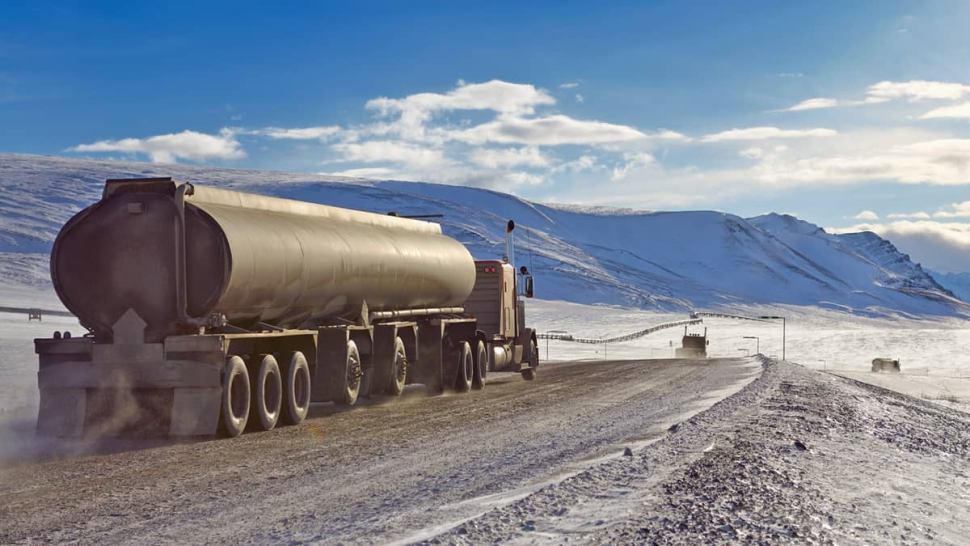
Not many people are aware of this, but Alaska received a special exemption from the HOS regulations. Is this because Alaskan truck drivers are less susceptible to fatigue? Of course not. It is because Alaska is very different from the Lower 48.
Spatially, Alaska is the nation’s largest state – larger than Texas, California and Montana combined. In fact, Alaska would take up the space of about 20% of the entire Lower 48. Toss in a road network that runs mainly northward from the Kenai Peninsula, through Anchorage, and up to Fairbanks (with a narrow haul-road up to the Prudhoe Bay oil fields) and the uniqueness becomes all too clear. This thousand-mile trunk line through the center of the state contains most of Alaska’s 735,000 residents.
The FMCSA recognized the logistical differences of doing business in Alaska when it came to HOS regulations. Where commercial truck drivers in the Lower 48 have a 14-hour duty-time window, Alaskans have 20 hours. Where commercial truck drivers in the Lower 48 have an 11-hour driving-time window, Alaskans have 15 hours.
This certainly gives truckers in Alaska more time to complete their duties. Do they need it? A case can be made when one considers that about 75% of Alaska’s consumer goods enter the state via the Port of Alaska in Anchorage. The vast majority of the “last-mile” deliveries to the populations from the Kenai Peninsula to Fairbanks need to be made by truck. This is especially important during Alaska’s challenging winter months.
The Alaska HOS exemption shows that federal regulations need not be administered in a uniform manner if a compelling case can be made for exemptions to certain sub-sectors, regions, etc. The situation on the ground always changes and it is healthy for regulators from time to time to use the NPRM process for that purpose.
Ideally, what is to be gained by periodically revisiting such regulations is to give regulators a chance to hear from stakeholders.
In other words, are truck-related accidents down since the last iteration of HOS rules? Are there any adverse effects on delivery times and transport costs as a result of the mandated rest time? Are there any emerging forms of technology (e.g., driver-assistance cameras and semi-autonomous vehicles) that mitigate the need to dictate HOS in its current form?
All stakeholders should provide experiential and, whenever possible, data-informed opinions on such an important set of regulations. Like so many regulations, they filter into people’s behavior, the cost of doing business and consumer prices in ways that are not always easy to see at first. Let the debate continue and let the regulations be reasonable and flexible.
Brokerage Compliance Symposium
The day before F3. Every compliance issue you face - fraud exposure, carrier liability, FMCSA rules, cargo theft, insurance gaps - navigated by attorneys and operators defining best practices in a changing industry.
F3 Awards Dinner
The night before F3. FreightTech100 companies honored. FreightTech 25 and Shipper of Choice winners revealed live. Cocktail reception into dinner and live music - 300 industry leaders in one purpose-built room.
F3: Future of Freight Festival
Industry-defining keynotes, rapid-fire technology demos, and industry leaders networking in experiences across Chattanooga - plus the inaugural F3 Awards Dinner featuring the FreightTech and Shipper of Choice reveals.
The day before F3. Every compliance issue you face - fraud exposure, carrier liability, FMCSA rules, cargo theft, insurance gaps - navigated by attorneys and operators defining best practices in a changing industry.
The Signal at Chattanooga Choo Choo • Chattanooga, TN Register NowThe night before F3. FreightTech100 companies honored. FreightTech 25 and Shipper of Choice winners revealed live. Cocktail reception into dinner and live music - 300 industry leaders in one purpose-built room.
The Signal at Chattanooga Choo Choo • Chattanooga, TN Register NowIndustry-defining keynotes, rapid-fire technology demos, and industry leaders networking in experiences across Chattanooga - plus the inaugural F3 Awards Dinner featuring the FreightTech and Shipper of Choice reveals.
The Signal at Chattanooga Choo Choo • Chattanooga, TN Register Now