



In a new report from the FreightWaves Freight Intel Group – “Why Truck Failures Could Increase in 2019,” – the authors have found that trucking company failures are usually the result of unexpected large spikes in diesel prices that then cannot be adequately passed on via fuel surcharges by small to midsize carriers.
In the report the FreightWaves Freight Intel Group outlines three statistical factors that may portend an increase in truck failures in the near future.
First, spot rates are down meaningfully – 20 percent year-over-year and 30 percent off of their peak. Second, contract rates are moving lower (and are at risk of downward revisions going forward). Third, trucking companies’ costs are running higher due to wage increases and excess capacity entering the market following a robust 2018. Finally, there is a very real potential for higher diesel prices because of the implementation of IMO 2020.
Because of these factors, staff members of the FreightWaves Freight Intel Group believe the first meaningful increase in trucking company failures in years could occur in 2019.
Trucking company failures have been quite low both on an absolute and relative basis over the past several years (outside of a small increase in 2013-2014). In fact, trucking company failures reached an all-time low in 2018 across the 30 years of data FreightWaves staff analyzed going back to 1990. It has been 11 years since the trucking market has seen a really significant bout of failures.
“Why Truck Failures Could Increase in 2019” is available to FreightWaves SONAR subscribers. In the report, FreightWaves staff and Michigan State University professor Jason Miller examined nearly 30 years of truck failure data through a regression analysis to eliminate the noise and determine which factors are statistically significant indicators of truck failures.
They concluded that just three factors were particularly significant drivers: the number of trucking company failures in the prior quarter; the natural logarithm of diesel prices; and the natural logarithm of the producer price index (PPI) for long-haul trucking. Diesel prices and the truckload PPI are equally important factors.
Trucking company failures are a good barometer for general trucking market and economic health. Increasing numbers of failures indicate a weakening climate for trucking while low or decreasing values indicate a stable environment.
What Are the Leading Causes of Trucking Failures?
When contemplating the leading causes for trucking failures, the principal qualitative reasons often cited by the failing companies and the media include the following (which are not mutually exclusive and often co-dependent):
- Recessions
- Falling contract and spot prices
- Rising diesel prices
- Expensive, rising and unaffordable insurance costs
- High labor and maintenance costs
- Unionized labor forces
- Onerous contracts with large shippers (e.g. Amazon)
All make a great deal of sense on the surface and likely do play some part in most failures. However, the single most predictive variable was the number of failures in the quarter before. Failures tend to cluster, spike episodically and persist for a number of quarters when conditions in the industry deteriorate.
The next predictive variable was the year-over-year change in the natural logarithm of diesel prices. The natural logarithm is used because it translates into percentage changes. The easiest way to describe why the natural logarithm is the superior measure is that a $0.20 increase in the price of diesel today (with average diesel prices of $3 per gallon) is not equivalent to a $0.20 increase back in the 1990s when the average price per gallon was hovering around $1.
Equally as predictive of the change in trucking failures is the year-over-year change in the natural logarithm of the truckload PPI. The PPI data primarily captures truckload carriers’ contract rates, given the vast majority of truckload (TL) freight moves under contract. Contract rates are used because carriers with greater than five trucks normally source two-thirds to three-fourths of their business from the contract market. Contract rates are not nearly as volatile as spot rates for trucking. In the study, the year-over-year changes in contract rates varied between a 10 percent increase in boom times (2018) and a 10 percent decrease in dreadful times (2009).
Lastly, there is a high correlation (0.73) between diesel prices and contract rates because as diesel prices move higher, they get passed on as fuel surcharges (at least by mid-size and large-size carriers). The failure data shows that these fuel surcharges sometimes simply are not enough and do not fully pass on the diesel cost increases.
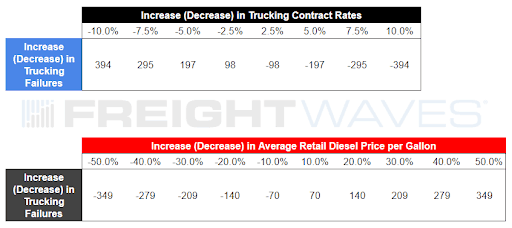
Sensitivity Analysis: Change in Trucking Failures vs. % Change in Contract Rates and Average Retail Diesel Price per Gallon
The biggest surprise to most outside of trucking industry professionals would be that failures are not primarily caused by spot and contract rates falling steeply in a recession. Instead, failures are primarily due to huge spikes in diesel prices that smaller carriers cannot pass on.
The failure model as constructed by Michigan State University (MSU) Professor Jason Miller and FreightWaves is not intended to be utilized primarily as a forecasting tool. Rather, it is designed to try and explain what factors account for the time-series variance in trucking failures. That being said, we would expect a significant pick-up in failures due to the confluence of several negative factors: the lagged effect of extremely down spot prices will begin to filter through to lower contract rates; IMO 2020 should keep diesel prices at least flat (and potentially cause materially higher diesel prices in our view); and labor/operational costs should remain high as many trucking companies increased driver pay that will not be clawed back. This dual revenue and cost pressure is likely to cause a meaningful increase in failures.
A final negative factor that is likely to come into play and cause increasing failures throughout 2019 is excess capacity, with outbound tender rejections (OTRI.USA) at 12-month lows. Tender rejections are a measure of carrier optionality and with much more capacity in the market competing for lower freight volumes (OTVIY.USA), which are down 7.6 percent year-over-year, carriers are experiencing downward rate pressure exacerbating their increasing lack of viability.
With record levels of Class 8 new truck orders in 2018 and delivery dates well into this summer, a large number of trucks will be hitting the market just as demand begins softening and lapping hard comparisons from the prior year. This type of environment characterized by growing excess capacity is highly conducive to growing truck failures.
Again, SONAR subscribers can download the entire report on the SONAR platform. For more information on the FreightWaves Freight Intel Group, please contact Kevin Hill at khill@www.freightwaves.com or Seth Holm at sholm@www.freightwaves.com.
Brokerage Compliance Symposium
The day before F3. Every compliance issue you face - fraud exposure, carrier liability, FMCSA rules, cargo theft, insurance gaps - navigated by attorneys and operators defining best practices in a changing industry.
F3 Awards Dinner
The night before F3. FreightTech100 companies honored. FreightTech 25 and Shipper of Choice winners revealed live. Cocktail reception into dinner and live music - 300 industry leaders in one purpose-built room.
F3: Future of Freight Festival
Industry-defining keynotes, rapid-fire technology demos, and industry leaders networking in experiences across Chattanooga - plus the inaugural F3 Awards Dinner featuring the FreightTech and Shipper of Choice reveals.
The day before F3. Every compliance issue you face - fraud exposure, carrier liability, FMCSA rules, cargo theft, insurance gaps - navigated by attorneys and operators defining best practices in a changing industry.
The Signal at Chattanooga Choo Choo • Chattanooga, TN Register NowThe night before F3. FreightTech100 companies honored. FreightTech 25 and Shipper of Choice winners revealed live. Cocktail reception into dinner and live music - 300 industry leaders in one purpose-built room.
The Signal at Chattanooga Choo Choo • Chattanooga, TN Register NowIndustry-defining keynotes, rapid-fire technology demos, and industry leaders networking in experiences across Chattanooga - plus the inaugural F3 Awards Dinner featuring the FreightTech and Shipper of Choice reveals.
The Signal at Chattanooga Choo Choo • Chattanooga, TN Register Now