








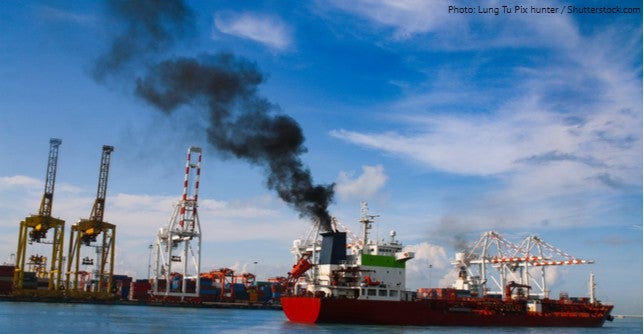
Ocean carriers could start increasing fuel surcharges as early as Oct. 1 to help pay for the higher cost of low sulfur fuel under a mandate by the International Maritime Organization (IMO) that will take effect Jan. 1, Mohawk Global Logistics Vice President of International Transportation Rich Roche said Tuesday.
Low-sulfur fuel will start being stored aboard vessels as early as three months before the IMO requirement activates, he said.
Speaking during the National Customs Brokers and Forwarders Association of America (NCBFAA) Annual Conference in San Antonio, Roche advised attendees to challenge carriers if they claim they will start burning fuel before the Jan. 1 effective date.
“They don’t necessarily have to burn it, even though they’re bringing it on board the vessels,” Roche said. “Don’t let anyone fool you that just because it’s on board means they’re burning it. They have many tanks where they put the fuel on vessels, and they’re actually storing it until they have to burn it.”
Price impacts of the IMO mandate will be “quite large,” ranging anywhere from $200 per TEU to $400 per TEU, he said.
“There’s a lot of variables that will go along with the calculation, and all of those variables are going to be specific by carrier, because they’re all coming up with their own formula,” Roche said. “Some of that’s quite subjective. So, it’s one of those things you need to be prepared for.”
During a webinar last week, analysts from AlixPartners estimated that container carriers would have to increase their bunker adjustment factors by 40 percent or $270 per 40-foot container on Asia-to-Europe services and by 33 percent or $150 per 40-foot container on eastbound transpacific services to maintain margins when they shift to low-sulfur fuel oil.
Speaking later during the conference, Rebecca Dye, a commissioner on the Federal Maritime Commission (FMC), said while her agency primarily focuses on competition enforcement and has no direct role in implementation of IMO rules, “if an IMO rule seriously affects freight rates and service levels, I would not be surprised if the commission … becomes a part of the process.”
Concerns associated with the low-sulfur fuel mandate include service disruptions, impacts of higher costs, and fuel surcharges, Dye said.
“Will enough low-sulfur fuel be available when and where it’s needed, and if so, at what cost?” she asked. “Also at issue is will the move to low-sulfur fuel result in higher costs for other low-sulfur distillates, like heating oil?”
Brokerage Compliance Symposium
The day before F3. Every compliance issue you face - fraud exposure, carrier liability, FMCSA rules, cargo theft, insurance gaps - navigated by attorneys and operators defining best practices in a changing industry.
F3 Awards Dinner
The night before F3. FreightTech100 companies honored. FreightTech 25 and Shipper of Choice winners revealed live. Cocktail reception into dinner and live music - 300 industry leaders in one purpose-built room.
F3: Future of Freight Festival
Industry-defining keynotes, rapid-fire technology demos, and industry leaders networking in experiences across Chattanooga - plus the inaugural F3 Awards Dinner featuring the FreightTech and Shipper of Choice reveals.
The day before F3. Every compliance issue you face - fraud exposure, carrier liability, FMCSA rules, cargo theft, insurance gaps - navigated by attorneys and operators defining best practices in a changing industry.
The Signal at Chattanooga Choo Choo • Chattanooga, TN Register NowThe night before F3. FreightTech100 companies honored. FreightTech 25 and Shipper of Choice winners revealed live. Cocktail reception into dinner and live music - 300 industry leaders in one purpose-built room.
The Signal at Chattanooga Choo Choo • Chattanooga, TN Register NowIndustry-defining keynotes, rapid-fire technology demos, and industry leaders networking in experiences across Chattanooga - plus the inaugural F3 Awards Dinner featuring the FreightTech and Shipper of Choice reveals.
The Signal at Chattanooga Choo Choo • Chattanooga, TN Register Now