A newly surfaced draft memo from inside the U.S. Department of Transportation signals one of the strongest federal moves yet to identify and shut down “chameleon carriers” — companies that repeatedly shut down, reopen under new names, and dodge enforcement. For years, these operators have quietly slipped through the cracks, hurting small legitimate carriers and putting unsafe trucks back on the road.
Now, based on this internal document, DOT wants to overhaul how it identifies high-risk carriers by creating a severity scoring system powered by registration data, operational behavior, and patterns tied to fraud.
It’s still early — the memo is labeled pre-decisional — but it offers the clearest picture yet of how regulators plan to target a problem the trucking industry has been begging them to address for over a decade.
And if the proposals inside eventually become policy, the freight landscape could shift fast.
What the Memo Says, In Plain Language
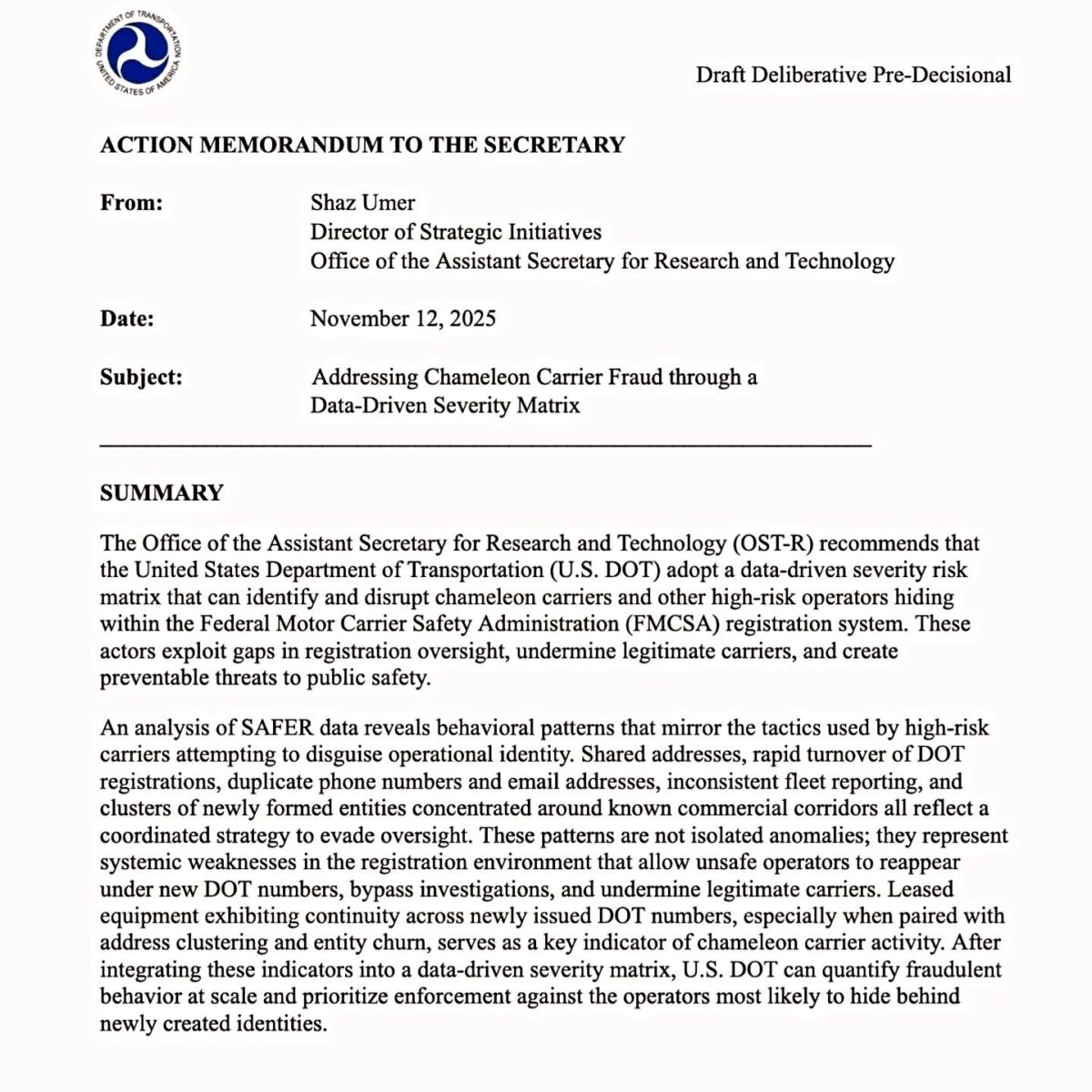
The memo, written by Shaz Umer, Director of Strategic Initiatives in the Office of the Assistant Secretary for Research and Technology, was submitted to the Secretary on November 12, 2025. It outlines a plan to build a “data-driven severity matrix” — basically a risk score — that identifies carriers whose behavior suggests they’re hiding behind new DOT numbers.
According to the memo, DOT believes unsafe and fraudulent carriers are exploiting weaknesses in the FMCSA registration system. These flaws create opportunities for companies with bad safety histories to:
• close an old company
• open a new one with a clean slate
• hide past violations
• avoid audits
• bypass investigations
• and get back on the road as if nothing happened
In the industry, these operators are known as chameleon carriers.A newly surfaced draft memo from inside the U.S. Department of Transportation signals one of the strongest federal moves yet to identify and shut down “chameleon carriers” — companies that repeatedly shut down, reopen under new names, and dodge enforcement. For years, these operators have quietly slipped through the cracks, hurting small legitimate carriers and putting unsafe trucks back on the road.
Now, based on this internal document, DOT wants to overhaul how it identifies high-risk carriers by creating a severity scoring system powered by registration data, operational behavior, and patterns tied to fraud.
It’s still early — the memo is labeled pre-decisional — but it offers the clearest picture yet of how regulators plan to target a problem the trucking industry has been begging them to address for over a decade.
And if the proposals inside eventually become policy, the freight landscape could shift fast.
So What Exactly Is a Chameleon Carrier?
Most trucking companies shut down for normal reasons — finances, contracts drying up, rising insurance, or personal decisions. That’s part of the business.
A chameleon carrier is different.
A chameleon carrier is a company that intentionally closes its DOT number after receiving violations or enforcement actions, immediately opens a new one under a different name, and continues operating the same trucks, same business, and sometimes the same unsafe practices.
In other words:
• same trucks
• same drivers
• same owners
• new identity
The goal isn’t to stay in business — it’s to stay ahead of enforcement.
These carriers often have patterns like:
• identical addresses across multiple companies
• recycled phone numbers and emails
• fleets that appear and disappear overnight
• sudden DOT number changes after major violations
• identical operating areas
• leased equipment that hops between new entities
And the memo states DOT has the data to spot these patterns at scale — they just haven’t been using it fully until now.
What DOT’s Analysis Found
The memo says analysts reviewed SAFER and registration data and noticed “behavioral patterns that mirror the tactics used by high-risk carriers attempting to disguise operational identity.” That includes:
Shared addresses, rapid DOT number turnover, duplicate contact information, inconsistent equipment reporting, clusters of nearly identical companies in the same commercial corridors and leased equipment appearing under multiple DOT numbers within short time spans.
These aren’t one-off anomalies — the memo says they indicate “systemic weaknesses” that unsafe operators keep exploiting.
The next step, according to the memo, is to use these indicators to generate a severity score for every carrier, showing which ones are most likely to be fraudulent.
If deployed, federal regulators could quickly isolate carriers hiding behind new DOT numbers and prioritize them for audits or shutdowns.
Unscrupulous operators saw an opening: shut down before a violation sticks, reopen quickly, and keep running freight. But these carriers don’t just dodge rules — they actively harm legitimate small carriers by:
• driving down rates
• creating unsafe conditions
• raising insurance premiums for everyone
• ruining trust with brokers and shippers
• and undercutting carriers who actually do the right thing
DOT’s memo states bluntly that these actions “undermine legitimate carriers and create preventable threats to public safety.” And anybody who’s been in the industry long enough knows they’re right.
How DOT Plans To Stop It
The memo outlines a simple but powerful approach:
- Collect key data points linked to fraudulent identity changes
- Feed them into a scoring model
- Prioritize enforcement and investigations on carriers with high-risk scores
Instead of waiting for a crash or complaint, DOT would proactively use data to catch carriers who are most likely disguising their identity.
That would allow:
• faster enforcement
• fewer unsafe fleets slipping through
• greater registration oversight
• and a more level playing field for compliant carriers
This isn’t just enforcement — it’s prevention.
What This Could Mean for Small Carriers
For carriers who run clean, this is good news. It protects your business, your safety record, and your reputation. But small carriers should also understand what tighter registration scrutiny might bring:
• More verification when applying for a DOT or MC
• More data cross-checks if addresses or emails appear suspicious
• Delays if your company resembles others in the same location
• Additional steps if you lease equipment or share a yard with other carriers
• Enforcement outreach if your profile matches a known risk pattern
The memo isn’t about punishing honest carriers. It’s about using data to filter out the ones misusing the system. But the trucking world is full of shared terminals, leased units, family businesses, and overlapping addresses — not fraud, just how small fleets operate. DOT will need to be careful not to confuse normal business with fraudulent business.
Final Thought
The draft memo reveals something larger than a new scoring model — it shows that DOT finally recognizes how damaging chameleon carriers have become, not just to safety but to the entire freight ecosystem. Fraud doesn’t just break rules. It breaks trust, raises costs, hurts the carriers who play by the book, and clogs the system with operators who should never have been allowed back onto the road. If the severity matrix becomes policy, the trucking world may see the most aggressive identity-fraud enforcement push in years. And if done right, it could make the industry safer and fairer for every small carrier trying to run legitimately.
Brokerage Compliance Symposium
The day before F3. Every compliance issue you face - fraud exposure, carrier liability, FMCSA rules, cargo theft, insurance gaps - navigated by attorneys and operators defining best practices in a changing industry.
F3 Awards Dinner
The night before F3. FreightTech100 companies honored. FreightTech 25 and Shipper of Choice winners revealed live. Cocktail reception into dinner and live music - 300 industry leaders in one purpose-built room.
F3: Future of Freight Festival
Industry-defining keynotes, rapid-fire technology demos, and industry leaders networking in experiences across Chattanooga - plus the inaugural F3 Awards Dinner featuring the FreightTech and Shipper of Choice reveals.
The day before F3. Every compliance issue you face - fraud exposure, carrier liability, FMCSA rules, cargo theft, insurance gaps - navigated by attorneys and operators defining best practices in a changing industry.
The Signal at Chattanooga Choo Choo • Chattanooga, TN Register NowThe night before F3. FreightTech100 companies honored. FreightTech 25 and Shipper of Choice winners revealed live. Cocktail reception into dinner and live music - 300 industry leaders in one purpose-built room.
The Signal at Chattanooga Choo Choo • Chattanooga, TN Register NowIndustry-defining keynotes, rapid-fire technology demos, and industry leaders networking in experiences across Chattanooga - plus the inaugural F3 Awards Dinner featuring the FreightTech and Shipper of Choice reveals.
The Signal at Chattanooga Choo Choo • Chattanooga, TN Register Now