



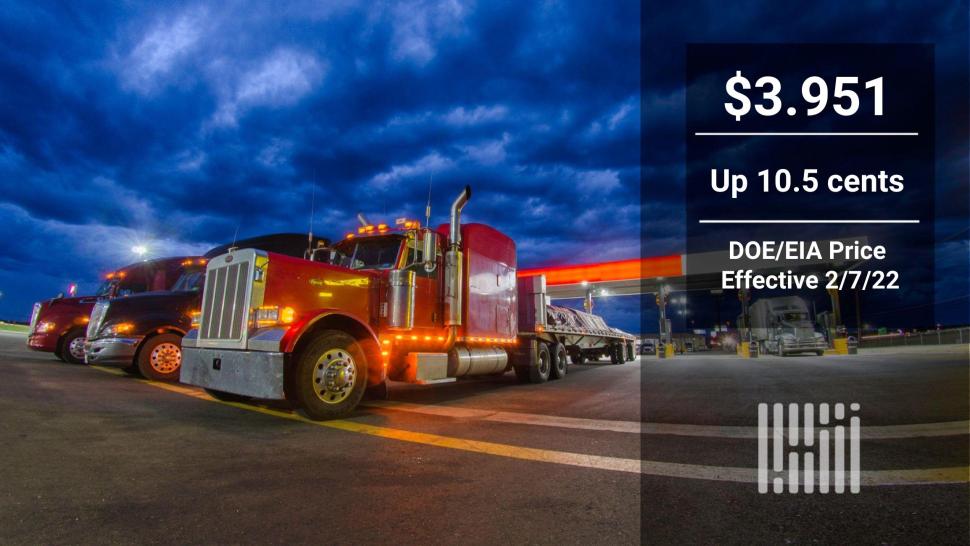
Only four times in the past 10 years has the weekly average retail diesel price published by the Department of Energy/Energy Information Administration risen double digits in a week.
The price posted Monday was one of those four. It rose 10.5 cents per gallon to $3.951. That’s the highest level since the posting of May 5, 2014, when it was $3.9614 a gallon.
It may be small comfort, but the gap between current prices and the “highest since” data is growing wide enough that looking at inflation-adjusted prices is beginning to attract interest.
According to the Bureau of Labor Statistics’ online inflation calculator, the May 5, 2014, price translates to a current price of $4.63 a gallon. Additionally, improved fuel efficiency in most trucks means that a price of $3.95 today would not have the same impact on trucking economics as in 2014.
But that doesn’t mean it isn’t an issue of concern to consumers. The benchmark price is now up 33.8 cents in five weeks. And in those five weeks, the smallest gain was 4.4 cents, an increase that by itself would be considered significant.
A year ago, the DOE/EIA price stood at $2.801 a gallon.
According to a report by John Kemp of Reuters, investor interest in the ultra low sulfur diesel and gasoline prices on the CME commodity exchange has soared recently. Investor interest does not necessarily portend higher prices, because the investors can take bets that markets could go down. But according to the Reuters story, that is not what is happening now.
“The most recent buying was concentrated on the fuels side, with purchases in European gas oil (+14 million barrels), U.S. diesel (+2 million) and U.S. gasoline (+5),” Kemp wrote. Gas oil is a distillate product, like diesel.
The report cited the tight inventories for diesel and nonjet distillates worldwide. It said that fund managers hold six times as many long positions in distillates — bets that prices will rise — as they do short positions.
Those tight inventories are visible in several key numbers. On the CME, the spread between front-month ULSD and the price 12 months out has been near 35 cents in recent days, with the front month that much higher than the 12-month price. That market structure known as backwardation occurs when markets are tight. The 35-cent 12-month backwardation is the widest at least since 2006 and may be the widest in the history of the contract, which began life as a heating oil contract before transitioning more to a diesel contract as diesel and heating oil specifications aligned because of environmental regulations.
That inventories are tight is also visible in an easy-to-understand figure: days’ cover. It is a statistic that divides current inventories by daily consumption. The resulting figure is the number of days of demand that could be covered by inventories alone.
According to the EIA’s most recent weekly report, days’ cover for all distillates except jet fuel (which is its own category) was 27.7 days. It had not been less than 28 days since November 2019. The average for the five years before the pandemic hit — 2015 through 2019 — was 35.6 days.
More articles by John Kingston
Jobs report: Lots of them but more in warehousing than in trucking
Saia stepping up its cadence of adding terminals
Highly profitable Heartland draws concern about its revenue from Barclays
Brokerage Compliance Symposium
The day before F3. Every compliance issue you face - fraud exposure, carrier liability, FMCSA rules, cargo theft, insurance gaps - navigated by attorneys and operators defining best practices in a changing industry.
F3 Awards Dinner
The night before F3. FreightTech100 companies honored. FreightTech 25 and Shipper of Choice winners revealed live. Cocktail reception into dinner and live music - 300 industry leaders in one purpose-built room.
F3: Future of Freight Festival
Industry-defining keynotes, rapid-fire technology demos, and industry leaders networking in experiences across Chattanooga - plus the inaugural F3 Awards Dinner featuring the FreightTech and Shipper of Choice reveals.
The day before F3. Every compliance issue you face - fraud exposure, carrier liability, FMCSA rules, cargo theft, insurance gaps - navigated by attorneys and operators defining best practices in a changing industry.
The Signal at Chattanooga Choo Choo • Chattanooga, TN Register NowThe night before F3. FreightTech100 companies honored. FreightTech 25 and Shipper of Choice winners revealed live. Cocktail reception into dinner and live music - 300 industry leaders in one purpose-built room.
The Signal at Chattanooga Choo Choo • Chattanooga, TN Register NowIndustry-defining keynotes, rapid-fire technology demos, and industry leaders networking in experiences across Chattanooga - plus the inaugural F3 Awards Dinner featuring the FreightTech and Shipper of Choice reveals.
The Signal at Chattanooga Choo Choo • Chattanooga, TN Register Now