



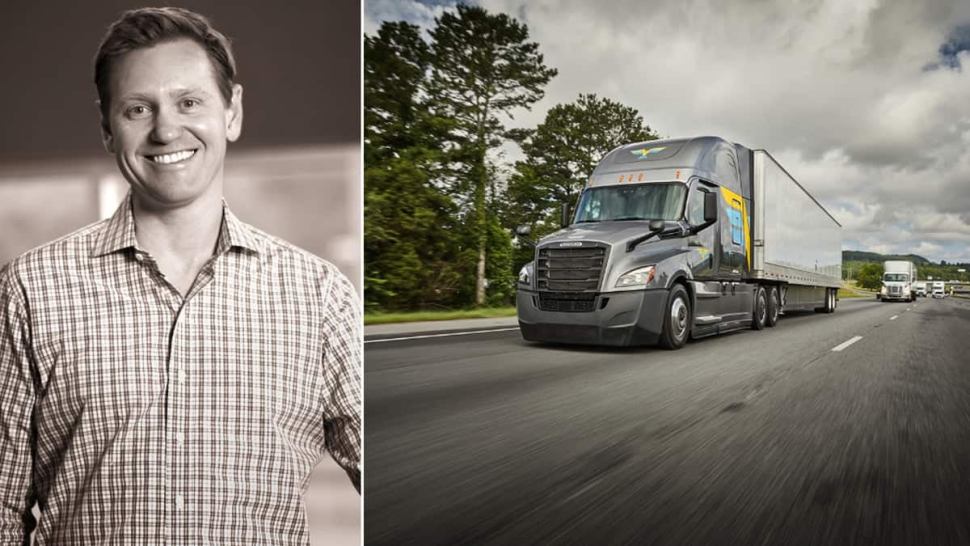
With Variant, the startup within U.S. Xpress that is about to wrap up its first full calendar year of operation, the company’s CEO told an audience of investors Thursday that sequential financial improvement at the company is likely to begin in the first quarter of 2022.
The third-quarter earnings of U.S. Xpress were a clear disappointment, with the company’s truckload operating ratio rising to 98% from 94.6% a year earlier and the consolidated adjusted OR coming in at 98.5%, weakening from 96.1%. This occurred during a quarter when several truckload peers turned in significantly stronger performances.
Fuller was asked at the Stephens Annual Investment Conference when he expects to see sequential improvement in the company’s OR as a result of the benefits of Variant starting to edge out what he conceded were continuing problems in the U.S. Xpress legacy model. “Starting in the first quarter,” he said.
The U.S. Xpress (NYSE: USX) presentation was webcast.
Fuller said that sequential improvement had been hoped for by the current fourth quarter. But without offering specifics, he said there were “a number of items that are probably going to have a negative impact” on U.S. Xpress’ fourth-quarters earnings and that sequential improvement over the third quarter was not likely.
But he continued to send the same message he has been attempting to get across to investors since Variant was first launched in mid-2020: “We are trying to focus on where we want to go,” Fuller said.
So rather than spend a lot of money to ensure sequential improvement now, longer-term fixes have been the focus and “we think we will be fairly clean going into 2022,” he said.
Variant is a division of U.S. Xpress that the company sees as its future. It relies heavily on AI for the mapping of routes and driver scheduling, it seeks to make significant changes in driver recruitment and retention, and Fuller has spoke often about his view that it was a matter of time before somebody came along in the truckload work with a hugely disruptive model. The company’s goal is that it will be the Variant way that will be the disruptive model or will at least be able to adapt to changes from elsewhere.
Fuller has been saying all year that Variant was on track to have 1,500 trucks in its fleet by the end of the year. He said at the conference that the number was expected to be hit later that day.
But despite that target being reached, Fuller said part of the failure of Variant to produce bigger improvements in OR has been an earlier lag in some of the gains that Variant is expected to produce.
He spelled out the numbers. The costs of conversion are currently running at an annual run rate of about $30 million. But the improvement in margin per truck is about $25,000. To cover the costs of that conversion, a fleet of about 1,400 to 1,500 trucks is needed.
That number has now been reached. “Once we can scale beyond that is where we see earnings improvements, and that is where we are at,” Fuller said.
But even though the 1,500 end point has been reached, the process was slowed during the year, according to Fuller. Driver recruitment during the year was hampered by additional federal unemployment benefits that expired in September; Fuller said that as a result, the Variant division had no net positive driver growth in July and August. “We didn’t grow as fast as we thought we would,” he said. “So maybe we’re getting that inflection point a few quarters past that.”
Fuller had mentioned an “inflection point” for Variant on the company’s first-quarter earnings call.
The failure of Variant to have a noticeable impact on U.S. Xpress’ current finances appears to have hit the stock price. U.S. Xpress is down more than 44% from its 52-week high of $12.33 set on March 31 and is down about 7.5% in the last 52 weeks.
By contrast, truckload carrier Werner (NASDAQ: WERN) is up 12% over the 52 weeks and is down just 10% from its 52-week high, set in May.
“As long as our truck count is growing, and we can maintain this growth, we will see sequential improvement from quarter to quarter, and maybe we can outrun seasonality,” Fuller added.
In earnings calls with analysts, Fuller has often been pressed to give specifics on how the Variant model is different from that for the legacy business at U.S. Xpress or at other companies. Details have been emerging, though at times it appeared as if the analysts wanted more than what was being discussed within the format of a quarterly earnings presentation.
However, at the Stephens conference, Fuller got specific about one particular area: driver recruitment. And he laid out a model that is unique and designed for “scalability,” a word that Fuller often uses in discussing how U.S. Xpress expects Variant to succeed.
Under the plan, drivers who recruit other drivers are known as ambassadors, and it comes with a financial incentive that goes beyond the payment of a one-time bonus. Fuller said ambassadors also get 2 cents per mile for every mile driven by the person they recruit.
Not only that, but if that driver then recruits another driver, the miles of that third driver yield 2 cents per mile not only to the person who recruited them but also to the original driver. So if driver Bob recruits driver Sue, and then Sue recruits driver Steve, Steve’s miles result in a payment not only to Sue but to Bob as well.
That chain of drivers is known as a “squad,” Fuller said, and it can be lucrative. One driver this year at Variant will make about $200,000, he said, and a good chunk of those earnings is coming from funds in his paycheck provided by the miles driven by members of that driver’s squad.
Fuller said the old model of recruiting — “hundreds of thousands of dollars in things like Facebook advertisements” and a “small army processing applications and trying to hire drivers” — was not scalable. But the model of the ambassadors and the squads is scalable, he said, because it incentivizes drivers not only to recruit new drivers but also to work with them to ensure they stay on board.
“If I am getting 2 cents per mile, I am going to call you and make sure you’re happy,” Fuller said. “So it is creating some positive retention. We think this is a model that has real scalability potential.”
Where all this is going, Fuller said, is a company that is seeking to double its revenue in the next three to four years. It would be a company that would have “a good bit” more trucks, and a lot of that would be in Variant.
Through three quarters, U.S. Xpress’ revenue this year was approximately $1.4 billion. That is an annual run rate of close to $1.9 billion.
With that growth, U.S. Xpress will be a bigger player in the market, giving it more access to capital, Fuller said, “whereas some of the smaller guys won’t have that.”
Disclosure: FreightWaves founder and CEO Craig Fuller retains ownership of U.S. Xpress shares through his family trust.
More articles by John Kingston
U.S. Xpress bottom line takes hit from big labor cost increases
Red ink turns black in U.S. Xpress first quarter report
U.S. Xpress makes its case on Variant at length in public forum
Brokerage Compliance Symposium
The day before F3. Every compliance issue you face - fraud exposure, carrier liability, FMCSA rules, cargo theft, insurance gaps - navigated by attorneys and operators defining best practices in a changing industry.
F3 Awards Dinner
The night before F3. FreightTech100 companies honored. FreightTech 25 and Shipper of Choice winners revealed live. Cocktail reception into dinner and live music - 300 industry leaders in one purpose-built room.
F3: Future of Freight Festival
Industry-defining keynotes, rapid-fire technology demos, and industry leaders networking in experiences across Chattanooga - plus the inaugural F3 Awards Dinner featuring the FreightTech and Shipper of Choice reveals.
The day before F3. Every compliance issue you face - fraud exposure, carrier liability, FMCSA rules, cargo theft, insurance gaps - navigated by attorneys and operators defining best practices in a changing industry.
The Signal at Chattanooga Choo Choo • Chattanooga, TN Register NowThe night before F3. FreightTech100 companies honored. FreightTech 25 and Shipper of Choice winners revealed live. Cocktail reception into dinner and live music - 300 industry leaders in one purpose-built room.
The Signal at Chattanooga Choo Choo • Chattanooga, TN Register NowIndustry-defining keynotes, rapid-fire technology demos, and industry leaders networking in experiences across Chattanooga - plus the inaugural F3 Awards Dinner featuring the FreightTech and Shipper of Choice reveals.
The Signal at Chattanooga Choo Choo • Chattanooga, TN Register Now