








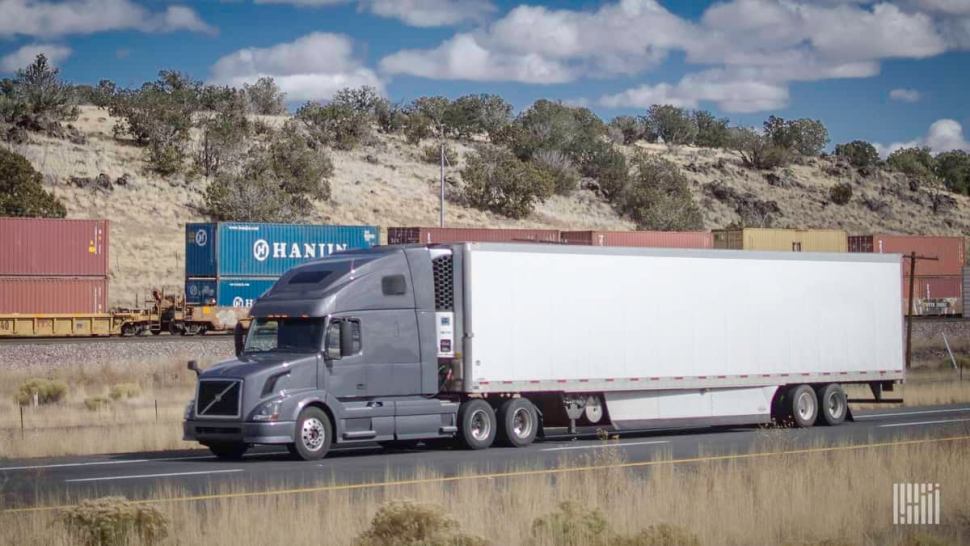
A study commissioned by the Coalition Against Bigger Trucks (CABT) asserts that allowing heavier and longer trucks on U.S. roads could divert intermodal and railcar traffic from rail to truck by as much as 25% and even by as much as 60% under certain scenarios.
The study, “Estimating the Rail-to-Truck Traffic Diversions Attributable to Increased Truck Size and Weight,” sought to quantify how much intermodal and railcar traffic could be taken off the railroads should trucking companies be allowed to utilize longer trucks of varying lengths. It also studied how rail traffic might be affected by trucks that can handle heavier loads due to increased cargo capacity.
The study comes as the debate on truck sizes and weights reignites amid the trucking industry’s response to the coronavirus pandemic. Some lawmakers also tried, but failed, to change current regulations as part of the wider surface transportation and infrastructure bill. Trade groups such as the Americans for Modern Transportation have also sought to modify existing rules to allow for longer and heavier trucks.
Using truck and rail pricing and demand data, author Mark Burton of the Appalachian Transportation Institute of Marshall University studied how six different truck configurations could result in the diversion of rail traffic to trucks. Those truck configurations were a 91,000-pound, single trailer truck with six axles; a 97,000-pound, single trailer truck with six axles; an 80,000-pound, double 33-foot trailer truck; a 91,000-pound, double 33-foot trailer truck; a 97,000-pound, double 33-foot trailer truck; and a 120,000-pound, double 33-foot trailer truck.
Federal law currently allows double trailer trucks to be no more than 28 feet in length per trailer, with the weight of a single trailer set at no more than 80,000 pounds on interstate highways.
The report concluded that how much rail volume gets diverted to trucks varies by truck configuration. An increase in allowed total gross truck weights from 80,000 to 91,000 pounds – but with no change in trailer length – is estimated to result in the diversion of 2.6 million railroad carloads and 1.8 million intermodal units annually, Barton said in the report.
Meanwhile, an increase of truck weights to 120,000 pounds combined with twin 33-foot trailers leads to a predicted diversion of 7.5 million rail carloads and 8.5 million diverted intermodal shipments annually, according to the report.
“The results are compelling. In a setting where policy makers openly and even vigorously pursue intermodal and other non-highway freight transport as a means of reducing highway congestion, improving safety outcomes, and protecting environmental resources, allowing bigger and/or heavier trucks would be hugely counterproductive,” Barton said.
Barton continued, the analysis “demonstrates that even a modest relaxation of the standards that govern truck sizes and weights will produce a measurable diversion of rail freight traffic to all-truck routings. In the extreme, the most aggressive changes to truck size and weight standards could be ruinous to rail carriers and to the public sector policies designed to mitigate the growth of truck-related harms.”
Legislative actions related to modify existing rules on truck sizes and weights
CABT’s release of the study comes as elected officials are debating the current rules governing truck sizes and weights. Some of the stand-alone bills currently in Congress include H.R. 2453 and S. 1509, which would allow heavier timber trucks across the nation, and H.R. 5773, which would increase interstate weights for a variety of commodities nationwide, according to CABT. These bills were introduced as amendments to the House version of the surface transportation and infrastructure bill, known as the INVEST in America Act.
Although the amendments to change truck sizes and weights didn’t make their way into the INVEST in America Act that the House passed, “the next opportunity is the appropriations process. Currently, there is no language about longer or heavier trucks in the Transportation, Housing and Urban Development appropriations markup, but there still may be an opportunity to offer amendments on the floor,” a CABT spokesperson told FreightWaves. “Historically, proponents have attempted, and in some cases succeeded, in getting bigger truck language included in appropriations bills.”
CABT continued, ““We need to stay vigilant. We are also tracking exemptions as a result of the pandemic, and 29 states currently allow heavier weights. We are monitoring any attempts to make those changes permanent.”
Click here for more FreightWaves articles by Joanna Marsh.
Related articles:
COVID-19 reenergizes truck size/weight battle
Would increasing U.S. truck weight limits make sense?
Truck stops join owner-operators in rejecting Dems’ highway bill
Brokerage Compliance Symposium
The day before F3. Every compliance issue you face - fraud exposure, carrier liability, FMCSA rules, cargo theft, insurance gaps - navigated by attorneys and operators defining best practices in a changing industry.
F3 Awards Dinner
The night before F3. FreightTech100 companies honored. FreightTech 25 and Shipper of Choice winners revealed live. Cocktail reception into dinner and live music - 300 industry leaders in one purpose-built room.
F3: Future of Freight Festival
Industry-defining keynotes, rapid-fire technology demos, and industry leaders networking in experiences across Chattanooga - plus the inaugural F3 Awards Dinner featuring the FreightTech and Shipper of Choice reveals.
The day before F3. Every compliance issue you face - fraud exposure, carrier liability, FMCSA rules, cargo theft, insurance gaps - navigated by attorneys and operators defining best practices in a changing industry.
The Signal at Chattanooga Choo Choo • Chattanooga, TN Register NowThe night before F3. FreightTech100 companies honored. FreightTech 25 and Shipper of Choice winners revealed live. Cocktail reception into dinner and live music - 300 industry leaders in one purpose-built room.
The Signal at Chattanooga Choo Choo • Chattanooga, TN Register NowIndustry-defining keynotes, rapid-fire technology demos, and industry leaders networking in experiences across Chattanooga - plus the inaugural F3 Awards Dinner featuring the FreightTech and Shipper of Choice reveals.
The Signal at Chattanooga Choo Choo • Chattanooga, TN Register Now