








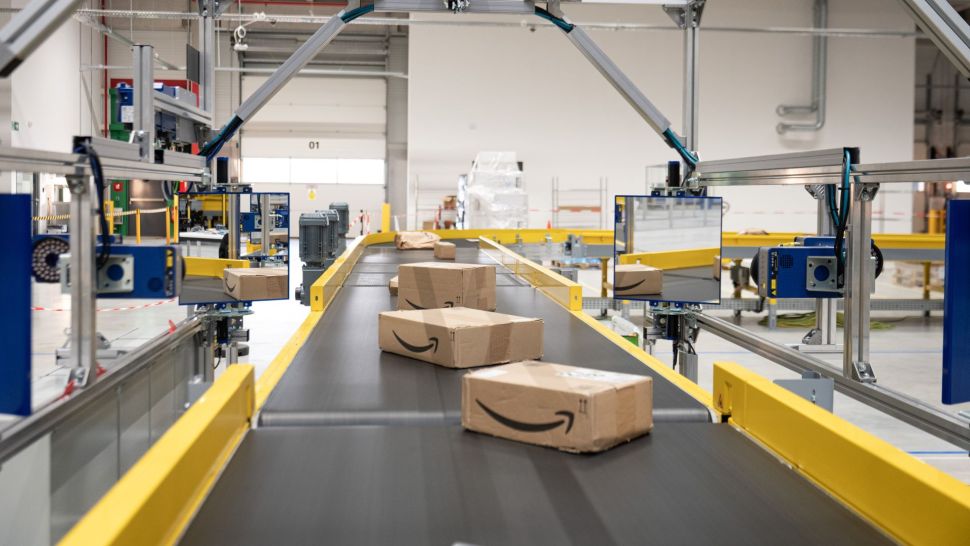
Amazon continued to speed up delivery service and make improvements to its fulfillment network during the second quarter, executives said in conjunction with the release of financial results on Thursday.
Globally, Amazon (NASDAQ: AMZN) delivered more than 40% of items same day or overnight in the first half of the year versus the same period last year. And it expanded ultra-fast delivery service Amazon Now, which promises delivery in 30 minutes or less on thousands of everyday essentials, to 80 cities and towns across the United States and several major cities in Egypt.
Amazon Now is available in nine countries and over 250 cities and towns, including Atlanta, Houston and Denver. The service has proven popular, with more than 80% growth in gross sales and units sold quarter-over-quarter and more than 60% more customers served from the prior quarter, CEO Andy Jassey told analysts. Faster delivery speeds combined with a broad selection of products on the marketplace are driving consumers to make more purchases on the Amazon site, he added.
Ultra-fast delivery is the latest move to increase delivery speed and keep customers buying on Amazon’s marketplace by offering extreme convenience. Amazon also offers one-hour and three-hour delivery on more than 90,000 products and same-day delivery on millions of items.
Chief Financial Officer Brian Olsavsky said Amazon made progress optimizing inventory, shortening shipping distances, reducing touches per package, and improving consolidation rates. The company is also expanding deployment of robotics and automation, which have been at the center of logistics operations for many years.
Amazon recently surpassed 1 million robots developed, produced and deployed across its operations network.
“We’re retrofitting our facilities with our latest generation technology, and we expect to more than double our fleet of robotic arms, like Cardinal and Sparrow, in 2026,” he said on the earnings call.
Cardinal is a robotic arm that tightly loads packages up to 50 pounds into carts in a Tetris-like manner.
Sparrow is a robotic system that supports employees who aggregate items for customer orders. This robotic arm picks up and moves individual items from containers into specific totes to send off to employees before they’re packaged. It can lift packages up to 12 pounds. Sparrow uses computer vision and AI to identify the correct item and add it to the tote on its delivery journey.
In early June, Amazon said it planned to install three types of new robots across its European fulfillment centers as part of a $10 billion modernization plan.
[Why It Matters: Amazon continues to set the bar for speed to beat and fulfillment costs across e-commerce logistics.]
Amazon was able to partially offset rising transportation costs driven by fuel inflation from the Iran war and higher trucking rates by implementing a fuel and logistics surcharge in April for Fulfillment by Amazon customers, Olsavsky said.
“Looking ahead, we see meaningful opportunities to further enhance productivity across our global fulfillment network, all while continuing to raise the bar in delivery speed. While operating margin may fluctuate and progress may not always be linear, we take a deliberate approach to achieving sustained long-term improvement in our cost to serve,” he said.
Many merchants are rethinking the speed equation, betting that most customers will be satisfied with predictable delivery times.
“For years, retailers have treated faster shipping as the way to compete with Amazon. That’s becoming a harder strategy to justify as fulfillment costs rise and logistics networks become more fragmented. Amazon has the scale and logistics infrastructure to absorb rising fulfillment and delivery costs, but most retailers don’t have that luxury. Brands don’t need to match the delivery speed of industry giants; they need to focus on giving customers a reason to come back after the package ships,” said Eric Kobe, CEO of Route, a post-purchase tech platform, via email.
Amazon’s stock leaped 15% by midday on Friday as cloud services drove outsize earnings gains. Amazon Web Services delivered $42 billion in revenue during the second quarter. Overall, Amazon reported a 20% gain in net sales to $200.6 billion. Operating income was $27.5 billion, up 43% year over year.
Click here for more FreightWaves/American Shipper stories by Eric Kulisch.
Write to Eric Kulisch at ekulisch@freightwaves.com.
RELATED STORIES:
Amazon air bridge supports Venezuela earthquake relief
Robots drive $10B Amazon investment for European fulfillment centers
DHL eCommerce to acquire Baltic parcel carrier Venipak
UPS explores outsourcing UK parcel delivery to third-party couriers
Brokerage Compliance Symposium
The day before F3. Every compliance issue you face - fraud exposure, carrier liability, FMCSA rules, cargo theft, insurance gaps - navigated by attorneys and operators defining best practices in a changing industry.
F3 Awards Dinner
The night before F3. FreightTech100 companies honored. FreightTech 25 and Shipper of Choice winners revealed live. Cocktail reception into dinner and live music - 300 industry leaders in one purpose-built room.
F3: Future of Freight Festival
Industry-defining keynotes, rapid-fire technology demos, and industry leaders networking in experiences across Chattanooga - plus the inaugural F3 Awards Dinner featuring the FreightTech and Shipper of Choice reveals.
The day before F3. Every compliance issue you face - fraud exposure, carrier liability, FMCSA rules, cargo theft, insurance gaps - navigated by attorneys and operators defining best practices in a changing industry.
The Signal at Chattanooga Choo Choo • Chattanooga, TN Register NowThe night before F3. FreightTech100 companies honored. FreightTech 25 and Shipper of Choice winners revealed live. Cocktail reception into dinner and live music - 300 industry leaders in one purpose-built room.
The Signal at Chattanooga Choo Choo • Chattanooga, TN Register NowIndustry-defining keynotes, rapid-fire technology demos, and industry leaders networking in experiences across Chattanooga - plus the inaugural F3 Awards Dinner featuring the FreightTech and Shipper of Choice reveals.
The Signal at Chattanooga Choo Choo • Chattanooga, TN Register Now