The benchmark diesel price used for most fuel surcharges rose by an amount seen only a few times in the history of the data series.
A one-week jump of 22.2 cents a gallon has been surpassed several times in the history of the Department of Energy/Energy Information Administration average retail price. That was the increase effective Monday, and it brought the price up to $4.127 a gallon, the highest since a price of $4.128 a gallon on March 27. The price has risen 36 cents a gallon in four weeks.
The history stretches back to 1994.
But almost all other times that a gain that big or more was recorded, it could be tied to a specific event: Hurricanes Katrina and Rita in 2005 (30.8 and 34.6 cents a gallon, respectively), the surging market of spring 2008 that led to an all-time high West Texas Intermediate price of $147 a barrel (22.6 cents a gallon), or more recently, the Russian invasion of Ukraine (increases of 74.5, 40.1 and 34.9 cents a gallon over the course of several weeks). A one-week increase of 38.8 cents a gallon last fall could be said to be indirectly due to the invasion but was mostly driven by tight inventories that likely had their root cause in the invasion.
That leaves the increase Monday in something of a category of its own: a huge one-week jump that can’t really be linked to any specific news event. But it has been driven by a monthlong surge in crude and product prices.
Statistics on the increase in the price of diesel are becoming too large for the transportation sector to ignore. Here are a few of key data points:
- The price of ultra low sulfur diesel on the CME commodity exchange Monday traded in excess of $3 a gallon. It did not settle above $3 — the settlement was $2.9909 a gallon, up 3.23 cents on the day — but the last time the ULSD contract did settle above $3 was Jan. 31. The Monday settlement was the highest since that day.
- Wholesale diesel on a national average basis, as measured by the ULSDR.USA data series in SONAR, climbed to $3.143 a gallon Saturday from $2.609 on July 1.
- The strength at the pump evidenced in the DOE/EIA price is not being driven by retail prices outpacing wholesale numbers. The FUELS.USA data series in SONAR, which measures the spread between the national average wholesale price in ULSDR.USA and the national average retail price in DTS.USA, was 91.5 cents a gallon Sunday. It was $1.039 a gallon last Monday, showing that retail prices are not keeping up with the wholesale prices that retailers are paying. That is a strong signal that retail prices, regardless of what happens in futures and wholesale markets, have some catching up to do. The FUELS.USA spread on May 4 was $1.615 a gallon.
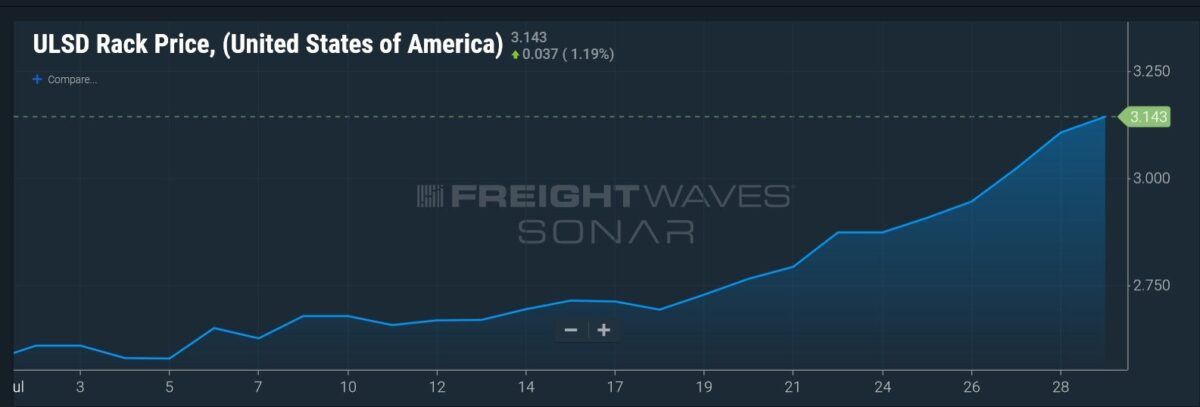
In the absence of a particular news event driving the market, consensus is building that robust demand worldwide and the impact of the cuts made by OPEC+ members at the beginning of May, plus an added Saudi cut of 1 million barrels a day (b/d) on top of that, are leading to a tight market that was not the horizon just a few months ago.
One of the biggest questions in the market has been the role of China. Reports of the country’s slow recovery from its zero-COVID policy drove the argument from market bears that the decline in prices through much of the first half of the year were justified on the basis that global demand, primarily because of weak Chinese activity, would more than offset production cutbacks implemented by the OPEC+ group since April.
In an appearance on CNBC Monday morning, Jeffrie Currie, the head of commodities research at Goldman Sachs and a man whose pronouncements are closely followed, said Chinese demand is strong.
Chinese demand is back up to 15.8 million b/d, Currie said, “which is rather healthy for July.” The soft market in the first half of the year, he said, “was driven by weakness in China, and a lot of that has shifted and I think that is one of the big factors that has driven us.”
July inventories of all petroleum globally probably declined about 2.2 million b/d in July, Currie said, “and that’s big and reinforcing the potential for more upside.”
In the report to the market that spurred Currie’s CNBC appearance, Goldman Sachs on Monday said it estimated that global petroleum demand in July probably hit an all-time high at 102.8 million b/d. It increased its estimate on full-year demand by 550,000 b/d, but China wasn’t a factor in that decision, Goldman said; rather, it was demand and gross domestic product estimates in India and the U.S.
On the supply side, Goldman increased its estimates of 2003 supply by 175,000 b/d. But when laid against the 550,000 b/d increase in demand, it led Goldman to see a “moderate” increase in the daily deficit between supply and demand of 1.8 million b/d and a smaller deficit of 600,000 b/d in 2024.
Despite the stronger outlook, Goldman is sticking to its full-year forecast of $86 a barrel for Brent for the full year — it settled Monday at $85.56 and through July averaged just under $80 — and now forecasts $93 a barrel in the second quarter of next year.
The bullish demand picture got another boost Monday with the release of the monthly U.S. statistics from the EIA. They are one a two-month lag but are considered more accurate than the weekly figures.
The May figure of 20.776 million b/d is an all-time high and marked a huge revision upward from what the weekly numbers were showing.
More articles by John Kingston
Covenant sees some opportunity from Yellow collapse
Yellow elephant in the room for Saia’s Q2 earnings call
The State of Freight: 5 takeaways on Yellow’s fate and a UPS strike
Brokerage Compliance Symposium
The day before F3. Every compliance issue you face - fraud exposure, carrier liability, FMCSA rules, cargo theft, insurance gaps - navigated by attorneys and operators defining best practices in a changing industry.
F3 Awards Dinner
The night before F3. FreightTech100 companies honored. FreightTech 25 and Shipper of Choice winners revealed live. Cocktail reception into dinner and live music - 300 industry leaders in one purpose-built room.
F3: Future of Freight Festival
Industry-defining keynotes, rapid-fire technology demos, and industry leaders networking in experiences across Chattanooga - plus the inaugural F3 Awards Dinner featuring the FreightTech and Shipper of Choice reveals.
The day before F3. Every compliance issue you face - fraud exposure, carrier liability, FMCSA rules, cargo theft, insurance gaps - navigated by attorneys and operators defining best practices in a changing industry.
The Signal at Chattanooga Choo Choo • Chattanooga, TN Register NowThe night before F3. FreightTech100 companies honored. FreightTech 25 and Shipper of Choice winners revealed live. Cocktail reception into dinner and live music - 300 industry leaders in one purpose-built room.
The Signal at Chattanooga Choo Choo • Chattanooga, TN Register NowIndustry-defining keynotes, rapid-fire technology demos, and industry leaders networking in experiences across Chattanooga - plus the inaugural F3 Awards Dinner featuring the FreightTech and Shipper of Choice reveals.
The Signal at Chattanooga Choo Choo • Chattanooga, TN Register Now