




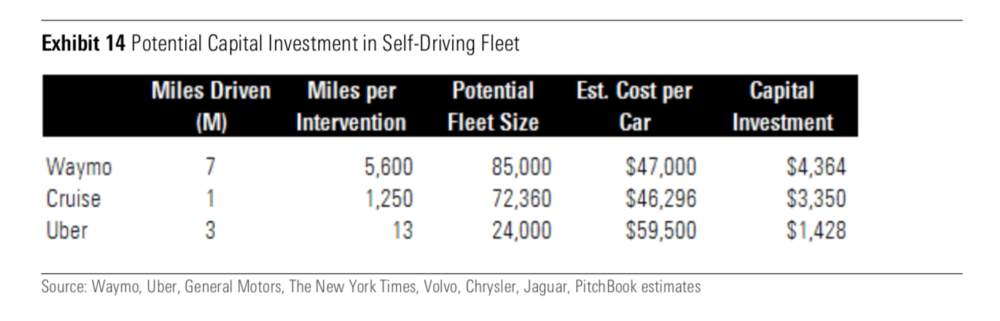
 Clearly, the company has a lot of work to do to ensure that Waymo or another competitor doesn’t Blockbuster them.
What does this mean for Uber Freight?
So far, Uber Freight appears to be a part of Uber’s business plan. Originally started do the same thing for truckload freight that the ride-hailing app did for passengers, the freight brokerage was constructed using industry professionals who understood the freight brokerage business. And, like the ride-hailing side of the company, autonomous technology promised to deliver much wider margins per ride/load for the Freight side of the business. So far the Uber Freight’s strategy of gaining market share has been working, but many in the industry have questioned whether Uber has been subsidizing the Uber Freight operation to allow it to gain market-share at the expense of gross margins. The strategy has been followed at other digital brokerages with some significant gains. For other VC-backed startups, using investor capital to build share might be the most efficient way to prove out the model, after all, they have no choice but to get big and optimize the franchise. But Uber Freight is different. Up until today, the goal (at least from the outside) appeared to be the use of Uber Freight’s brokerage arm to build out network density, so when self-driving trucks are market ready, the trucks had volumes of loads to pull from. Now Uber Freight says that it doesn’t need self-driving truck technology to compete effectively in the digital brokerage space. If the company is shutting down the autonomous trucking operation for good, Uber Freight looks like an outlier in the company. Uber Freight is unlikely to dominate the crowded freight brokerage industry any time soon–an industry with well-capitalized incumbents who have invested heavily in technology–and any resources that are diverted from the core business could stress the company. Uber Freight tells us that they have doubled load volumes every quarter, but they won’t share revenue information. At some point, Uber Freight will require self-sufficiency, which will stunt its growth. Additionally, Wall Street investors prefer simple business models that they can understand. Uber’s passenger business is easy to grasp. Also, easy to grasp: Waymo and other the player’s threat to Uber’s core business. If company executives are distracted in markets where the company is a small participant and unlikely to dominate, then what is the point? Freight brokerage and logistics is massively complicated. Shippers are not ordering many trucks on the Uber app (yes Morningstar suggested that people would order a 53′ on the same Uber app that people use to order a car). Savy supply-chain executives manage their business on a mode agnostic basis, using an enterprise ERP and TMS system to route freight. They will not see much value in a mobile app for freight booking. If Uber Freight loses the benefit of selling the concept of an autonomous trucking future, investors might prefer company executive attention on protecting and building out the core business. Few would care if Uber Freight went away, but if Uber were to lose the position as the dominate player in the passenger on-demand market, college courses on innovation and business failures will replace the section on Blockbuster with the story of Uber. Stay up-to-date with the latest commentary and insights on FreightTech and the impact to the markets by subscribing.Brokerage Compliance Symposium
The day before F3. Every compliance issue you face - fraud exposure, carrier liability, FMCSA rules, cargo theft, insurance gaps - navigated by attorneys and operators defining best practices in a changing industry.
F3 Awards Dinner
The night before F3. FreightTech100 companies honored. FreightTech 25 and Shipper of Choice winners revealed live. Cocktail reception into dinner and live music - 300 industry leaders in one purpose-built room.
F3: Future of Freight Festival
Industry-defining keynotes, rapid-fire technology demos, and industry leaders networking in experiences across Chattanooga - plus the inaugural F3 Awards Dinner featuring the FreightTech and Shipper of Choice reveals.
The day before F3. Every compliance issue you face - fraud exposure, carrier liability, FMCSA rules, cargo theft, insurance gaps - navigated by attorneys and operators defining best practices in a changing industry.
The Signal at Chattanooga Choo Choo • Chattanooga, TN Register NowThe night before F3. FreightTech100 companies honored. FreightTech 25 and Shipper of Choice winners revealed live. Cocktail reception into dinner and live music - 300 industry leaders in one purpose-built room.
The Signal at Chattanooga Choo Choo • Chattanooga, TN Register NowIndustry-defining keynotes, rapid-fire technology demos, and industry leaders networking in experiences across Chattanooga - plus the inaugural F3 Awards Dinner featuring the FreightTech and Shipper of Choice reveals.
The Signal at Chattanooga Choo Choo • Chattanooga, TN Register Now