




With a rebound in the freight market expected to have commenced long before the end of 2025, the inevitable question among analysts and observers is: what happened?
That was the focus of the November State of Freight webinar Tuesday, with FreightWaves’ strategic analyst John Paul Hampstead joining SONAR’s head of freight market intelligence Zach Strickland to take up the issue. FreightWaves and SONAR CEO Craig Fuller sat out the November webinar, with Hampstead taking his place.
One of the culprits was identified quickly in the discussion between Hampstead and Strickland: a turndown in demand. That was one of the five takeaways from the November discussion.
They’re not buying what carriers are selling
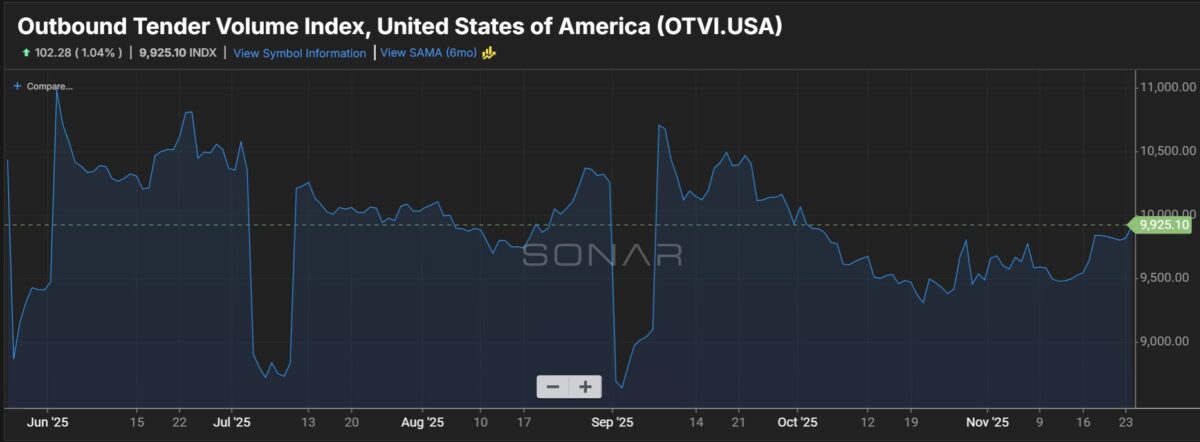
Carriers sell capacity. Strickland and Hampstead reviewed data in SONAR’s Outbound Tender Volume Index (OTVI) and it shows that demand for that capacity is soft by any measure.
“The tender volume index is not very impressive at this point,” Strickland said, pointing to “the big dip.” He said volume is down about 11% from this point in the calendar last year though last year at this point, the OTVI was taking a sudden counterseasonal downturn.
A recent upturn in the OTVI was noted by Strickland, but he said it was not “robust growth.”
Hampstead said many retailers may be expecting an “anemic or soft demand or sales environment going forward.” Given that, “I think that these retailers are happy to kind of burn off those inventories and let them run down,” he said.
Demand, Hampstead said, “is really what is holding the truckload market back.”
What the rejection index is saying
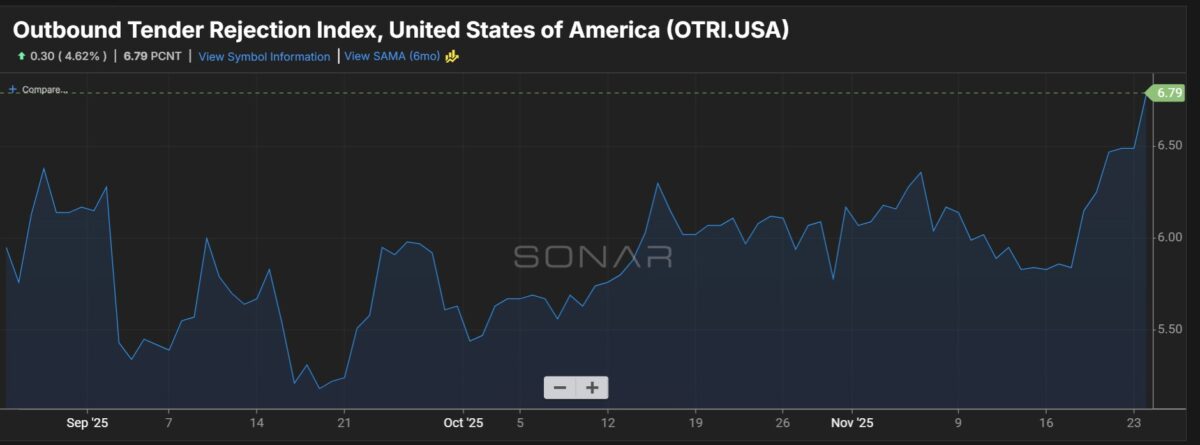
The counterpart to the OTVI is the Outbound Tender Rejection Index (OTRI). It is a measure of capacity and Strickland noted it is stronger…but not by a lot.
The rejection rate has been rising, standing Tuesday at 6.79%. Last year at this time, Strickland noted, it was about 6.5%. “We’ve had this incremental tightening of capacity that most people would not have felt, or they didn’t feel it, because it’s not happening quickly,” Strickland said. A difference of that magnitude over a year is “essentially nothing,” he said. “It has been slowly getting higher, so these increases are just not easily felt as much.”
Rates turning higher
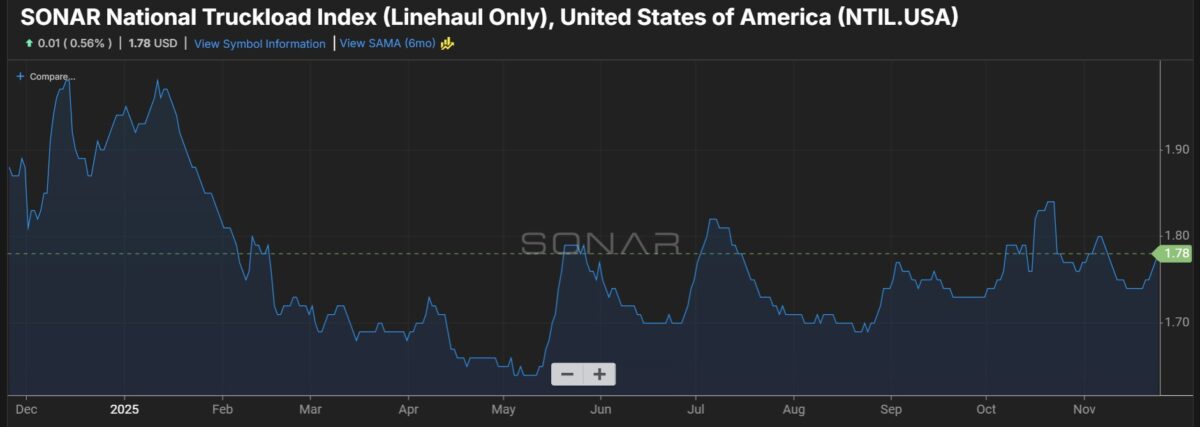
Although it hasn’t happened yet, Strickland said spot rates are an area where “a lot of people expect things to really take off.” Recent movement has seen an upward move in SONAR’s NTIL, the National Truckload Index (Linehaul Only),
Hampstead said data from the OTVI suggests that there has been more long-haul business recently, and that tends to push down the rate per mile calculations.
But the latest moves have been upward. When everything is put together–the recent small upturn in rejection rates and the higher NTIL numbers–”it tells you that there has been a slow burn of capacity leaving, and that even in a weak demand environment, things are still tightening,” Hampstead said.
As Strickland pointed out, a lot of carriers need that help. “A lot of these operators are basically just losing money to stay alive,” he said. “Their operating ratios are above 100 which means that if it’s 101, you’re losing a penny for every dollar you spend on moving freight.”
Renewed focus on regulation
One of the arguments for tightening capacity is a multi-pronged approach toward tighter regulation coming from the states and from the Federal Motor Carrier Safety Administration.
Beyond the crackdown over English language proficiency, Hampstead said a trip through the list of registered training providers who teach the pipeline of new truck drivers has numerous interesting addresses, “like random Baptist churches, PO boxes and people’s apartments. They’re clearly not providing training.”
“I think a lot of that can be cleaned up,” Hampstead said. “I think there are additional sorts of vectors of attack that this administration is using to help clean up the sort of shadier end of the spot market.”
Hampstead also said the issue of broker liability before the Supreme Court may lead 3PLs to ramp up even greater vetting of the carriers they chose. “This will put pressure on brokers and their insurers to really understand who they’re working with,” Hampstead said.
Crackdown on ELDs
Hampstead cited another area of regulatory push that has never been a leading focus of regulatory concern but is starting to move up the charts: the FMCSA crackdown on ELDs, removing the agency’s seal of approval from an increasing number of them.
The problem with ELDs sold by shady operators is that they can be easy to edit and manipulate, allowing a driver to exceed the normal Hours of Service rules. That adds to capacity. Taking them out of the market could work to tighten it. FMCSA has reported that this year, it has revoked 24 ELDs, which it says is the highest number since ELD enforcement began in 2018.
“There are lots of bad ELD providers that change people’s hours of service and let them sort of run illegally,” Hampstead said. “Those are finally getting cracked down on, and they’re removing bunches of providers every week. So I think that will also tend to tighten capacity in the spot market.”
More articles by John Kingston
A ‘jobs apocalypse’: panel at Trimble eyes AI’s future in logistics
Likely 1st AB5 trucking enforcement action in California snags 3 companies
Trucking takeaways from Trimble: volume down, driver population sliding
Brokerage Compliance Symposium
The day before F3. Every compliance issue you face - fraud exposure, carrier liability, FMCSA rules, cargo theft, insurance gaps - navigated by attorneys and operators defining best practices in a changing industry.
F3 Awards Dinner
The night before F3. FreightTech100 companies honored. FreightTech 25 and Shipper of Choice winners revealed live. Cocktail reception into dinner and live music - 300 industry leaders in one purpose-built room.
F3: Future of Freight Festival
Industry-defining keynotes, rapid-fire technology demos, and industry leaders networking in experiences across Chattanooga - plus the inaugural F3 Awards Dinner featuring the FreightTech and Shipper of Choice reveals.
The day before F3. Every compliance issue you face - fraud exposure, carrier liability, FMCSA rules, cargo theft, insurance gaps - navigated by attorneys and operators defining best practices in a changing industry.
The Signal at Chattanooga Choo Choo • Chattanooga, TN Register NowThe night before F3. FreightTech100 companies honored. FreightTech 25 and Shipper of Choice winners revealed live. Cocktail reception into dinner and live music - 300 industry leaders in one purpose-built room.
The Signal at Chattanooga Choo Choo • Chattanooga, TN Register NowIndustry-defining keynotes, rapid-fire technology demos, and industry leaders networking in experiences across Chattanooga - plus the inaugural F3 Awards Dinner featuring the FreightTech and Shipper of Choice reveals.
The Signal at Chattanooga Choo Choo • Chattanooga, TN Register Now