









WASHINGTON — A long-standing quest for better data on how delays experienced by truck drivers waiting to load and unload affects safety and lost pay will get a fresh start by federal regulators.
The Federal Motor Carrier Safety Administration released on Wednesday the parameters of a new data collection it hopes will close an information gap preventing regulators from fully understanding the effects of truck driver detention time.
“This research study will collect data on commercial motor vehicle driver detention time representative of the major segments of the motor carrier industry, analyze that data to determine the frequency and severity of detention time, and assess the utility of existing intelligent transportation systems solutions to measure detention time,” according to an Information Collection Request (ICR) FMCSA plans to submit to the Office of Management and Budget (OMB) for approval.
The ICR points out that while a 2014 FMCSA study provided “valuable insights” on the effect of detention time on carrier and driver safety, it was limited, among other things, by a small sample size and the inability to separate legitimate time drivers spent loading and unloading from excess wait times.
“Therefore, FMCSA needs additional data from a broader sample of carriers to understand the safety and operational impact of detention time, to better understand why detention time occurs, and to identify potential mitigation strategies the industry may use to reduce detention time while improving operational efficiencies and safety,” the ICR notes.
To close the information gap, FMCSA’s study will use data collected from electronic logging devices, transportation management systems, vehicle telematic systems, safety records and from questions using carrier dispatching systems.
“The TMS, ELD, telematics, and safety data are already collected by carriers,” the ICR states. “The only additional data that will be collected will be the answers to questions submitted through the carriers’ dispatching systems. This information will allow FMCSA to identify the severity and frequency of detention time, the factors that contribute to detention time, and the administrative, operational, and safety outcomes of detention time.”
The agency wants to recruit approximately 80 carriers and 2,500 drivers to participate in the 12-month study. Most of the data is to be collected from clients of SpeedGauge, a San Francisco-based telematics company that generates data used by insurance companies to help make underwriting decisions for commercial carriers. FMCSA said it will also consider data from individual carriers that want to participate.
FMCSA outlined three primary objectives for the data collection:
- Assess the frequency and severity of driver detention time using data that represents the major segments of the motor carrier industry.
- Assess the utility of existing intelligent transportation systems solutions to measure detention time.
- Prepare a final report that summarizes the findings, answers the research questions and offers strategies to reduce detention time.
“Completing these research objectives will provide insight into any relationship between driver detention time and CMV safety,” FMCSA stated.
“Additionally, the findings from this study can contribute to a more complete understanding of these issues and facilitate private sector decisions that lead to reductions in detention time and improvements in safety and supply chain efficiency.”
FMCSA is giving the public 60 days to comment on the ICR before submitting it to OMB.
Getting a better understanding of the effects of driver detention time on safety and driver pay has been a priority of regulators and lawmakers over the last five years.
Predicted Crash Rates for Changes in Average Dwell Time
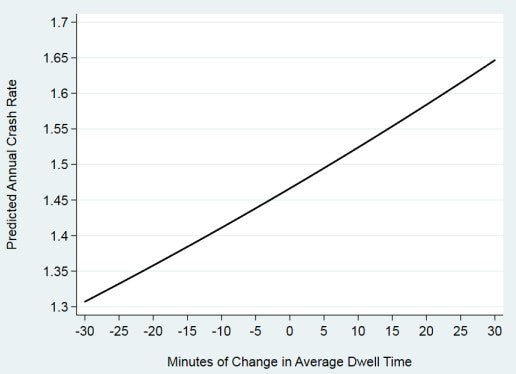
Source: DOT OIG 2018 report
A 2018 analysis by the U.S. Department of Transportation’s Office of Inspector General estimated that a 15-minute increase in average dwell time (the total time spent by a truck at a facility) increases the average expected crash rate by 6.2% – the theory being, drivers paid by the mile or by the load have an incentive to make up lost time by speeding (see chart).
The report also estimated that detention reduces annual earnings by $1.1 billion to $1.3 billion for drivers in the truckload sector.
In 2020, Democratic lawmakers attempted to include in a highway reauthorization bill not only a detention time study but a follow-on rulemaking to establish limits on the amount of time a driver could be detained by a shipper or receiver before being required to be compensated for lost time. The provision did not make it into the final reauthorization passed in 2021.
Related articles:
Brokerage Compliance Symposium
The day before F3. Every compliance issue you face - fraud exposure, carrier liability, FMCSA rules, cargo theft, insurance gaps - navigated by attorneys and operators defining best practices in a changing industry.
F3 Awards Dinner
The night before F3. FreightTech100 companies honored. FreightTech 25 and Shipper of Choice winners revealed live. Cocktail reception into dinner and live music - 300 industry leaders in one purpose-built room.
F3: Future of Freight Festival
Industry-defining keynotes, rapid-fire technology demos, and industry leaders networking in experiences across Chattanooga - plus the inaugural F3 Awards Dinner featuring the FreightTech and Shipper of Choice reveals.
The day before F3. Every compliance issue you face - fraud exposure, carrier liability, FMCSA rules, cargo theft, insurance gaps - navigated by attorneys and operators defining best practices in a changing industry.
The Signal at Chattanooga Choo Choo • Chattanooga, TN Register NowThe night before F3. FreightTech100 companies honored. FreightTech 25 and Shipper of Choice winners revealed live. Cocktail reception into dinner and live music - 300 industry leaders in one purpose-built room.
The Signal at Chattanooga Choo Choo • Chattanooga, TN Register NowIndustry-defining keynotes, rapid-fire technology demos, and industry leaders networking in experiences across Chattanooga - plus the inaugural F3 Awards Dinner featuring the FreightTech and Shipper of Choice reveals.
The Signal at Chattanooga Choo Choo • Chattanooga, TN Register Now