









Buried in the U.S. House and Senate versions of highway reauthorization legislation currently being negotiated are provisions that would allow billions of dollars to be spent dismantling portions of the interstate highway system without replacing the lost transportation capacity.
The provisions — “Reconnecting Neighborhoods” in the House version, “Reconnecting Communities” in the Senate — reflect the Biden administration’s goals of using infrastructure funding to address historic racial and social inequities.
“The construction of the nation’s interstate highway system was shaped by systemic racism,” states an appropriations committee report that accompanies the House bill. “There are countless examples of interstate highways that were directly and purposefully routed through established minority communities, causing community upheaval, loss of homes and businesses, and economic hardship.”
The committee encouraged Secretary of Transportation Pete Buttigieg, and DOT secretaries that follow, to prioritize projects that reconnect these communities — by replacing highway segments with local streets or park space, for example — to “increase opportunity, advance racial equity and environmental justice, and promote affordable access.”
But not everyone is on board. The policy being promoted by President Joe Biden and his Democratic colleagues in Congress places the freight supply chain at risk, according to a shipper advocate.
Truck productivity in crosshairs
“There’s no language in the statute at this point that allows federal money to be used to tear down an interstate without replacing it,” said Randy Mullett, a policy adviser for the National Industrial Transportation League, which lobbies on behalf of shippers. “The language in these bills would change that.”
Mullett said the supply chain implications of the policy are clear: Less capacity to move freight by truck will mean longer transit times for carriers and higher costs for shippers.
“The location for retail outlets and distribution centers were based in many cases on the location of the interstate system and the ability to move truckloads within an 11-hour drive time window,” he said. “Moving the goal post by adding time to the trips because of rerouting or moving on slower local roads, even if it’s just an extra half-hour per day, carrier fuel costs go up and a driver can’t get as far due to hours-of-service restrictions. It would be a major hit to driver wages and carrier productivity, with costs passed down to shippers.”
A project that could be first to test Mullett’s theory involves removing a portion of Interstate 81 in Syracuse, New York, a major trucking route for both local freight and a “national and international north-south trade route from Tennessee to the Canadian border,” according to the New York State Department of Transportation. The $2 billion project would tear down a 1.4-mile elevated section of the highway running through downtown Syracuse and would be replaced with a “community grid” of city street connections. Through trucks would be rerouted around the city while some local freight would have to use the city grid, adding to transit times.
The project — which Biden mentioned specifically in his American Jobs Plan unveiled in March, along with a similar project involving Interstate 10 through downtown New Orleans — is scheduled to begin construction in 2022, according to Syracuse media sources.
‘New urbanism’ future?
Both the I-81 and I-10 projects are among 15 interstate highways across the country that are “prime for a transformation,” according to Congress for the New Urbanism (CNU), whose mission is to “champion walkable urbanism.”
The Washington-based nonprofit’s annual list, “Freeways Without Futures,” features sections of major highways that the group considers ripe for removal. CNU points out that the I-81 project in Syracuse will likely be the first of the projects in the report that can be removed from its Top 15 list given how close the project is to startup.
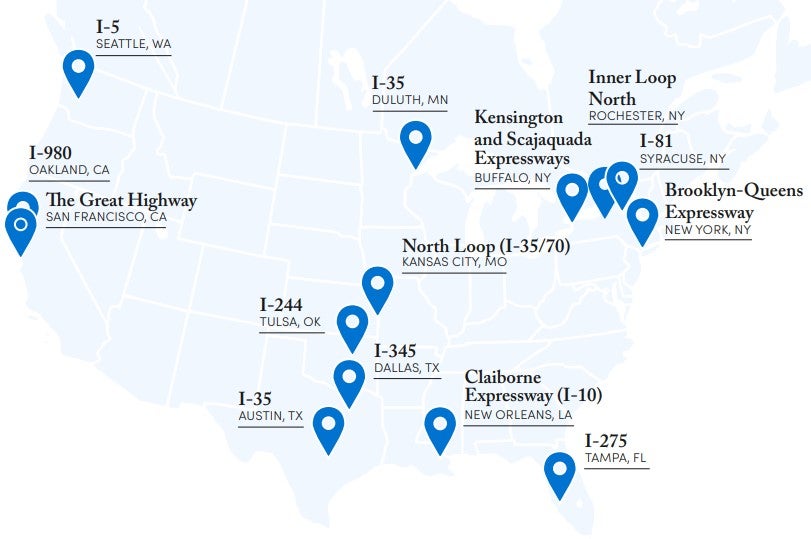
Asked about potential effects that such projects can have on commercial supply chains, Ben Crowther, program manager for CNU’s Highways to Boulevards initiative, told FreightWaves that in most cases the sections of highway that have support for removal from members of a local community “are far from integral to the larger interstate network.”
“These are highways in urban areas, where trucking already experiences delays mixing with city traffic, often spur routes, and often no more than a mile or two in length.”
That’s not how some truckers who would be affected by such projects view the highway removal issue. One of the projects on CNU’s list involves the potential removal of a section of Interstates 35 and 70 known as the North Loop that runs through downtown Kansas City, Missouri, in an effort to reconnect neighborhoods cut off by the interstate.
“I can’t imagine what would happen to travel times if the North Loop were to be removed,” Kristen Storey, business development manager for International Express Trucking, a Kansas City, Kansas-based intermodal trucking company, told FreightWaves. “That’s a huge trucking corridor that already gets backed up, and taking it out would cause more delays for sure.”
Related articles:
Brokerage Compliance Symposium
The day before F3. Every compliance issue you face - fraud exposure, carrier liability, FMCSA rules, cargo theft, insurance gaps - navigated by attorneys and operators defining best practices in a changing industry.
F3 Awards Dinner
The night before F3. FreightTech100 companies honored. FreightTech 25 and Shipper of Choice winners revealed live. Cocktail reception into dinner and live music - 300 industry leaders in one purpose-built room.
F3: Future of Freight Festival
Industry-defining keynotes, rapid-fire technology demos, and industry leaders networking in experiences across Chattanooga - plus the inaugural F3 Awards Dinner featuring the FreightTech and Shipper of Choice reveals.
The day before F3. Every compliance issue you face - fraud exposure, carrier liability, FMCSA rules, cargo theft, insurance gaps - navigated by attorneys and operators defining best practices in a changing industry.
The Signal at Chattanooga Choo Choo • Chattanooga, TN Register NowThe night before F3. FreightTech100 companies honored. FreightTech 25 and Shipper of Choice winners revealed live. Cocktail reception into dinner and live music - 300 industry leaders in one purpose-built room.
The Signal at Chattanooga Choo Choo • Chattanooga, TN Register NowIndustry-defining keynotes, rapid-fire technology demos, and industry leaders networking in experiences across Chattanooga - plus the inaugural F3 Awards Dinner featuring the FreightTech and Shipper of Choice reveals.
The Signal at Chattanooga Choo Choo • Chattanooga, TN Register Now