








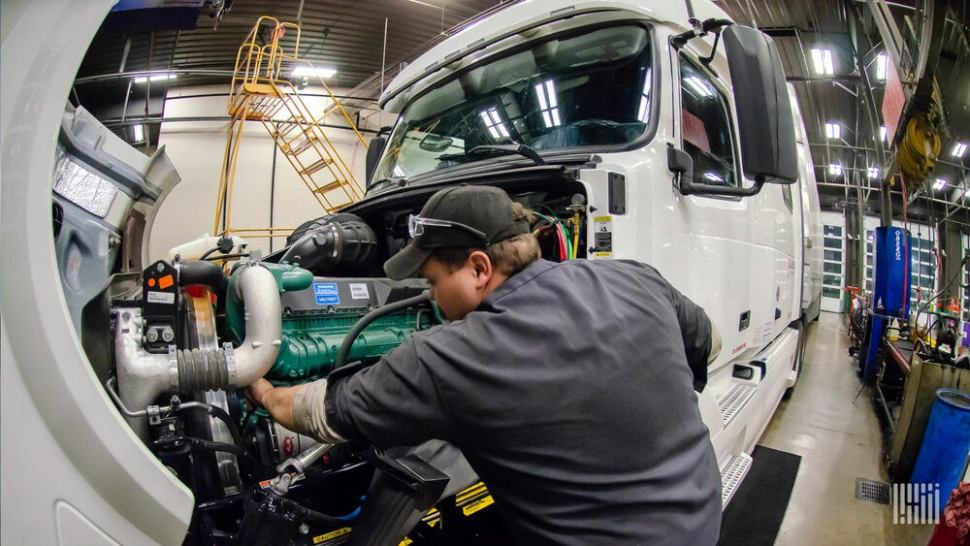
With razor-thin margins, trucking fleets seeking a financial edge are often left to massaging rates, squeezing every penny they can out of a customer. Some fleets, though, gain an edge through their maintenance practices.
The American Transportation Research Institute (ATRI) said it cost $1.82 per mile to operate a truck in 2018, based on its Operational Costs of Trucking survey. That includes repair and maintenance expenses, which ATRI said accounts for 17.1 cents per mile, and another 3.8 cents per mile for tires, bringing the total to 20.9 cents per mile.
Chris Henry, program manager for the Truckload Carrier Association’s Profitability Program (TPP), told audience members at the Katz, Sapper & Miller Trucking Roundtable in March that maintenance costs are the biggest potential cost savings for fleets.
“Maintenance cost per mile is the biggest opportunity we have to drive profitability,” Henry said.
TPP is a group of more than 200 carriers that share internal data with other members of the group. The data is anonymized and used for benchmarking purposes. TPP also provides participating fleets with educational opportunities and additional data measurement opportunities to help them improve their profitability.
According to Henry, TPP members have documented a wide range of maintenance costs per mile, suggesting there is room for improvement.
“In the last six months we’ve seen 9 cents per mile, and we can document that, all the way up to 40 cents per mile – that’s all profit,” Henry said.
Why do some fleets have maintenance costs that are so low and others much more? The answer is probably not as straightforward as it would seem.
Maintenance cost per mile is the biggest opportunity we have to drive profitability.
For one, vehicle age plays a role. Henry said that the average age of vehicles in TPP member fleets is 2.3 years. That compares to the average age of 4.4 for the fleets in the ATRI survey. As vehicles age and mileage piles up, the inherent maintenance costs will increase.
Secondly, some fleets are just better at preventive maintenance than others. TMW Systems has said that maintenance costs have risen over 50% in the past five years, with 20% of that cost associated to vehicle breakdowns and unplanned service repairs, some of which can be mitigated through robust preventive maintenance programs. J.J. Keller & Associates considers preventive maintenance to be “the key to any successful maintenance program for commercial motor vehicles.”
A good preventive maintenance program thoroughly inspects the vehicle and identifies items that need replacement and worn items that should be replaced. It is especially important to identify wear items as this allows fleets to schedule downtime and minimize cost, rather than paying for an unscheduled, on-road repair.
Chris Marks, regional director of Ryder System, Inc., explained to FreightWaves last fall the importance of proper preventive maintenance.
“We can control the cost of the repair when it’s in the shop,” Marks said, “but when it’s on the road broken down, we have lost all control and the cost of repairs can skyrocket at that point.
“Preventive maintenance is not cheap, but it’s something you choose to invest in,” Marks said. “A truck owner must be aware of the cost of repairs and preventing those breakdowns. Often this ends up saving money in the end.”
Another factor impacting maintenance costs is technician pay. Whether fleets operate their own maintenance shop or outsource, the industry is facing a lack of qualified technicians. The U.S. Bureau of Labor Statistics has said the industry will need 9.2% more technicians by 2022 compared to 2012’s numbers. The average technician salary in 2018 was $61,000. This is driving up costs such as salary and overtime, all of which goes into the maintenance per mile cost.
Henry said fleets should include labor, parts, tires, supplies, oil, lubrication and fixed overhead when calculating maintenance cost per mile. Consequently, labor and preventive maintenance are just one part of the larger puzzle.
Benchmarking is another.
The fleet that is paying 40 cents per mile for maintenance may not know its costs are out of line with competitors, unless it benchmarks, which makes programs like the TPP so valuable. Assuming the average fleet is paying 20 cents per mile, the fleet that is paying 40 cents per mile is losing 20 cents for every mile it drives – meaning each truck driving 100,000 miles is costing $20,000 more to operate than a competitor’s truck.
“This industry has an endless number of modes and operating models, not to mention people and aptitudes,” Henry wrote in a recent FreightWaves article. “Being a top performer in one category doesn’t necessarily equate to top performance in multiple categories. However, understanding the numbers and their place in your margin equation can be the difference between survival and realizing the American (and Canadian) dream.”
Brokerage Compliance Symposium
The day before F3. Every compliance issue you face - fraud exposure, carrier liability, FMCSA rules, cargo theft, insurance gaps - navigated by attorneys and operators defining best practices in a changing industry.
F3 Awards Dinner
The night before F3. FreightTech100 companies honored. FreightTech 25 and Shipper of Choice winners revealed live. Cocktail reception into dinner and live music - 300 industry leaders in one purpose-built room.
F3: Future of Freight Festival
Industry-defining keynotes, rapid-fire technology demos, and industry leaders networking in experiences across Chattanooga - plus the inaugural F3 Awards Dinner featuring the FreightTech and Shipper of Choice reveals.
The day before F3. Every compliance issue you face - fraud exposure, carrier liability, FMCSA rules, cargo theft, insurance gaps - navigated by attorneys and operators defining best practices in a changing industry.
The Signal at Chattanooga Choo Choo • Chattanooga, TN Register NowThe night before F3. FreightTech100 companies honored. FreightTech 25 and Shipper of Choice winners revealed live. Cocktail reception into dinner and live music - 300 industry leaders in one purpose-built room.
The Signal at Chattanooga Choo Choo • Chattanooga, TN Register NowIndustry-defining keynotes, rapid-fire technology demos, and industry leaders networking in experiences across Chattanooga - plus the inaugural F3 Awards Dinner featuring the FreightTech and Shipper of Choice reveals.
The Signal at Chattanooga Choo Choo • Chattanooga, TN Register Now