








FreightWaves Classics is sponsored by Sutton Transport, an LTL leader in the Midwest for more than 40 years. Sutton Transport proudly services Illinois, Minnesota, Missouri and Wisconsin. Request a quote here.
The many industries that make up the world of freight have undergone tremendous change over the past several decades. FreightWaves explores the archives of American Shipper’s nearly 70-year-old collection of shipping and maritime publications to showcase interesting freight stories of long ago.
In today’s edition, from the April 1991 issue of American Shipper (virtual pages 59-60), FreightWaves Classics dives into plans to revolutionize intermodal shipping of automobiles.
Two years after it piqued interest at the Atlanta International Expo, a new automobile-shipping system is undergoing live tests — and getting positive reviews.
“It’s performed excellently,” said Tim Stuckey, executive vice president of the Greenbrier Companies, which developed the Autostack system for shipping cars inside containers.
“There have been some glitches, but they’ve all been relatively minor,” said Jerry Taylor, general manager of automotive operations for Burlington Northern Railroad.
Some suggest that Autostack has the potential to revolutionize automobile shipping, which now relies on specialized equipment such as multi-stack railcars and pure car carrier ships.
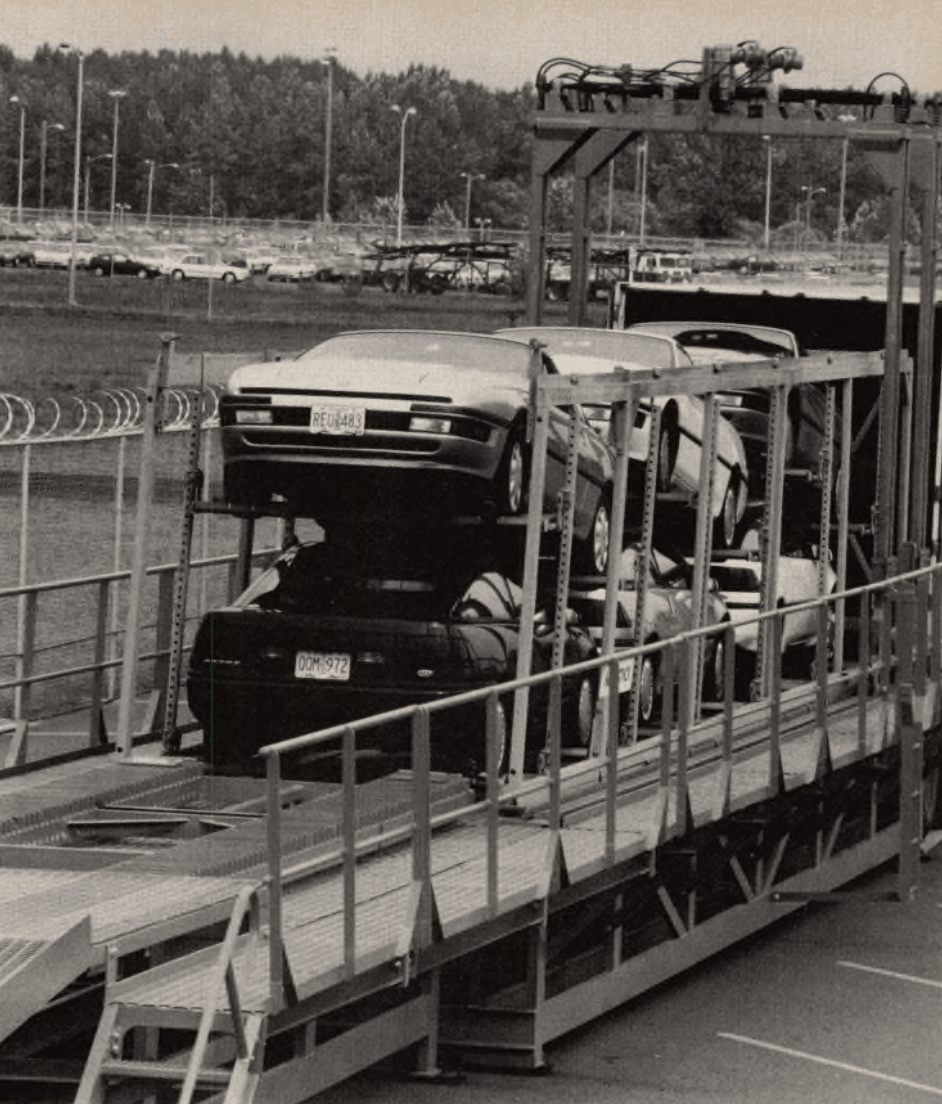
The Autostack system has been tested since Feb. 15 on shipments moving five times a week each way on Burlington Northern trains between Seattle and Chicago. The tests will run through April.
The new system allows automobiles to move in regular intermodal containers instead of the multilevel railcars that now are the industry standard.
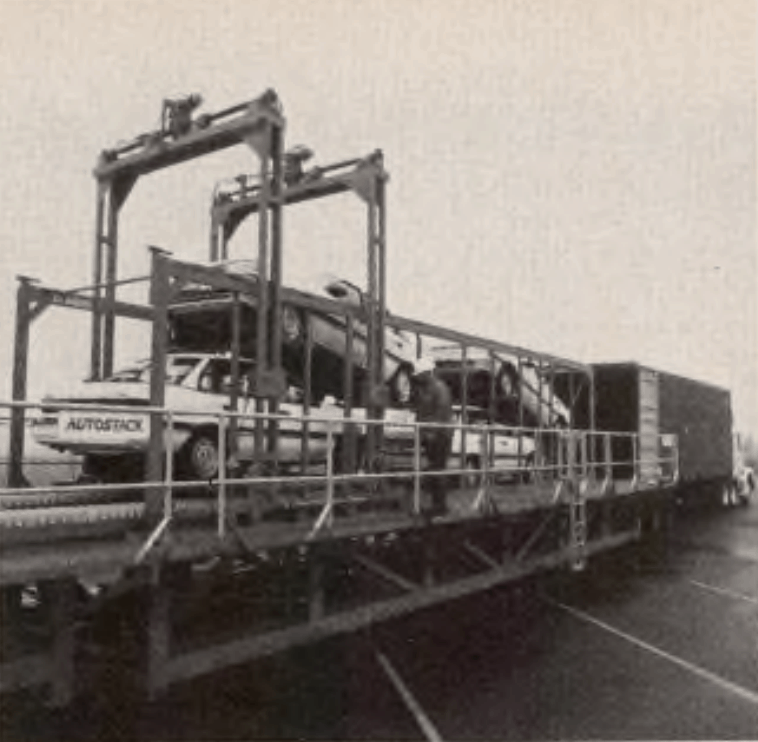
With Autostack, as many as six autos are rolled into a rack that a special loader mechanically inserts into a container for transport. The racks are collapsible and can fit six to a container when they are knocked down.
Sneak preview
The system attracted keen interest during a sneak preview at the Atlanta Intermodal Expo in 1989. It wasn’t on full display at the expo because some foreign patents were still pending. But enough was shown to whet the interest of careful observers, particularly other equipment makers.
Stuckey said Greenbrier, a major railcar builder and lessor, intentionally kept quiet about the system until it could be completed and evaluated. “We didn’t want to make fools of ourselves or our customers.”
The operational testing of the system has been done in cooperation with Burlington Northern. BN has been providing the containers and trains, while Greenbrier’s Autostack Inc. subsidiary has been operating the equipment.
The system is being used to transport Ford automobiles from the Chicago suburb of Naperville, Illinois, to Seattle and Nissan vehicles from Seattle back to Naperville.
Less damage
Bill DeWitt, Burlington Northern’s automotive vice president, said the system could revolutionize the intermodal transportation of automobiles.
“Automotive manufacturers have been asking for safer modes of transport,” DeWitt said.
Greenbrier officials said reduced damage is a big selling point for the system. They said the system reduces the potential for damage in several ways:
- Because the system for inserting the auto-carrying racks into containers means cars don’t have to be driven into tight enclosures, dents and dings are avoided.
- Autos can travel in sealed containers, which reduces the potential for theft and vandalism and allows for shippers to use smoother-rising stacktrains.
Besides reducing damage, the system has the potential to free shippers from dependence on specialized equipment that requires expensive repositioning on one-way moves.
Niche markets
Greenbrier officials envision the Autostack system serving niche markets in the hub-to-hub shipments.
Examples would be expensive vehicles that require special safeguards against damage and overseas shipments in lots too small to justify use of a pure car carrier ship.
Richard Tierney, a Greenbrier spokesman, said that because the collapsible racks lend themselves to one-way shipments, a natural market might be exports from foreign-owned “transplant” U.S. automotive factories that import parts in containers.
They don’t foresee it replacing pure car carriers or traditional multilevel railcars that are designed to handle vans and trucks as well as automobiles. Autostack handles only automobiles.
Over the long term, however, BN’s Taylor said the ideal use of the system would be to allow cars to be shipped directly from manufacturer to dealer.
However, all concerned say that ideal won’t be reached soon. For one thing, too much has been invested in other, specialized types of equipment for vehicle transport.
How it works
The Autostack machinery is simple and can be set up quickly and operated easily, Greenbrier officials say.
The most complicated part of the system is the loader, an apparatus that employs basic technology and uses hydraulic jacks to raise and lower the racks on which the cars are stowed.
The wheeled racks that fit into the containers are made from steel pipe and are hinged at one end so they can be collapsed for the backhaul leg on one-way shipments.
The racks weigh about 5,000 pounds for 40-foot containers and 6,500 pounds for 48-footers.
In designing the system, Greenbrier avoided using hydraulic jacks in the racks because of the potential for damage from leaks.
“The steamship and railroad lines weren’t crazy about having hydraulic fluid in their containers,” Stuckey said, pointing out the system has worked well, even during winter operations in Chicago. “We wanted to see what it would do in cold weather and it performed well when there was a chill factor of 35 below.”
FreightWaves Classics articles look at various aspects of the transportation industry’s history. If there are topics that you think would be of interest, please send them to fwclassics@www.freightwaves.com
Click for more content from the American Shipper Archives.
You may also like:
1981: US yards watching plans for floating electric generating vessels
Brokerage Compliance Symposium
The day before F3. Every compliance issue you face - fraud exposure, carrier liability, FMCSA rules, cargo theft, insurance gaps - navigated by attorneys and operators defining best practices in a changing industry.
F3 Awards Dinner
The night before F3. FreightTech100 companies honored. FreightTech 25 and Shipper of Choice winners revealed live. Cocktail reception into dinner and live music - 300 industry leaders in one purpose-built room.
F3: Future of Freight Festival
Industry-defining keynotes, rapid-fire technology demos, and industry leaders networking in experiences across Chattanooga - plus the inaugural F3 Awards Dinner featuring the FreightTech and Shipper of Choice reveals.
The day before F3. Every compliance issue you face - fraud exposure, carrier liability, FMCSA rules, cargo theft, insurance gaps - navigated by attorneys and operators defining best practices in a changing industry.
The Signal at Chattanooga Choo Choo • Chattanooga, TN Register NowThe night before F3. FreightTech100 companies honored. FreightTech 25 and Shipper of Choice winners revealed live. Cocktail reception into dinner and live music - 300 industry leaders in one purpose-built room.
The Signal at Chattanooga Choo Choo • Chattanooga, TN Register NowIndustry-defining keynotes, rapid-fire technology demos, and industry leaders networking in experiences across Chattanooga - plus the inaugural F3 Awards Dinner featuring the FreightTech and Shipper of Choice reveals.
The Signal at Chattanooga Choo Choo • Chattanooga, TN Register Now