



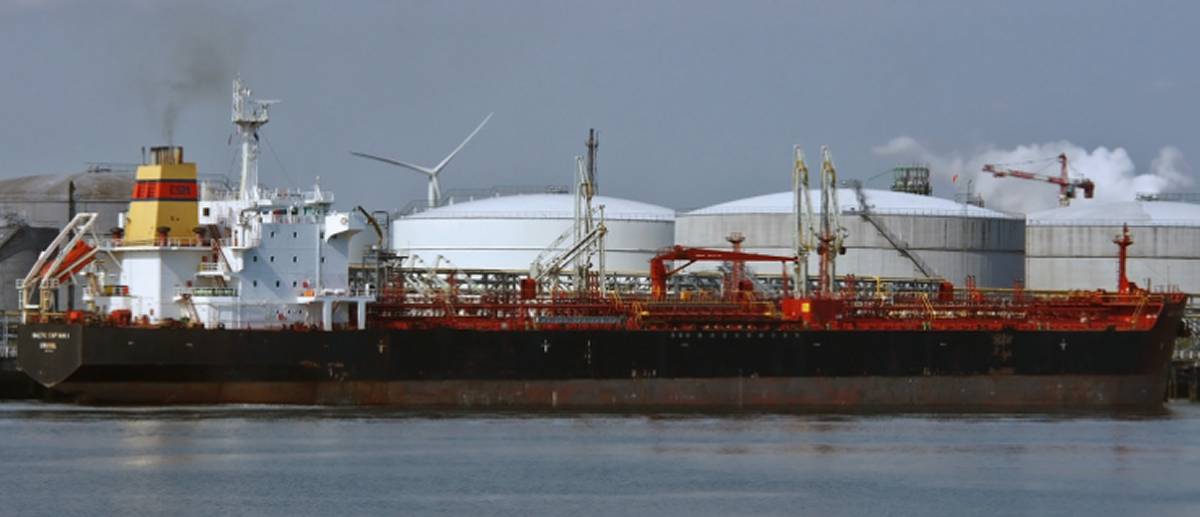
Tanker rates spiked last year after attacks on tankers in the Middle East. Could history repeat itself? The U.S. has just seized four Iranian petroleum cargoes, adding more fuel to rising tensions at the Strait of Hormuz, where a quarter of the world’s oil transits.
The Department of Justice (DOJ) confirmed Friday that “with the assistance of foreign partners,” it seized the gasoline cargoes aboard four Liberian-flagged, Greek-managed product tankers: the Bella, Bering, Pandi and Luna.
The cargoes total 1.116 million barrels — “the largest-ever seizure of fuel shipments,” said the DOJ.
Escalating US-Iran tensions
The DOJ obtained warrants for the cargoes on July 2. It argued that Iran’s Islamic Revolutionary Guard Corps (IRGC) would benefit from the sale of petroleum on the ships bound for Venezuela. The U.S. designates IRGC as a foreign terrorist organization.
The U.S. did not seize the four tankers themselves, just the cargoes. According to sources speaking to the New York Times, the cargoes were transferred to other vessels. Two of the tankers were stopped and cargoes were removed near the Middle East, two in the Atlantic Ocean.
Meanwhile, the DOJ secured a court order on August 7 (document here) to seize the Iranian-flagged tanker Adrian Darya (ex-Grace 1).
That vessel was at the center of a high-profile incident last year. Authorities in Gibraltar detained the tanker last July while it was en route to Syria. Iran then arrested the British-flagged tanker Stena Impero in retaliation.
The location of the Adrian Darya is unknown. Its automatic identification system (AIS) tracking equipment has been off for the past year.
The DOJ also commented on a separate incident, in which Iranian forces boarded a tanker on Tuesday using two vessels and a helicopter.

The Iranians boarded the Liberian-flagged, Greek-managed product tanker Wila near the Strait of Hormuz. The U.S. claimed the incident occurred in international waters. The Wila is currently at anchorage off the United Arab Emirates.
The DOJ claimed that the boarding was “an apparent attempt to recover the seized petroleum, but was unsuccessful.” An Iranian source speaking to the New York Times claimed the Wila boarding was meant as retaliation for the cargo seizures.
There does appear to be a connection between the recent cargo seizures and the Wila. According to the IMO Global Integrated Shipping Information System (GISIS), the office address of the Wila’s commercial manager in Athens, Greece is the same as the address of the manager of the Pandi and Bering.
Heightened Hormuz transit risk
The U.S. cargo seizures do not affect vessel supply. However, they do ratchet up tensions with Iran. This could lead to more incidents in the Strait of Hormuz. And that could increase risk premiums paid by charterers and disincentivize sailings in the region. In the most extreme case, it could impede cargo flows.
Security company Dryad Global issued an alert Friday warning of heightened risks for all vessels transiting the Persian Gulf, Strait of Hormus and Gulf of Oman with U.S.-related cargo.
“In assessing this risk, the threat is viewed through the lens of ‘tit for tat’ actions. Iran is acutely aware that its actions are seen to be proportionate and thus legitimate by the international community and that the U.S. is seen as the aggressor,” said Dryad.
Ton-mile effect
Jefferies analyst Randy Giveans told FreightWaves, “Actions like this will certainly increase tensions between the U.S. and Iran — as well as the U.S. and Venezuela.
“That said, tensions are already high anyway,” he noted.
“I’m sure there will be some posturing by Iran about retaliation and an increased risk premium for the Strait of Hormuz,” Giveans continued. “If the threat is real, expect fewer exports out of the Arabian Gulf and more out of West Africa, Norway, Brazil, and the U.S.

“That would be good for ton-mile demand as those regions are much further from China than the Arabian Gulf,” he said.
Tanker demand is not measured in volume, but in “ton miles”: volume multiplied by distance.
As recently reported by FreightWaves, crude-tanker demand in the long-haul Atlantic Basin-to-Asia market is falling — a negative for ton-miles.
Tensions in the Middle East might partially reverse that trend and re-lengthen voyages. However, this would hinge on Chinese import demand, which is currently being curbed by extreme congestion at the country’s ports.
Precedent-setting seizure
The successful U.S. seizure of Iranian property outside of U.S. waters is a precedent-setter — one that could very well elicit a sharp Iranian response. The U.S. has tried to do so twice before: once with the Grace 1 when it was in Gibraltar last year, and then in an action filed in May involving tanker called Nautic (document here).
According to the U.S. government’s legal argument on the four tanker cargoes (document here), the IRGC is a foreign terrorist organization “engaged in planning and perpetrating federal crimes of terrorism against the United States.”
The Treasury Department maintains that the IRGC has “a dominant presence in Iran’s commercial and financial sectors,” including the oil industry, and “profits support the IRGC’s full range of nefarious activities.” The U.S. considers the National Iranian Oil Company (NOIC) an “agent” of the IRGC.
The U.S. claims its statutes allow it to seize any property of the IRGC, whether “foreign or domestic.” The property would then be sold and proceeds placed in the U.S. Victims of State-Sponsored Terrorism Fund.
Taken to its logical conclusion, this legal argument implies that the U.S. believes it can seize Iranian oil anywhere in the world, regardless of its destination. The targeting of cargoes aboard the Bella, Bering, Pandi and Luna could be just the beginning. Click for more FreightWaves/American Shipper articles by Greg Miller
MORE ON IRAN AND VENEZUELA SANCTIONS: Inside the world of clandestine crude shipping: see story here. How the U.S. used a carrot versus a stick with Greek owners serving Venezuela: see story here. A look back at U.S.-Iran tensions in early 2020: see story here.
Brokerage Compliance Symposium
The day before F3. Every compliance issue you face - fraud exposure, carrier liability, FMCSA rules, cargo theft, insurance gaps - navigated by attorneys and operators defining best practices in a changing industry.
F3 Awards Dinner
The night before F3. FreightTech100 companies honored. FreightTech 25 and Shipper of Choice winners revealed live. Cocktail reception into dinner and live music - 300 industry leaders in one purpose-built room.
F3: Future of Freight Festival
Industry-defining keynotes, rapid-fire technology demos, and industry leaders networking in experiences across Chattanooga - plus the inaugural F3 Awards Dinner featuring the FreightTech and Shipper of Choice reveals.
The day before F3. Every compliance issue you face - fraud exposure, carrier liability, FMCSA rules, cargo theft, insurance gaps - navigated by attorneys and operators defining best practices in a changing industry.
The Signal at Chattanooga Choo Choo • Chattanooga, TN Register NowThe night before F3. FreightTech100 companies honored. FreightTech 25 and Shipper of Choice winners revealed live. Cocktail reception into dinner and live music - 300 industry leaders in one purpose-built room.
The Signal at Chattanooga Choo Choo • Chattanooga, TN Register NowIndustry-defining keynotes, rapid-fire technology demos, and industry leaders networking in experiences across Chattanooga - plus the inaugural F3 Awards Dinner featuring the FreightTech and Shipper of Choice reveals.
The Signal at Chattanooga Choo Choo • Chattanooga, TN Register Now