








At any given point in time, more than 6,000 vessels carrying containers are sailing the world’s seas. While ship fires and capsizes make international headlines, container losses actually are few and far between, according to the World Shipping Council (WSC).
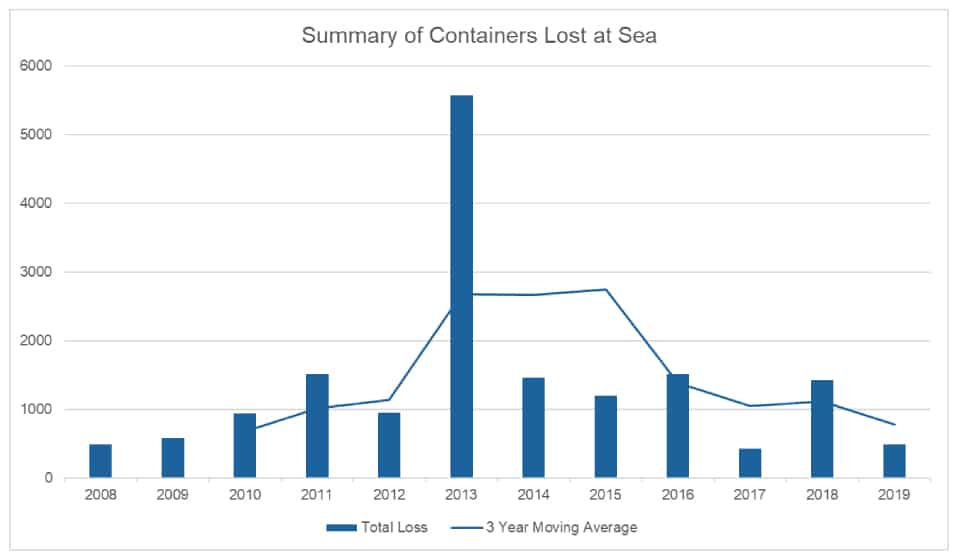
In fact, an average of only 1,382 containers were lost at sea per year between 2008 and 2019, the WSC said in a report released Wednesday. That represents less than one-1,000th — or .0006% — of the roughly 226 million shipped each year carrying more than $4 trillion worth of cargo.
The WSC has surveyed its members each year since 2011 to come up with an estimate of the number of containers lost at sea. The WSC said it is confident that its survey provides “a valid basis for a meaningful estimate” because its member companies carry more than three-quarters of the containers transported globally.
The WSC also looks at three-year averages. From 2008 through 2010, container losses averaged 675 per year, then quadrupled to an average of 2,683 per year from 2011 through 2013. The WSC said this spike was due in large part to the 2013 sinking of the MOL Comfort, which resulted in the loss of 4,293 containers, as well as the 2011 grounding of the M/V Rena in which about 900 containers were lost.
The three-year period of 2014 to 2016 included the tragic loss of 33 crew members and 517 containers aboard the SS El Faro. Despite that, the three-year average annual loss for that period was 1,390 containers, about half that of the previous three-year span.
The downward trend continued in the most recent three-year period, from 2017 through 2019, when the annual loss was almost halved again to 779 containers.
“There were no individual losses as significant as those noted in the previous periods, which is a welcome development,” the WSC said. “However, 2018 and 2019 were marked with a few incidents that each lost more than 100 containers.”
Incidents in 2019 included the loss of about 345 containers from the MSC Zoe.
Even with proper packing of cargo, correct container weight declaration, and proper stowage and securing aboard ship, containers are lost at sea, whether because of severe weather, structural failures or even collisions.
The WSC said the liner shipping industry has partnered with governments and other stakeholders to enhance container safety in order to further reduce the number of containers lost. These include amendments to the Safety of Life at Sea (SOLAS) Convention.
On July 1, 2016, changes to the SOLAS convention went into effect requiring verification of container weights before packed containers could be loaded onto ships. Simply, the requirement makes container weight verification a legally binding condition for vessel loading.
Revisions are in the pipeline for the 2014-approved Code of Practice for Packing of Cargo Transport Units (CTU Code). The code came about through a collaborative effort of the International Maritime Organization (IMO), International Labour Organization and United Nations Economic Commission for Europe and outlines specific procedures for the safe handling of containers, including weight distribution, positioning and bracing.
In support of the IMO’s efforts to enhance container safety, the International Organization for Standardization (ISO) in 2015 revised its standards for lashing equipment and corner castings.
The WSC currently is trying to resolve discrepancies in container stacking strength standards. WSC said it proposed to the IMO’s Subcommittee on Carriage of Cargoes and Containers (CCC 6) last September the alignment of Safe Container Convention and ISO container stacking strength requirements, “noting that the existing discrepancy might have significant safety implications, including collapsed container stacks and containers lost at sea.”
No agreement has been reached on container stacking, but a proposal is being developed for consideration by the IMO’s Maritime Safety Committee (MSC), the WSC said.
The WSC and European Union have co-sponsored a proposal to the MSC on mandatory reporting of containers lost at sea. “The liner shipping industry supports such a mandatory reporting environment and will continue to advocate for an early implementation of an effective and practical requirement,” the WSC said.
The WSC said the CCC 6 has agreed in principle to amend IMO guidelines for inspection programs for cargo transport units, including containers, but further work on criteria is needed.
“There are over 6,000 container ships continuously operating on the world’s seas and waterways linking continents and providing vital supplies to communities around the globe,” the WSC said. “The liner shipping industry’s goal remains to keep the loss of containers carried on those ships as close to zero as possible.
“Carriers will continue to explore and implement preventive and realistic measures to make that happen and welcome continued cooperation from governments and other stakeholders to accomplish this goal,” it said.
Cocaine, two men found in container on Maersk vessel
Court allows APL England captain to leave Australia
Coast Guard ends search for tanker crew member
Click for more FreightWaves/American Shipper articles by Kim Link-Wills.
Brokerage Compliance Symposium
The day before F3. Every compliance issue you face - fraud exposure, carrier liability, FMCSA rules, cargo theft, insurance gaps - navigated by attorneys and operators defining best practices in a changing industry.
F3 Awards Dinner
The night before F3. FreightTech100 companies honored. FreightTech 25 and Shipper of Choice winners revealed live. Cocktail reception into dinner and live music - 300 industry leaders in one purpose-built room.
F3: Future of Freight Festival
Industry-defining keynotes, rapid-fire technology demos, and industry leaders networking in experiences across Chattanooga - plus the inaugural F3 Awards Dinner featuring the FreightTech and Shipper of Choice reveals.
The day before F3. Every compliance issue you face - fraud exposure, carrier liability, FMCSA rules, cargo theft, insurance gaps - navigated by attorneys and operators defining best practices in a changing industry.
The Signal at Chattanooga Choo Choo • Chattanooga, TN Register NowThe night before F3. FreightTech100 companies honored. FreightTech 25 and Shipper of Choice winners revealed live. Cocktail reception into dinner and live music - 300 industry leaders in one purpose-built room.
The Signal at Chattanooga Choo Choo • Chattanooga, TN Register NowIndustry-defining keynotes, rapid-fire technology demos, and industry leaders networking in experiences across Chattanooga - plus the inaugural F3 Awards Dinner featuring the FreightTech and Shipper of Choice reveals.
The Signal at Chattanooga Choo Choo • Chattanooga, TN Register Now