




Fallout from the oil price war extends far beyond U.S. crude production. America’s liquefied petroleum gas (LPG) exports are also in the crosshairs.
The global LPG trade rose 14% in 2019, to an all-time-high 109 million tons, with almost all of the seaborne volume evenly split between exports from the Middle East and U.S. Gulf. John Hadjipateras, CEO of Dorian LPG (NYSE: LPG), said on his company’s Feb. 5 quarterly call that “it appears annual U.S. export volumes will surpass the Middle East for the first time in 2020.”
But the world has dramatically changed since Hadjipateras made that statement. It now appears U.S. LPG exports will fall back and Middle East exports will rise.
LPG market dynamics
LPG is an associated-gas byproduct of the crude and natural gas drilling process and a byproduct of the crude-refining process. Propane and butane are the primary LPG cargoes.
Just over half of LPG is used around the world for cooking and heating, with most of the remainder used as feedstock for the petrochemical industry. In the latter case, LPG competes with naphtha, which is created by refining crude oil. Asian and European petrochemical producers switch between using LPG and naphtha as a feedstock, depending on which is cheaper.
LPG is transported on long-haul routes aboard vessels known as very large gas carriers (VLGCs) that have a capacity of around 84,000 cubic meters. The top listed VLGC owners are Dorian in the U.S. and BW LPG and Avance Gas in Norway.
Shift to the Middle East
The plunge in crude oil pricing driven by the Saudi production surge is likely to reduce U.S. LPG output.
“The preponderance of incremental [U.S. LPG] production would be from associated gas [from drilling] in the West Texas Permian Basin,” explained Stifel analyst Ben Nolan during this week’s Virtual Investor Forum, hosted by J Mintzmyer on Value Investor’s Edge via Seeking Alpha.
Permian Basin crude production is expected to be heavily curtailed. “If the U.S. scales back [crude] production, we will see a reduction of associated gas coming out of there in the future,” said John Lycouris, CEO of Dorian LPG subsidiary Dorian LPG (USA) LLC, during the Virtual Investor Forum.
However, Lycouris emphasized that “with the amount of crude oil that’s going to be produced [globally], there’s going to be plenty of associated gas from the countries producing more crude — countries in the Middle East and also Russia.”
“That means there will be perhaps be a shift in the next few months, with more gas coming out of the Middle East than out of the U.S. Gulf.”
If so, continued Lycouris, “we’re going to have an increase in shipping demand from the Middle East and we expect that whatever utilization might be lost from the U.S., if any, would be mopped up very quickly by Middle East demand.”
Ton-mile effect
VLGC demand is measured in “ton-miles” — volume multiplied by distance. The shorter the voyage distance, the lower the vessel demand for the same cargo volume.
The voyage between Ras Tanura, Saudi Arabia, and Chiba, Japan, is 29% shorter than from Houston to Chiba via the Panama Canal. Thus, if the volume of LPG transported by sea remains the same but more comes out of the Middle East than the U.S. Gulf, it’s negative for VLGC demand.
Dorian LPG CFO Ted Young characterized the voyage distance for U.S. and Middle East exports as “not a whole lot different” and affirmed that Dorian is “somewhat indifferent [to where exports come from] as long as the products are moving on our ships.”
Demand destruction ahead?
The worst-case scenario for VLGC owners would be for Asian petrochemical producers to opt for naphtha over LPG as a feedstock.
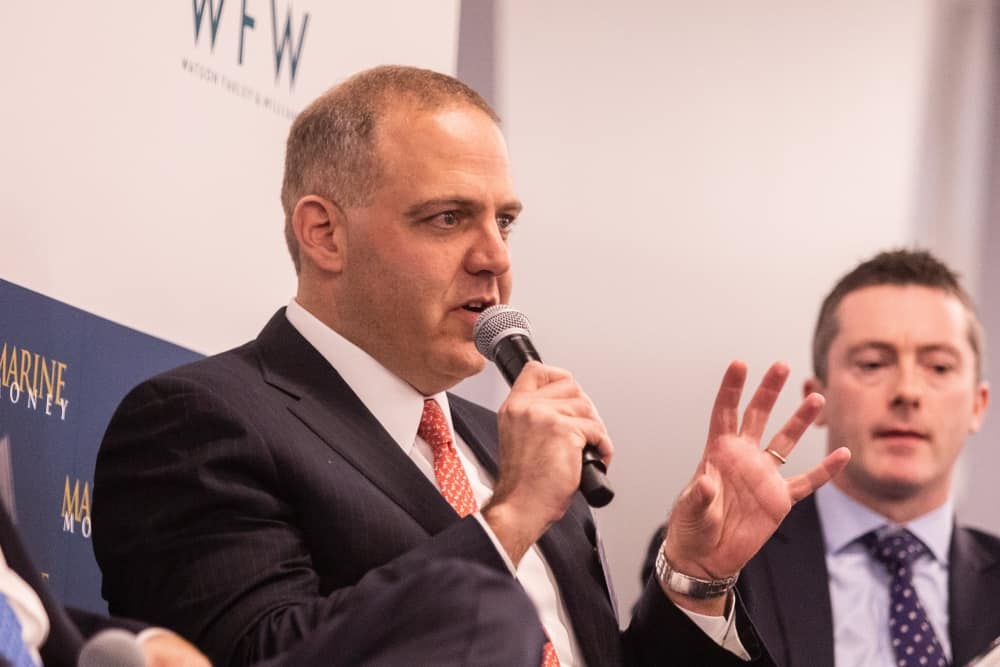
“If the price of propane becomes more expensive in the U.S. because there is less supply, and if international oil prices fall [bringing down the price of naphtha], then the arb closes,” said Nolan, referring to the arbitrage profit that compels shippers to transport LPG from the U.S. Gulf to Asia.
Young said that “naphtha is becoming a bit more preferred in some places, but not all over the world … and don’t forget, there is less naphtha around because the refiners are producing lighter [crude grade] runs.”
Young also pointed out that beyond the petrochemical market, “53% of the world demand is pretty inelastic — it’s heating and cooking. For heating and cooking, you’ve got the hardware in your home. That’s not going to change. There’s going to continue to be demand for that.” More FreightWaves/American Shipper articles by Greg Miller
Brokerage Compliance Symposium
The day before F3. Every compliance issue you face - fraud exposure, carrier liability, FMCSA rules, cargo theft, insurance gaps - navigated by attorneys and operators defining best practices in a changing industry.
F3 Awards Dinner
The night before F3. FreightTech100 companies honored. FreightTech 25 and Shipper of Choice winners revealed live. Cocktail reception into dinner and live music - 300 industry leaders in one purpose-built room.
F3: Future of Freight Festival
Industry-defining keynotes, rapid-fire technology demos, and industry leaders networking in experiences across Chattanooga - plus the inaugural F3 Awards Dinner featuring the FreightTech and Shipper of Choice reveals.
The day before F3. Every compliance issue you face - fraud exposure, carrier liability, FMCSA rules, cargo theft, insurance gaps - navigated by attorneys and operators defining best practices in a changing industry.
The Signal at Chattanooga Choo Choo • Chattanooga, TN Register NowThe night before F3. FreightTech100 companies honored. FreightTech 25 and Shipper of Choice winners revealed live. Cocktail reception into dinner and live music - 300 industry leaders in one purpose-built room.
The Signal at Chattanooga Choo Choo • Chattanooga, TN Register NowIndustry-defining keynotes, rapid-fire technology demos, and industry leaders networking in experiences across Chattanooga - plus the inaugural F3 Awards Dinner featuring the FreightTech and Shipper of Choice reveals.
The Signal at Chattanooga Choo Choo • Chattanooga, TN Register Now