




Expedited and truckload freight brokers told me today that while they’re seeing positive year-over-year volume growth across the board, overcapacity is preventing rates from rising higher in most lanes.
It is the case that capacity is gradually tightening—on a national basis, outbound tender rejections have jumped 102 bps since September 15 to 6.02% (OTRI.USA). It’s just not enough, yet, to raise prices on a national basis (DATVF.VNU).

The national average for dry van spot rates is moving mostly sideways, but note that the chart keeps hitting higher lows, indicating some support for upward momentum. In the trucking freight futures market hosted on the Nodal Exchange, futures traders are maintaining positive sentiment and expect September to end at a national average higher (FWD.VNU) than today’s prices.
National tendered volumes for contract freight (OTVI.USA) are still up 3.5% year-over-year, but we believe that number belies the true strength of the freight economy. Industrial production beat expectations in August, and Deloitte’s annual Holiday Retail survey suggested that retail sales will be up 4.5-5% year-over-year in November, December, and January.
Shippers are still exploiting the spread between paper and spot rates, and pushing freight into the spot market. The chairman of a large enterprise truckload carrier told me today that on 40% of his awarded lanes, he’s not getting the volume he was promised. Meanwhile, freight brokers in Chicago with exposure to the spot market are seeing volumes hit year-to-date peaks.
Expedited freight is a leading indicator for truckload and less-than-truckload. Demand for expedited is more volatile because in addition to its core verticals of automotive, chemicals, and pharmaceuticals, the mode catches spillover freight that falls off truckload carriers when capacity in that mode tightens up.
Bob Poulos, president of V3 Transportation, a top five expedited carrier with hundreds of straight trucks and Sprinter vans, said that he isn’t seeing a demand pop capable of moving rates.
“We booked more loads this August than in August 2018, but the revenue and margins are down so much,” Poulos said. “Between lengths of haul and weight per shipment, our average bill is down roughly $200 a load; it’s an odd phenomenon.”
Poulos went on to characterize the expedited freight market as ‘spotty’, saying that each week V3 saw two to three strong days and two to three weak days. His core Midwest markets including Chicago and Indianapolis are strong, but the West Coast and Southeast are not strong. Laredo, which is generally balanced, has turned spotty.
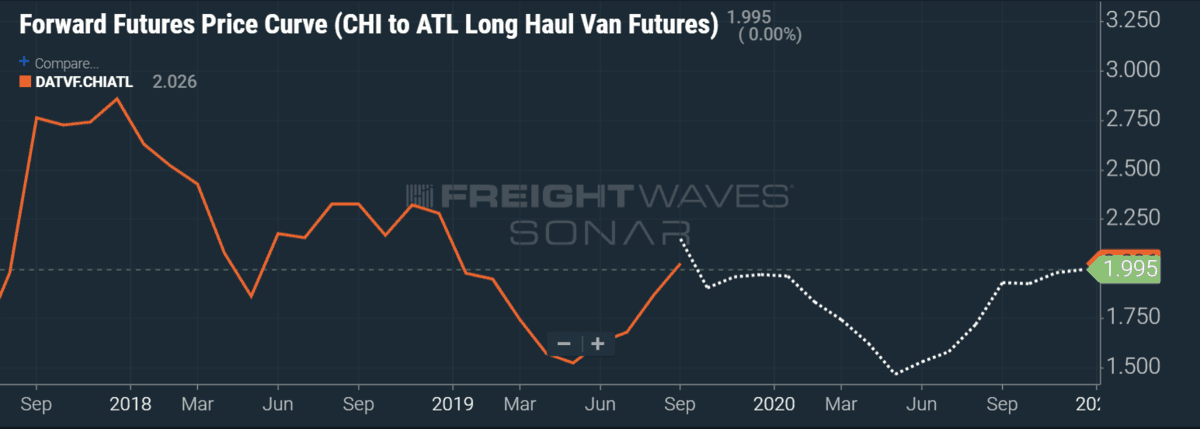
Dry van spot rates from Chicago to Atlanta excluding fuel are at $2.02/mile now, but the forward curve shows rates increasing to $2.15/mile by the end of the month.
Kohl Forrest, a broker at Summit Expedited Logistics, was more optimistic. Forrest said that his current volumes are slightly up from August, and that expedited requests are coming in more frequently but price is still very competitive.
“One positive sign that the market is beginning to recover is that we are declining loads again,” Forrest pointed out.
Another expedited broker based in Chicago said that he heard anecdotes that of a pick-up in expedited demand, but said that the talk in that sector was typically bullish.
A brokerage executive at Nolan Transportation Group said that NTG is seeing an uptick in expedited shipments month-over-month, but that the data was noisy due to moves associated with Hurricane Dorian preparedness and relief.
The truckload space was less optimistic, although brokerages with spot exposure told me that they’re receiving the highest number of spot loads they’ve seen all year.
A broker from Schneider National (NYSE: SNDR) said his shop was experiencing a slow volume uptick, but that rates were still flat. His guidance for peak season was muted: “we will see some uptick in the West Coast, but overall it will be a grind. Too much capacity remains in the market.”
At Swift Logistics (NYSE: KNX), a brokerage executive said that the week was off to a strong start, and that he assumed elevated rejections were causing an influx in secondary offers. He’s having a lot of fourth quarter conversations with shippers, who are insisting on the differences between 2019 and 2018 but still trying to lock in capacity.
Brokerage Compliance Symposium
The day before F3. Every compliance issue you face - fraud exposure, carrier liability, FMCSA rules, cargo theft, insurance gaps - navigated by attorneys and operators defining best practices in a changing industry.
F3 Awards Dinner
The night before F3. FreightTech100 companies honored. FreightTech 25 and Shipper of Choice winners revealed live. Cocktail reception into dinner and live music - 300 industry leaders in one purpose-built room.
F3: Future of Freight Festival
Industry-defining keynotes, rapid-fire technology demos, and industry leaders networking in experiences across Chattanooga - plus the inaugural F3 Awards Dinner featuring the FreightTech and Shipper of Choice reveals.
The day before F3. Every compliance issue you face - fraud exposure, carrier liability, FMCSA rules, cargo theft, insurance gaps - navigated by attorneys and operators defining best practices in a changing industry.
The Signal at Chattanooga Choo Choo • Chattanooga, TN Register NowThe night before F3. FreightTech100 companies honored. FreightTech 25 and Shipper of Choice winners revealed live. Cocktail reception into dinner and live music - 300 industry leaders in one purpose-built room.
The Signal at Chattanooga Choo Choo • Chattanooga, TN Register NowIndustry-defining keynotes, rapid-fire technology demos, and industry leaders networking in experiences across Chattanooga - plus the inaugural F3 Awards Dinner featuring the FreightTech and Shipper of Choice reveals.
The Signal at Chattanooga Choo Choo • Chattanooga, TN Register Now