



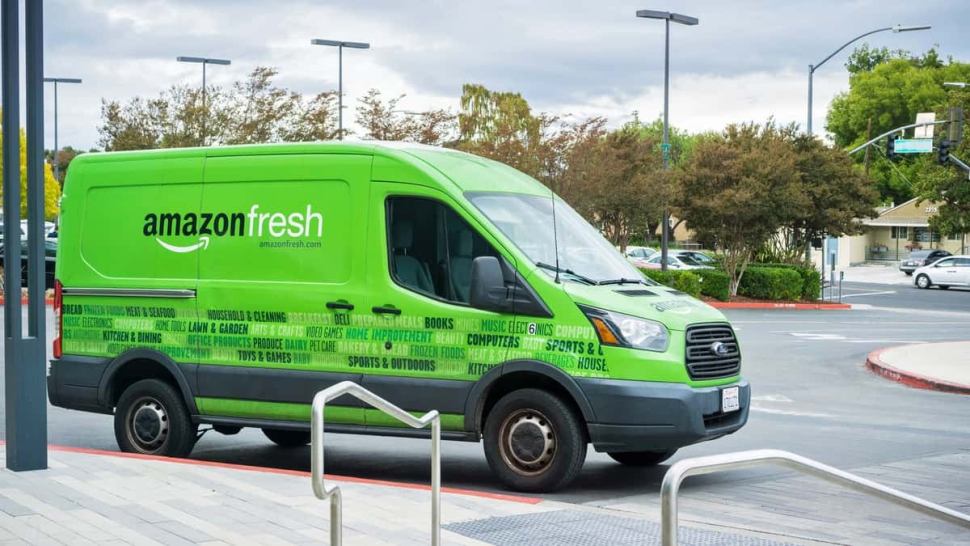
Over the last decade, much has changed in the context of last-mile delivery, prodded on by the rise of ecommerce and the evolution of consumer expectations enamoured by the idea of expedited delivery. This has led to a noticeable growth in the number of last-mile delivery vans coursing through city streets. This growth annoys city administrations as last-mile delivery proliferation has led to an increase in traffic congestion.
However, a bigger concern is the increase in carbon emissions, especially in urban settings. But making ecommerce the scapegoat of last-mile carbon emissions is incorrect. FreightWaves spoke with Robert DeDomenico, the founder and CEO of CargoFish, a last-mile automation startup, to understand what could be done to address carbon emissions that seem to grow every day.
DeDomenico explained that the most energy-intensive last-mile movement is when people take their cars out to shop at a nearby supermarket. To deconstruct this observation, it is essential to strip energy expended during the last-mile process into its basic measuring units – British thermal units (BTUs) per tonne mile.
“A tractor-trailer that hauls up to 40,000 pounds of net cargo at a time gets roughly six miles to the gallon. The specific energy intensity of a loaded tractor-trailer is about 1,000 BTUs per tonne mile. But for cars that head to the supermarket, their average consumption is around 4,000 BTUs per mile – about four times higher than a tractor-trailer,” said DeDomenico.
However, the story goes even further. In the U.S., the average grocery store basket is valued at around $34 and weighs roughly 20 pounds. This means that cars moving in and out of a supermarket never carry a tonne in load, but on average carry only about 1/100th of a tonne. This causes their specific energy intensity to increase, averaging 400,000 BTUs per tonne mile – a reduction of 400 times in energy efficiency compared to a tractor-trailer.
“This is caused primarily by consumers breaking up last-mile movement into numerous discrete individual payloads. In fact, the smallest of these payloads have energy intensity that is another 10 times worse, causing millions of BTUs per tonne mile. And here, we can have a distribution system that can easily reduce BTUs consumed by about three orders of magnitude,” said DeDomenico.
DeDomenico pointed out that retail goods movement in the U.S. accounted for almost 7 percent of primary energy consumption in the country, where total consumption equals roughly 100 quadrillion BTUs per year – the equivalent of about 8 gallons of gasoline per day per person.
To effect a change, it is essential to create a discrete payload utility distribution system that delivers goods at the expense of much lesser BTUs per tonne mile. DeDomenico calls it the ‘physical internet’ – an interconnected network through which discrete physical parcels can be moved between any two points in the network.
DeDomenico’s startup CargoFish is currently building its first demonstration, with this model being the sixth generation in a line of functional prototypes that have been tested and improved over the last eight years. DeDomenico hopes that the commercial installation of the system will be financed by government bodies or private entities, in a manner that is similar to other utilities like gas or water lines.
Though an ambitious project, DeDomenico believes that change will come in due time, and that a comprehensive demonstration will help convince authorities and the public on the concept, and divert investment from the more popular low-carbon emission alternatives like electric cars and mobility-as-a-service systems to the physical internet.
Brokerage Compliance Symposium
The day before F3. Every compliance issue you face - fraud exposure, carrier liability, FMCSA rules, cargo theft, insurance gaps - navigated by attorneys and operators defining best practices in a changing industry.
F3 Awards Dinner
The night before F3. FreightTech100 companies honored. FreightTech 25 and Shipper of Choice winners revealed live. Cocktail reception into dinner and live music - 300 industry leaders in one purpose-built room.
F3: Future of Freight Festival
Industry-defining keynotes, rapid-fire technology demos, and industry leaders networking in experiences across Chattanooga - plus the inaugural F3 Awards Dinner featuring the FreightTech and Shipper of Choice reveals.
The day before F3. Every compliance issue you face - fraud exposure, carrier liability, FMCSA rules, cargo theft, insurance gaps - navigated by attorneys and operators defining best practices in a changing industry.
The Signal at Chattanooga Choo Choo • Chattanooga, TN Register NowThe night before F3. FreightTech100 companies honored. FreightTech 25 and Shipper of Choice winners revealed live. Cocktail reception into dinner and live music - 300 industry leaders in one purpose-built room.
The Signal at Chattanooga Choo Choo • Chattanooga, TN Register NowIndustry-defining keynotes, rapid-fire technology demos, and industry leaders networking in experiences across Chattanooga - plus the inaugural F3 Awards Dinner featuring the FreightTech and Shipper of Choice reveals.
The Signal at Chattanooga Choo Choo • Chattanooga, TN Register Now