








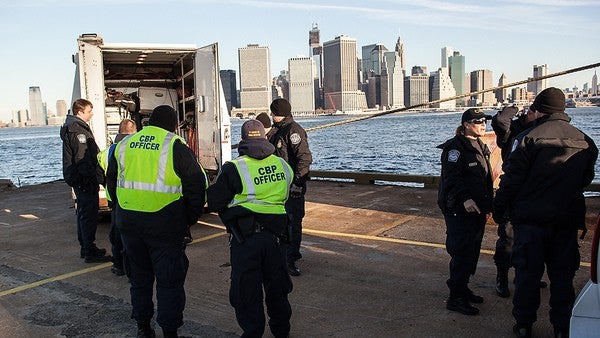
U.S. Customs and Border Protection has updated its seizure mitigation guidelines involving licensed and non-licensed exports for its officers at the nation’s ports of entry.
The new guidelines, which were developed by CBP’s Office of Regulations and Rulings, are part of a larger update involving 39 different types of agency enforcement actions, starting in October 2017.
The last time CBP updated its Forfeiture Guidelines for Export Control Violations occurred in 2004.
“I am impressed — finally a document that demonstrates transparency and predictability,” said Paul DiVecchio, a 40-year export control compliance consultant based in Boston.
While some trade enforcement guideline updates are published in the Federal Register for public comment, the export seizure mitigation guidelines were not. This decision was made by the Office of Regulations and Rulings, which oversaw the guidelines rewrite, a CBP spokesperson said.
One of the biggest changes in the new export seizure mitigation guidelines pertains to the application of “remission” amounts or monetary penalties for licensed and non-licensed export violations. Under the previous guidelines, the penalties were a set amount per violation. The new guidelines’ penalties are based on the percentage of the seized cargo’s value, which brings this practice in line with how CBP assesses import violation penalties, the CBP spokesperson said.
Another change in the new export seizure mitigation guidelines is the use of the terms “license violations” and “non-license violations,” rather than the former terms “technical violations” and “substantive violations.”
“CBP is no longer using those terms because they were often confusing and misleading to CBP personnel and the public and because they are not used by licensing agencies,” such as the Commerce Department’s Bureau of Industry and Security, State Department’s Directorate of Defense Trade Controls, Treasury Department’s Office of Foreign Assets Control and Drug Enforcement Administration, among others, the agency said in the new guidelines. “For example, a violation that may appear ‘technical’ in nature may actually be a significant and egregious violation for which a higher remission amount may be appropriate.”
Under the new export seizure mitigation guidelines, the agency said it’s also able to more clearly apply higher penalty amounts to license violations, which are “egregious in nature,” while applying penalty amounts “at the lower and middle of the range, depending on the specific nature” for non-license violations.
CBP’s Office of Regulations and Rulings in July disseminated the new guidelines to the Office of Field Operations leadership and the paralegal staff at the ports of entry around the country.
“Although CBP is not required to grant relief in any specific case, CBP may reference these guidelines when deciding whether to grant relief in any specific case and if CBP deems that relief is appropriate to determine the mitigation, remission or cancellation amount,” the agency said in the new guidelines. “CBP reviews the specific facts and circumstances of each case individually and may deviate from these guidelines if CBP determines that such deviation is appropriate.”
The new CBP mitigation guidelines for export seizures are also available to exporters and freight forwarders on the agency website.
While praising CBP for publishing updated mitigation guidelines for export seizures, Michael Ford, vice president of government and industry affairs for Philadelphia-based forwarder BDP International, warned that the penalty amounts for licensed exports are now much higher and “companies need to understand that a clerical error can cause a sizable penalty that they will need to deal with.”
For example, the remission amount for the first offense involving a license violation is 10 to 30% of the value of the export. “Generally, licensed or controlled exports have a higher value associated with them than non-controlled exports,” Ford said.
Ford also said he’s concerned that CBP officers using these new guidelines may be compelled to seize non-licensed exports with Census Bureau Automated Export System data filing errors.
“We need CBP to encourage good, timely data reporting for all shipments and not have the threat of heavy fines placed upon companies,” he said.
Brokerage Compliance Symposium
The day before F3. Every compliance issue you face - fraud exposure, carrier liability, FMCSA rules, cargo theft, insurance gaps - navigated by attorneys and operators defining best practices in a changing industry.
F3 Awards Dinner
The night before F3. FreightTech100 companies honored. FreightTech 25 and Shipper of Choice winners revealed live. Cocktail reception into dinner and live music - 300 industry leaders in one purpose-built room.
F3: Future of Freight Festival
Industry-defining keynotes, rapid-fire technology demos, and industry leaders networking in experiences across Chattanooga - plus the inaugural F3 Awards Dinner featuring the FreightTech and Shipper of Choice reveals.
The day before F3. Every compliance issue you face - fraud exposure, carrier liability, FMCSA rules, cargo theft, insurance gaps - navigated by attorneys and operators defining best practices in a changing industry.
The Signal at Chattanooga Choo Choo • Chattanooga, TN Register NowThe night before F3. FreightTech100 companies honored. FreightTech 25 and Shipper of Choice winners revealed live. Cocktail reception into dinner and live music - 300 industry leaders in one purpose-built room.
The Signal at Chattanooga Choo Choo • Chattanooga, TN Register NowIndustry-defining keynotes, rapid-fire technology demos, and industry leaders networking in experiences across Chattanooga - plus the inaugural F3 Awards Dinner featuring the FreightTech and Shipper of Choice reveals.
The Signal at Chattanooga Choo Choo • Chattanooga, TN Register Now