








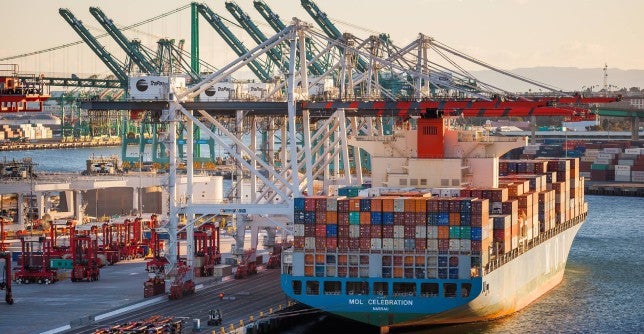
A new report by the investment rating agency Moody’s says automated container terminals “offer competitive advantages” and predicts more will be built in the next decade.
“Automation can lower operating costs, increase throughput capacity, improve service reliability and reduce emissions. However, significant capital investment, uncertain productivity gains, potential disruptions to active operations and labor concerns are key risks.”
Moody’s lists 48 terminals around the world that are fully or partially automated. The oldest on the list is the Hutchison Port Holdings ECT Delta terminal in Rotterdam, which was automated in 1993, and the last on the list is the Tuas Mega Terminal in Singapore that PSA expects to start opening in phases in 2021.
Listed are 18 fully automated terminals, including the TraPac terminal in Los Angeles and Long Beach Container Terminal, as well as 30 semi-automated terminals, including three in the U.S: the Virginia International Gateway Terminal and Norfolk International Terminal, both in Virginia, and the GCT Bayonne terminal in New Jersey.
Efforts to automate ports have been a contentious issue in the U.S. Members of the International Longshore and Warehouse Union are expected to show up in large numbers on Friday morning at the Los Angeles City Council meeting in an effort to get the body to veto a permit recently granted by its Board of Harbor Commissioners to APM Terminals so that the company can build infrastructure needed for operation of automated straddle carriers at Pier 400 in the Port of Los Angeles.
Moody’s said, “A signature feature of the 2018 International Longshoremen’s Association (ILA) contract was the prohibition on fully automated container terminals at ports on the East Coast and Gulf Coast.” It added that a strike was narrowly averted last month in Canada because of ILWU Canada opposition to automation in Vancouver, British Columbia.
Labor accounts for more than half of the cost structure of a conventional container terminal and “automated terminals have 40% to 70% lower labor requirements, one of the most significant expenses for operators,” said Moody’s, which noted that “in the U.S., port labor costs have historically risen annually in excess of inflation and continue to do so.” The biggest savings, it said, comes through the elimination of jobs of terminal truck drivers, container handlers and clerks and supervisors.
But the report also said peak productivity at automated terminals “does not always exceed conventional facilities and there is significant political and social risk associated with labor unions due to the impact on employment.”
With land at many port locations a scarce resource, automation provides a way to expand “vertically without impairing productivity. By converting to a semi-automated system at Norfolk International Terminal South, the Virginia Port Authority will increase capacity by 47% on the same footprint,” the report said.
“The near-zero-emission nature of the handling equipment used at fully automated terminals results in significantly lower emissions compared with conventional terminals. Key equipment at automated terminals runs largely on electric power instead of diesel fuel, while the terminal design minimizes the amount of travel (and idling) for horizontal transport and over-the-road trucks,” said Moody’s, adding that is particularly relevant in Los Angeles and Long Beach, where the two port authorities recently adopted an updated Clean Air Action Plan “focused on cargo-handling equipment on the terminal, with a policy aim to implement zero or near-zero emission container-handling equipment by 2030.”
Brokerage Compliance Symposium
The day before F3. Every compliance issue you face - fraud exposure, carrier liability, FMCSA rules, cargo theft, insurance gaps - navigated by attorneys and operators defining best practices in a changing industry.
F3 Awards Dinner
The night before F3. FreightTech100 companies honored. FreightTech 25 and Shipper of Choice winners revealed live. Cocktail reception into dinner and live music - 300 industry leaders in one purpose-built room.
F3: Future of Freight Festival
Industry-defining keynotes, rapid-fire technology demos, and industry leaders networking in experiences across Chattanooga - plus the inaugural F3 Awards Dinner featuring the FreightTech and Shipper of Choice reveals.
The day before F3. Every compliance issue you face - fraud exposure, carrier liability, FMCSA rules, cargo theft, insurance gaps - navigated by attorneys and operators defining best practices in a changing industry.
The Signal at Chattanooga Choo Choo • Chattanooga, TN Register NowThe night before F3. FreightTech100 companies honored. FreightTech 25 and Shipper of Choice winners revealed live. Cocktail reception into dinner and live music - 300 industry leaders in one purpose-built room.
The Signal at Chattanooga Choo Choo • Chattanooga, TN Register NowIndustry-defining keynotes, rapid-fire technology demos, and industry leaders networking in experiences across Chattanooga - plus the inaugural F3 Awards Dinner featuring the FreightTech and Shipper of Choice reveals.
The Signal at Chattanooga Choo Choo • Chattanooga, TN Register Now