




On January 1, 2020, the sulfur content of fuel used on ocean-going ships, as well as their emissions, will be capped globally at 0.5 percent. Today, just over six months before the deadline, the effect on fleet capacity at sea and on freight rates for cargo shippers is already apparent, according to Clarksons Platou Securities, the investment banking arm of Clarksons, a group that owns the world’s largest ship brokerage.
Many vessel owners are opting to comply with the new regulation by installing exhaust gas scrubbers. To do so, they must temporarily pull vessels from the market for installation.
This reduces the capacity of ships at sea, which increases charter and freight rates. The capacity and rate effects differ based upon the shipping segment, because it makes more sense to install scrubbers on some vessels rather than others. Generally, the larger the ship, the more space available for installation, and the more time a ship is at sea (versus in port operations), the more theoretical savings from scrubbers.
Consequently, the most likely candidates are the highest-capacity ships on the longest-haul trades – in the dry bulk sector, Capesizes, which have a capacity of over 100,000 deadweight tons each; larger container ships of 8,000 twenty-foot-equivalent units (TEU) or more; and very large crude carriers (VLCCs), each of which transports two million barrels of crude oil.
Clarksons compiles data on scrubber orders and the dates of estimated installations, and it projects the amount of capacity that will be offline per month, and how this theoretically impacts rates, all else being equal.
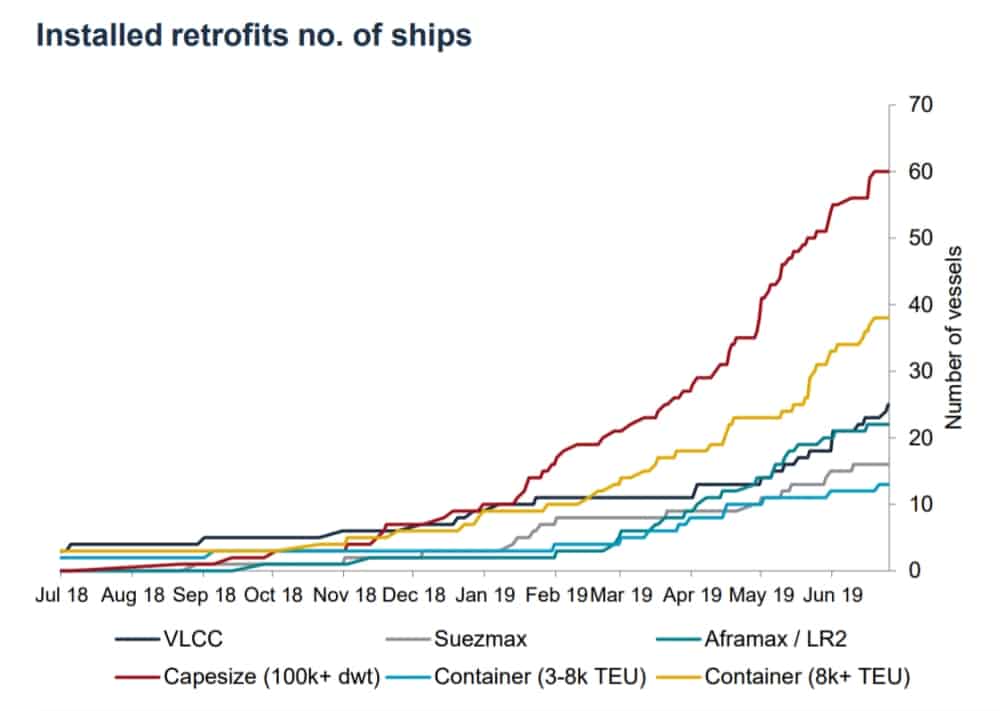
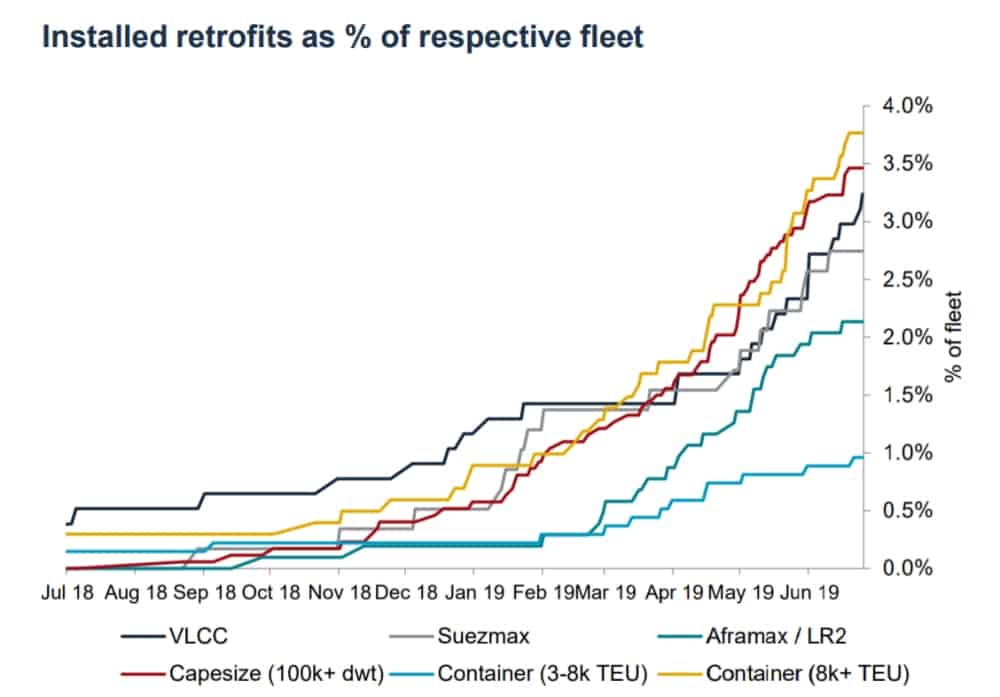
According to a June 26 client note issued by Clarksons Platou Securities, 0.9 percent of the VLCC fleet and 0.3 percent of the Capesize fleet was out of service this month for scrubber retrofits, based on data from Clarksons Research.
Clarksons believes that VLCCs would have averaged around $16,000 per day in June if none of these ships were pulled from the market, but averaged $19,000 per day, meaning that the IMO 2020 retrofits inflated rates by $3,000 per day or 18.75 percent.
It believes Capesizes would have earned $14,000 per day, but averaged $15,000 per day due to scrubber retrofits.
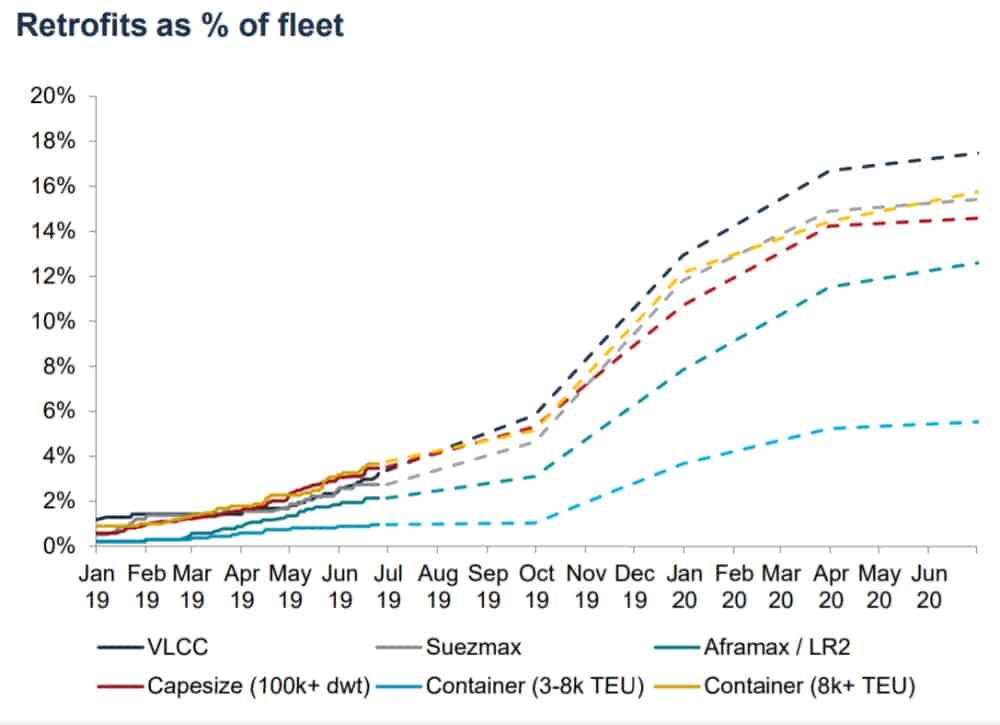
For the remainder of 2019, Clarksons sees an acceleration of retrofits. It believes that in the second half of this year, 1.6 percent of VLCCs, 1.4 percent of container ships over 8,000 TEU, and 1.2 percent of Capesizes will be out of service for scrubber installations.
Clarksons Platou Securities is projecting that scrubber-installation-related capacity withdrawals could lift VLCC earnings from $25,000 to $35,000 per day in the second half, or by 40 percent; Capesize rates from $18,500 to $23,000 per day, or by 24 percent; and 6- to 12-month charter rates for container ships from $27,000 to $33,000 per day, or 22 percent.
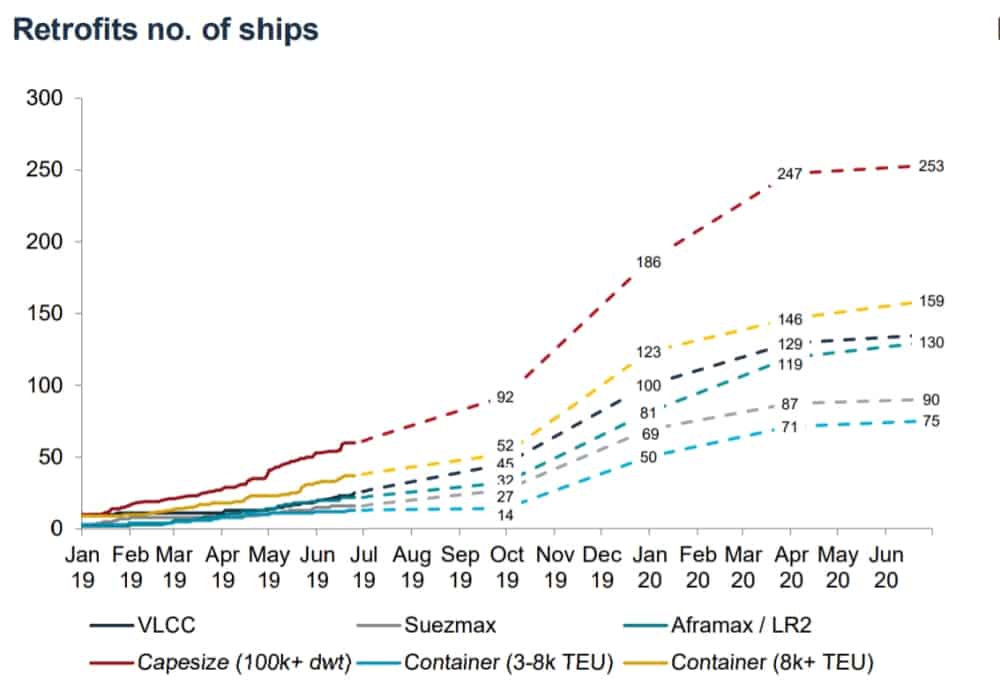
Scrubber installations are expected to continue throughout the first half of 2020. Clarksons sees 60 scrubbers Capesize installations as of June 25, 186 in January 2020, and 253 by mid-2020. It expects scrubbers on 8,000 TEU-plus container ships to total around 38 as of June 25, 123 in January 2020, and 159 by mid-2020. It sees VLCC scrubber installations at around 25 as of June 25, 100 in January 2020, and 130 by mid-2020.
In other words, even though the sulfur cap deadline is on January 1, 2020, ship owners that have opted for scrubbers as a solution will not be able to install all of those units in time, due to capacity constraints at shipyards and other factors. As a result, the rate tailwinds due to capacity removals will persist for months after the sulfur cap goes into effect.
Brokerage Compliance Symposium
The day before F3. Every compliance issue you face - fraud exposure, carrier liability, FMCSA rules, cargo theft, insurance gaps - navigated by attorneys and operators defining best practices in a changing industry.
F3 Awards Dinner
The night before F3. FreightTech100 companies honored. FreightTech 25 and Shipper of Choice winners revealed live. Cocktail reception into dinner and live music - 300 industry leaders in one purpose-built room.
F3: Future of Freight Festival
Industry-defining keynotes, rapid-fire technology demos, and industry leaders networking in experiences across Chattanooga - plus the inaugural F3 Awards Dinner featuring the FreightTech and Shipper of Choice reveals.
The day before F3. Every compliance issue you face - fraud exposure, carrier liability, FMCSA rules, cargo theft, insurance gaps - navigated by attorneys and operators defining best practices in a changing industry.
The Signal at Chattanooga Choo Choo • Chattanooga, TN Register NowThe night before F3. FreightTech100 companies honored. FreightTech 25 and Shipper of Choice winners revealed live. Cocktail reception into dinner and live music - 300 industry leaders in one purpose-built room.
The Signal at Chattanooga Choo Choo • Chattanooga, TN Register NowIndustry-defining keynotes, rapid-fire technology demos, and industry leaders networking in experiences across Chattanooga - plus the inaugural F3 Awards Dinner featuring the FreightTech and Shipper of Choice reveals.
The Signal at Chattanooga Choo Choo • Chattanooga, TN Register Now