


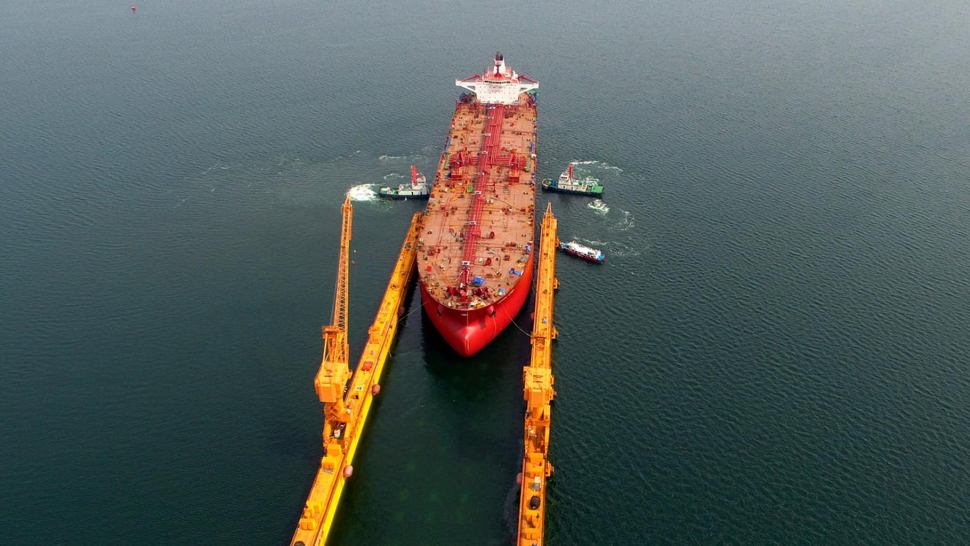
The big news for ocean shipping freight rates this week is demand out of the oil-producing nations of West Africa, which is pushing up rates for the second-largest category of crude oil tanker.
The container sector has rebounded from May’s travails, at least somewhat, while rates for liquefied natural gas (LNG) carriers have stumbled to a halt after their earlier rebound.
Suezmaxes surging
In the long-haul global crude trade, there are two main ‘workhorse’ vessel categories: very large crude carriers (VLCCs), which each carry around two million barrels of crude oil, and Suezmaxes, which each carry around one million barrels. As their name implies, Suezmaxes are sized to fit through the Suez Canal; VLCCs are forced to take the longer route around the Cape of Good Hope.
A key market for Suezmaxes is West Africa. While VLCCs are also active in this market, West Africa is known more as Suezmax territory. With outbound volumes rising from exporters such as Nigeria, this asset class is enjoying much higher rates.
Clarksons Platou Securities reported that as of June 12, Suezmax rates were averaging $26,700 per day, up 73 percent week-on-week and almost double current VLCC rates, which are at $13,600 per day. “Suezmax earnings continue to rise, with rates improving largely on higher activity out of West Africa,” said Clarksons Platou Securities analyst Frode Mørkedal.
Amit Mehrotra, a shipping analyst at Deutsche Bank, also highlighted West African crude exports, which he sees as helping VLCCs offset weakness out of the Arabian Gulf, as well as supporting Suezmaxes.
“Not surprisingly, the Suezmax segment was the biggest beneficiary of firmer sentiment out of West Africa, with rates surging,” said Mehrotra, who noted that “this may be a short-term blip, as we see available tonnage in the market; however, it provides an important reminder of how quickly and unexpectedly spot shipping rates can tighten.”
Both the U.S. and West African nations produce primarily light, sweet crude. West African crude used to be predominantly sold to the U.S., but since the shale oil boom, West Africa has been largely shut out as U.S. light, sweet import volumes have plummeted.
At first, it was believed that this dynamic would be negative for crude tanker demand, but it actually turned out to be a positive. West Africa crude flowed to Asia instead of the U.S. – a voyage that is around twice as long, and thus, the same cargo volume soaks up twice as many VLCCs and Suezmaxes.
Public companies with Suezmax shipping exposure: Nordic American Tankers (NYSE: NAT), Euronav (NYSE: EURN), Frontline (NYSE: FRO), Teekay Tankers (NYSE: TNK), Diamond S Shipping (NYSE: DSSI)
Container shipping stabilizes
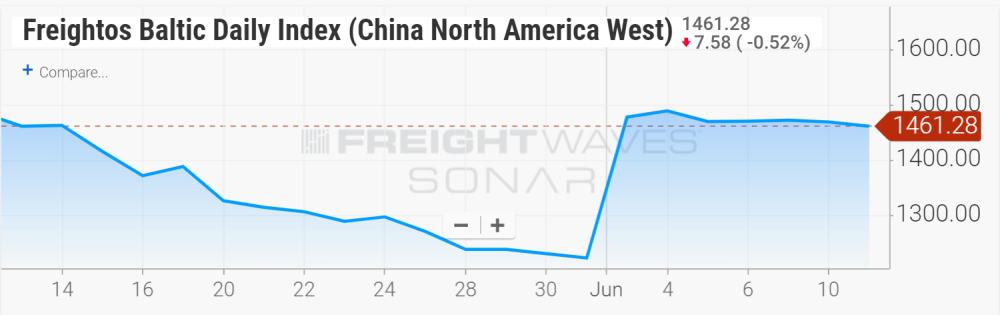
It was looking ugly for the trans-Pacific container trade in the month of May, as the price to ship containers along that route fell sharply. But rates jumped in early June and appear to have stabilized. Between June 1 and June 12, the Freightos Baltic Daily Index (China-North America West) has remained stuck on a plateau that’s well above May lows.
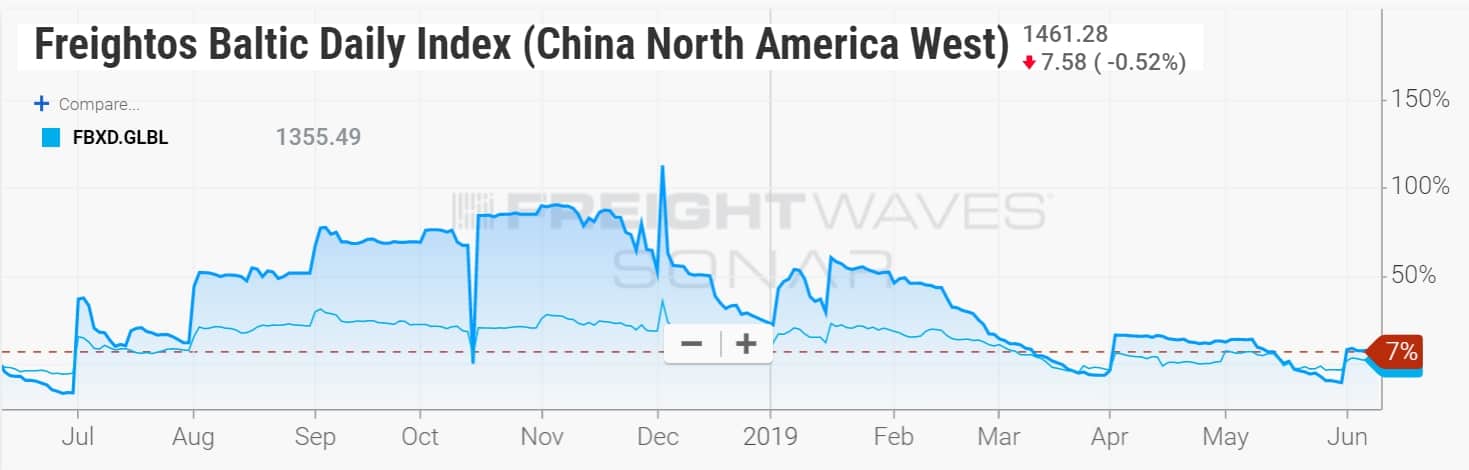
And despite the pessimism that prevailed last month, a variety of indices measuring the cost of shipping containers from China to the U.S. all show small growth year-on-year, in the low- to mid-single digit range.
The Freightos Baltic Daily Index (China-North America West) is up 7 percent year-on-year. The Freightos global index (FBXD.GLBL) is up 2 percent over the same period.
Regarding prospects for the global container shipping industry, Clarksons Platou noted that French carrier CMA CGM recently told bondholders that global trade volumes in the second quarter were growing 5 to 7 percent faster year-on-year, and that “trade in Africa is good, Latin America is fairly good, and intra-Europe is very strong.”
According to Clarksons, CMA CGM said that “we are not in an environment where liners are desperate, so no price cutting is seen” and 2019 is expected to be better than 2018.
Public shipping companies with exposure to spot box shipping rates: Maersk, Hapag-Lloyd, Matson (NYSE: MATX)
Editor’s note: Freightos has a business agreement with FreightWaves that includes editorial coverage.
LNG speed bump or something more?
Rates for liquefied natural gas (LNG) carriers had been rising rapidly off their early 2019 lows, but now, they seem to have stalled.
Mehrotra said that “the LNG carrier spot recovery took a bit of a breather last week after rebounding by over 70 percent since the start of April after a difficult first quarter.”
He noted that “spot rates for modern 174,000 cubic meter [cbm] MEGI [M-type, electronically controlled, gas injection] carriers were unchanged at $73,000 per day, while rates for 160,000 cbm TFDE [tri-fuel diesel engine] carriers remained at $60,000/day” and “spot rates for older 145,000 cbm steam turbine units fell 8 percent week-on-week to $42,000/day.”
More recent data from Clarksons Platou Securities confirms that the LNG rate lull persists this week. As of June 12, spot rates for MEGI carriers remained flat week-on-week, at $74,000 per day.
Mehrotra believes this is only a pause. “We continue to project firming LNG shipping rates throughout the remainder of 2019 as liquefaction capacity additions are back-end weighted. In addition, much of the supply growth is coming from the U.S., driving long-haul voyages,” he said.
“Given the tight underlying fundamentals, we continue to expect peak season will get pulled forward as operators look to avoid the vessel shortage that plagued LNG buyers in the fourth quarter of 2018.”
Public companies with spot LNG shipping exposure: GasLog Ltd (NYSE: GLOG), Golar LNG Ltd (NASDAQ: GLNG), Flex LNG (Oslo: FLNG), Cheniere Energy (NYSE: LNG)
Brokerage Compliance Symposium
The day before F3. Every compliance issue you face - fraud exposure, carrier liability, FMCSA rules, cargo theft, insurance gaps - navigated by attorneys and operators defining best practices in a changing industry.
F3 Awards Dinner
The night before F3. FreightTech100 companies honored. FreightTech 25 and Shipper of Choice winners revealed live. Cocktail reception into dinner and live music - 300 industry leaders in one purpose-built room.
F3: Future of Freight Festival
Industry-defining keynotes, rapid-fire technology demos, and industry leaders networking in experiences across Chattanooga - plus the inaugural F3 Awards Dinner featuring the FreightTech and Shipper of Choice reveals.
The day before F3. Every compliance issue you face - fraud exposure, carrier liability, FMCSA rules, cargo theft, insurance gaps - navigated by attorneys and operators defining best practices in a changing industry.
The Signal at Chattanooga Choo Choo • Chattanooga, TN Register NowThe night before F3. FreightTech100 companies honored. FreightTech 25 and Shipper of Choice winners revealed live. Cocktail reception into dinner and live music - 300 industry leaders in one purpose-built room.
The Signal at Chattanooga Choo Choo • Chattanooga, TN Register NowIndustry-defining keynotes, rapid-fire technology demos, and industry leaders networking in experiences across Chattanooga - plus the inaugural F3 Awards Dinner featuring the FreightTech and Shipper of Choice reveals.
The Signal at Chattanooga Choo Choo • Chattanooga, TN Register Now